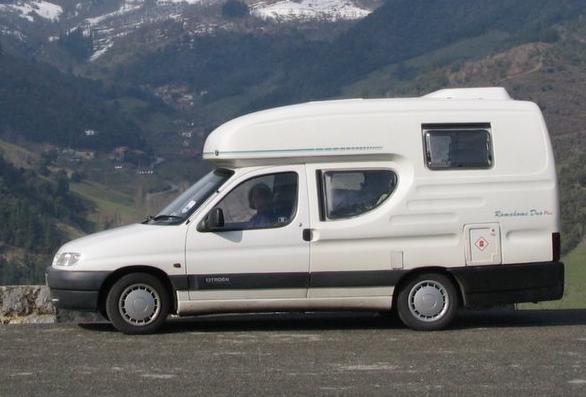
In the summer of 2005 we both retired at the age of sixty. In August we closed the door on our house and set off on a journey that was to last thirteen months and take us to eighteen different countries throughout Europe.
It all began several years ago. With retirement still no more than a rosy glow on the distant horizon, we set off in our elderly, battle-scarred Volvo for an autumn holiday in Italy. Our goal was to drive to Padua, find somewhere to stay for a few days and continue to Venice by train. We had only a fortnight before we needed to be back at work but because we also wanted to visit French friends in Normandy on the way out and others in Franche Comté on the way back we opted to drive rather than fly. In any case, we have always preferred to "travel hopefully" and independently. Nor do we always arrive at our intended destination, being easily side-tracked on the way. This trip was no exception. It started to rain as we arrived in Padua. By the time we found somewhere to stay it was teeming and by the following morning the streets were awash with water, gutters overflowing and the dark clouds over the city were promising days of similar weather. We stuck it out in Padua for several days but the streets of Venice remained flooded and the rain showed no sign of stopping. As our fortnight's holiday trickled away we were forced to abandon our plans and set off on the long drive back towards England.
It was then that we had our vision. If only we were retired and had a little camping car this weather wouldn't really matter. We could simply travel further south, to the sunshine of Florence perhaps, and return to Venice when the weather improved. From that moment the idea began to develop. We have friends in several countries of Europe with whom we have always retained a warm contact but we have seen all too rarely. Released from work and with a small camping car we could take to the byways of Europe, explore its natural and man-made splendours, meet new people, visit friends again, become Old Age travellers – as opposed to New Age ones – and enjoy a gap year between work and retirement while deciding what we want to do with the next stage in our lives.
Plans for our Great Escape began with a search for a suitable vehicle and making financial arrangements to retire at the earliest opportunity. We purchased a second-hand tiny Romahome slightly earlier than expected when our faithful Volvo made that final journey from which no vehicle returns. We named our new travelling companion Modestine, after the faithful but sadly unloved donkey that accompanied the writer Robert Louis Stevenson on his journey through the Cevennes in 1878. Our metal Modestine, paradoxically received great affection from us and curious interest from so many of the people we were to meet during our journey. We were warned by our children that we should not anthropomorphises an inanimate object as she wouldn't like it! We beg to differ. She appears to have developed a definite personality during our travels, patient and willing certainly, but with a skittish, flirtatious personality. She has also displayed occasional moments of sheer wickedness, such as the chilly February morning on a deserted beachside campsite in northern Spain when she contrived to lock us out in the rain for several hours in our nightclothes, the wind howling in across the Bay of Biscay!
Faster than we could have imagined, the day for retirement dawned for each of us. We arranged for some young work colleagues to take care of our house during our absence, purchased a laptop computer and a digital camera and set up a website on the internet so that we could report back to our family and friends as we progressed on our journey, deliberately largely unplanned, just seeing where chance and luck would take us.
And so we set off across the English Channel to follow our star on perhaps the most exciting, stimulating and enjoyable experience of our lives.
Link to Index page
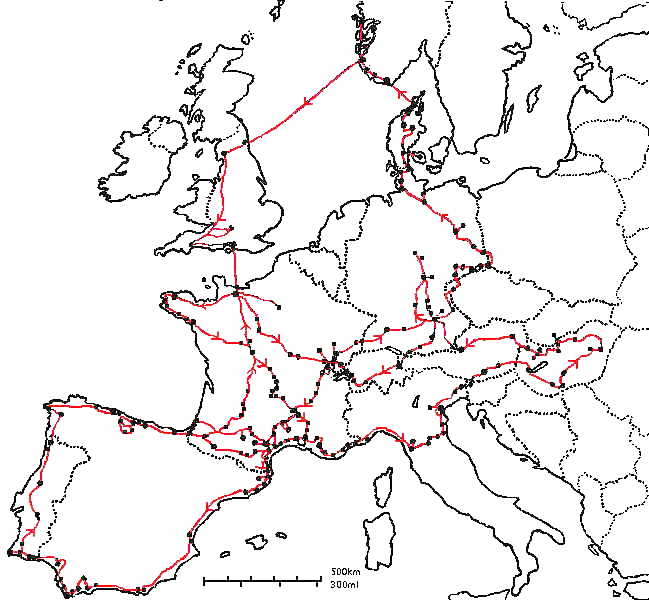
Map
This map is selective and does not include many smaller places, especially where they cluster thickly in the areas where we stayed for longer periods in the Jura and the Languedoc.
The hot links over the points on the map name the places and link to the first or the main posting where the places are described. In some cases localities were visited a number of times.
For a fuller listing of the places visited please consult the index.
Return to index page
The hot links over the points on the map name the places and link to the first or the main posting where the places are described. In some cases localities were visited a number of times.
For a fuller listing of the places visited please consult the index.
Return to index page


Index to the Maxted Travels European weblog
The details given for each posting are:
A running number
The first day covered
The title of the posting (which is a hotlink)
The main places included.
Each posting was also individually archived as it was posted onto the blog site. These are listed in the right-hand column of each page under "Earlier postings".
Map
Introduction Setting the Scene
2005
1. 19 Aug Champagne-sur-Loue at Last!
Caen, Frazé, Châteaudun, Saint Saulge, Châtillon-en-Bazois, Champagne-sur-Loue, Arc-et-Senans
2. 22 Aug Bees, Bisous and La Montagne de Modestine
Quingey, Arbois, Nans-sous-Sainte-Anne, Salins-les-Bains, Mouchard, Foncine-le-Haut
3. 26 Aug Poligny and elsewhere
Poligny, Salin-les-Bains, Besançon, Cascades du Hérisson, Lons-le-Saunier
4. 30 Aug Swiss Roll
Port-Lesney, Mont d'Or, Les Rousses, Vallorbe, Lac de Joux, Chissey, Dôle, Mont Poupet, Villers Robert
5. 4 Sep Besancon and around
Pagnoz, Besançon, Amancey, Grotte d’Osselle
6. 11 Sep From France to Germany
Colmar, Biesheim, Tubingen, Leipheim, Rohrbach, Regensberg, Munich
7. 14 Sep Weimar
Solnhofen, Bamberg, Weimar, Stolberg, Jena
8. 22 Sep Munich
Bayreuth, Pottenstein, Bielngries, Munich
9. 24 Sep Hans knees and bumps a daisy
Taubenstein, Urschalling, Wasserberg, Herrsching, Andechs, Munich
10. 28 Sep Wilhelm Tell and Switzerland
Oberammergau, Neuschwanstein, Austria, Allgäu, Liechtenstein, Switzerland, Klausen Pass, Furka Pass, Rhône Valley, Agarn, Chillon, Vevey, Lausanne
11. 2 Oct Back in the Jura
Dôle, Orchamps, Source du Lison, Besançon, Ornans, Buffard
12. 8 Oct Absinthe makes the carp grow stronger
Lons-Le-Saunier, Source de la Loue, Mouthiers-Haute-Pierre, Arc-et-Senans
13. 12 Oct The sunshine continues
Château-Chalon, Baume-les-Messieurs, Gray, Arbois, Reculée des Planches, Salins-les-Bains, Fraisans
14. 19 Oct Toodle-oo to the Loue
Montigny-lès-Arsures, Dijon
15. 21 Oct Cevennes up
Brou, Pérouges, Vienne, Le Puy-en-Velay, Le Monastier-sur-Gazeille
16. 25 Oct In the hoofprints of Modestine
St. Martin-de-Fugères, Goudet, Lac du Bouchet, Langogne, Cheylard l’Evêque, Luc, Notre-Dame-des-Neiges, Mende, Chasseradès, Sommet de Finiels, Pont de Montvert, Florac, Cassagnas, St. Germain-de-Calberte, St. Jean-du-Gard, Corniche des Cevennes, Gorges du Tarn, Sainte-Enimie, Causse de Larzac, Caylar
17. 30 Oct Into the Languedoc
Ambre-les-Espagnolettes, Saint-Chinian, Saint-Pons, Béziers, Cap d’Agde
18. 4 Nov Cathar country
Minerve, Aigne, Olargues, Boubals, Bédarieux, Le Moulin de la Roque, Fontcaude, Pezenas
19. 10 Nov Storms and floods
Roquebrun, Canal du Midi, Ecluses de Fonseranes, Narbonne
20. 15 Nov Pigs, paintings and poubelles
Agde, Oppidum d'Ensérune, Carcasonne, Castres
21. 19 Nov Saint Chinian and around
St Chinian, Cessenon, Berlou
22. 21 Nov Wholly snug on the holy trail
Rennes-le-Château, Montségur, Foix, Lourdes, Orthez, Salies-de-Béarn, Sauveterre, Cambo-les-Bains, Urrugne
23. 27 Nov The round of the Basque villes
St. Jean de Luz , Biarritz, San Sebastian, Capbreton, Soustons
24. 30 Nov Rose red cities
Nogaro, Auch, Toulouse, Cordes, Albi
25. 3 Dec Look back in Ambre
Lacaune, La Salvetat, Saint Chinian, Béziers
26. 12 Dec Starting to feel like Christmas at last
Capestang, Narbonne, Cruzy, Fontcaude, Sète, Saint-Chinian
27. 18 Dec The ups and downs of Languedoc
Gorge d’Héric, Vieussan, Lodève, Cirque de Navacelles, St.Guilhem-le-Désert, Lac du Salagou
28. 22 Dec Baubles at Boubals
Boubals, Montpellier, Bédarieux, Marseillan, St. Gervais-sur-Mare, Lamalou
29. 27 Dec Nîmes and Avignon
St.Gilles, Nîmes, Avignon
30. 30 Dec Farewell to 2005 in Avignon
Avignon, Villeneuve-lès-Avignon
2006
31. 1 Jan Happy new ear from Van Gogh and us
Pont du Gard, Beaucaire, Tarascon, Arles
32. 3 Jan Around the Camargue
Camargue, Saintes Maries de la Mer, Aigues-Mortes, la Grande Motte, Mèze
33. 6 Jan Catalonia
Collioure, Perpignan, Quéribus
34. 16 Jan ¡Viva Espana!
Estartit, Figueres, Cadaques
35. 20 Jan Girona and Barcelona
Estartit, Toroella de Montgri, Girona, Barcelona, Blanes
36. 23 Jan Home and dry
Blanes, Cullera, Almerimar
37. 30 Jan Ronda - a welcome in the hillside
Roquetas de Mar, Torremolinos, Marbella, Ronda
38. 4 Feb Gibraltar and Trafalgar
Parque Natural de los Alcornocales, La Línea, Gibraltar, Tarifa, Baelo Claudia, Cape Trafalgar
39. 7 Feb Return to Cadiz
Chiclana de la Frontera, Puerto de Santa Maria, Cadiz
40. 11 Feb The Wild West and beyond
Puerto de Santa Maria, El Rocio, Olhão, Tavira
41. 13 Feb The ends of the world
Cape St Vincent, Sagres, Lagos, Monchique, Evora
42. 16 Feb Evora and Coimbra
Evora, Coimbra, Viano do Castelo
43. 20 Feb All the Way to Santiago
Viana do Castelo, Caminha, Santiago de Compostela, Cabo Finisterre, Carnota, Puerto de Vega
44. 26 Feb A peek at the Picos
Candas, Gijon, Cangas de Onis, San Vicente de la Barquera, Nuestra Señora de Lebeña, Potes, San Toribio des Liebana, Picos de Europa
45. 28 Feb Cantabria to Gascony
Comillas, Santillana del Mar, Ainhoa, Salies de Béarn, Lelin-Lapujolle, Condom, Fourcés, Pujol
46. 5 Mar How far has mankind progressed?
Tournon d’Agenais, Monpazier, Lalinde, Molières, Cadouin, Beynac et Cazenac, La Roque Gageac, Domme, Font-de-Gaume, Oradour sur Glane
47. 8 Mar Homeward bound
Loches, Pocé, Lavardine, Caen, Ouistreham
48. 29 Mar Maxted travels part 2
England (Didcot and Exeter), Caen
49. 3 Apr Manifestly Paris
50. 5 Apr Encore Paris
51. 9 Apr Caen again
Caen, St Pierre-sur-Dives
52. 11 Apr Guissény
53. 15 Apr Around the coast of Brittany
Pointe du Penhir, Pointe du Van, Pont-Croix, Point l'Abbe, Quimper, Carnac etc
54. 18 Apr From Quimper to Vannes in a camper van
Quiberon, Morbihan, St Goustan, Vannes, La Roche Bernard
55. 20 Apr Villandry, vegetables, volcanoes and Volvic
Loire Valley, Villandry, Néris-les-Bains, Châtelguyon, Gour de Tazenat, Auvergne, Volvic
56. 25 Apr Clermont-Ferrand and the Auvergne
Royat, Clermont-Ferrand, Puy de Dome, Mont-d'Or, Puy de Sancy
57. 27 Apr From the Auvergne into Provence
St. Nectaire, Issoire, Montelimar, Orange, Luberon, Aix-en-Provence, Le Tholonet
58. 1 May Marcel Pagnol country and the Cote d'Azur
Allauch, La Treille, St Tropez, St. Maxime, Cannes
59. 5 May Menton – Not taking it on the chin!
Vallauris, Antibes, Monaco, Menton
60. 8 May Pisa and Lucca
Diano Marina, Pisa, Lucca
61. 11 May Fiesole and Florence
62. 15 May Faenza, Ravenna and Comacchio
Apennines, Faenza, Ravenna, Comacchio
63. 17 May Venice and Padua
64. 21 May Into Austria
Gemona del Friuli, Laghi di Fusine, Podkoren, Slovenia, Klagenfurt
65. 24 May Graz
66. 28 May Keszthely and Lake Balaton
Sümeg, Keszthely, Heviz
67. 1 Jun Pécs and library friends
68. 4 Jun On to Debrecen
Nagynarad, Mohács, Kiskunfélegyháza, Hortobágy region, Debrecen
69. 7 Jun The horsemen of the Puszta
Hortobagy
70. 10 Jun Tokaj, Eger, Visegrad and Esztergom
71. 14 Jun Szentendre and Budapest
72. 19 Jun With friends in Györ and Gyömöre
Gyömöre, Tét, Györ, Bakonygyirót, Pápa
73. 22 Jun Around Lake Fertö and Sopron
Fertöd, Hegykö, Esterházy, Nagycenk, Lake Fertö, Sopron
74. 26 Jun Tales from the Vienna Woods
Vienna
75. 28 Jun Salzburg and Mondsee
Nussdorf am Attersee, Mondsee, Salzburg
76. 1 Jul Berchtesgaden and Königssee
77. 3 Jul Rohrbach Landshut and Ingolstadt
Landshut, Rohrbach, Wolnzach, Ingolstadt
78. 6 Jul Furth im Wald and an encounter with dragons
Furth im Wald
79. 9 Jul This year in Marienbad
Schönsee, Bärnau, Marienbad
80. 11 Jul Meissen and Dresden
Freiberg, Meissen, Dresden
81. 14 Jul Saxon Alps and Oberlausitz
Moritzburg, Königstein, Jetrichovice, Seifhennersdorf, Lausche, Waltersdorf
82. 17 Jul Oi bin to Oybin
Zittau, Oybin, Zgorzelec, Görlitz, Niesky
83. 21 Jul From Prussia with love
Lübben, Potsdam, Berlin
84. 24 Jul Schleswig Holstein and Lübeck
Römnitz, Lübeck, Ratzeburg, Tremsbüttel, Büsum, Sankt Peter Ording,Friedrichstadt
85. 28 Jul North Friesland
Husum, Dagebüll, Niebüll, Föhr
86. 31 Jul Sylt and Flensburg
Sylt, Niebüll, Seebüll, Flensburg
87. 4 Aug Denmark - fairytales runes and Lego
Aabenraa, Vejen, Odense, Jelling, Silkeborg
88. 8 Aug North Jutland
Randers, Ertebølle, Naesby Dale, Vitskøl, Løgstør, Hirtshals, Skagen
89. 12 Aug From Danish Blue to Jarlsberg
Skagen, Frederikshavn, Strandby, Bangsbo, Sæby, Hjørring, Hirtshals
90. 16 Aug Kristiansand to Stavanger
Kristiansand, Mandal, Farsund, Flekkefjord, Egersund
91. 19 AugStavanger to Haugesund
Nærbo, Sandnes, Stavanger, Haugesund
92. 22 Aug Haugesund to Bergen
Haugesund, Lofthus, Odda, Sørfjorden,Kinsarvik
93. 25 Aug Bergen and the islands
Bergen, Holsnøy, Hundvin, Sævrøy
94. 29 Aug The end of a journey
Bergen, ferry to Newcastle
95. 15 Oct Postscript
96. 21 Oct A few facts and figures
A running number
The first day covered
The title of the posting (which is a hotlink)
The main places included.
Each posting was also individually archived as it was posted onto the blog site. These are listed in the right-hand column of each page under "Earlier postings".
Map
Introduction Setting the Scene
2005
1. 19 Aug Champagne-sur-Loue at Last!
Caen, Frazé, Châteaudun, Saint Saulge, Châtillon-en-Bazois, Champagne-sur-Loue, Arc-et-Senans
2. 22 Aug Bees, Bisous and La Montagne de Modestine
Quingey, Arbois, Nans-sous-Sainte-Anne, Salins-les-Bains, Mouchard, Foncine-le-Haut
3. 26 Aug Poligny and elsewhere
Poligny, Salin-les-Bains, Besançon, Cascades du Hérisson, Lons-le-Saunier
4. 30 Aug Swiss Roll
Port-Lesney, Mont d'Or, Les Rousses, Vallorbe, Lac de Joux, Chissey, Dôle, Mont Poupet, Villers Robert
5. 4 Sep Besancon and around
Pagnoz, Besançon, Amancey, Grotte d’Osselle
6. 11 Sep From France to Germany
Colmar, Biesheim, Tubingen, Leipheim, Rohrbach, Regensberg, Munich
7. 14 Sep Weimar
Solnhofen, Bamberg, Weimar, Stolberg, Jena
8. 22 Sep Munich
Bayreuth, Pottenstein, Bielngries, Munich
9. 24 Sep Hans knees and bumps a daisy
Taubenstein, Urschalling, Wasserberg, Herrsching, Andechs, Munich
10. 28 Sep Wilhelm Tell and Switzerland
Oberammergau, Neuschwanstein, Austria, Allgäu, Liechtenstein, Switzerland, Klausen Pass, Furka Pass, Rhône Valley, Agarn, Chillon, Vevey, Lausanne
11. 2 Oct Back in the Jura
Dôle, Orchamps, Source du Lison, Besançon, Ornans, Buffard
12. 8 Oct Absinthe makes the carp grow stronger
Lons-Le-Saunier, Source de la Loue, Mouthiers-Haute-Pierre, Arc-et-Senans
13. 12 Oct The sunshine continues
Château-Chalon, Baume-les-Messieurs, Gray, Arbois, Reculée des Planches, Salins-les-Bains, Fraisans
14. 19 Oct Toodle-oo to the Loue
Montigny-lès-Arsures, Dijon
15. 21 Oct Cevennes up
Brou, Pérouges, Vienne, Le Puy-en-Velay, Le Monastier-sur-Gazeille
16. 25 Oct In the hoofprints of Modestine
St. Martin-de-Fugères, Goudet, Lac du Bouchet, Langogne, Cheylard l’Evêque, Luc, Notre-Dame-des-Neiges, Mende, Chasseradès, Sommet de Finiels, Pont de Montvert, Florac, Cassagnas, St. Germain-de-Calberte, St. Jean-du-Gard, Corniche des Cevennes, Gorges du Tarn, Sainte-Enimie, Causse de Larzac, Caylar
17. 30 Oct Into the Languedoc
Ambre-les-Espagnolettes, Saint-Chinian, Saint-Pons, Béziers, Cap d’Agde
18. 4 Nov Cathar country
Minerve, Aigne, Olargues, Boubals, Bédarieux, Le Moulin de la Roque, Fontcaude, Pezenas
19. 10 Nov Storms and floods
Roquebrun, Canal du Midi, Ecluses de Fonseranes, Narbonne
20. 15 Nov Pigs, paintings and poubelles
Agde, Oppidum d'Ensérune, Carcasonne, Castres
21. 19 Nov Saint Chinian and around
St Chinian, Cessenon, Berlou
22. 21 Nov Wholly snug on the holy trail
Rennes-le-Château, Montségur, Foix, Lourdes, Orthez, Salies-de-Béarn, Sauveterre, Cambo-les-Bains, Urrugne
23. 27 Nov The round of the Basque villes
St. Jean de Luz , Biarritz, San Sebastian, Capbreton, Soustons
24. 30 Nov Rose red cities
Nogaro, Auch, Toulouse, Cordes, Albi
25. 3 Dec Look back in Ambre
Lacaune, La Salvetat, Saint Chinian, Béziers
26. 12 Dec Starting to feel like Christmas at last
Capestang, Narbonne, Cruzy, Fontcaude, Sète, Saint-Chinian
27. 18 Dec The ups and downs of Languedoc
Gorge d’Héric, Vieussan, Lodève, Cirque de Navacelles, St.Guilhem-le-Désert, Lac du Salagou
28. 22 Dec Baubles at Boubals
Boubals, Montpellier, Bédarieux, Marseillan, St. Gervais-sur-Mare, Lamalou
29. 27 Dec Nîmes and Avignon
St.Gilles, Nîmes, Avignon
30. 30 Dec Farewell to 2005 in Avignon
Avignon, Villeneuve-lès-Avignon
2006
31. 1 Jan Happy new ear from Van Gogh and us
Pont du Gard, Beaucaire, Tarascon, Arles
32. 3 Jan Around the Camargue
Camargue, Saintes Maries de la Mer, Aigues-Mortes, la Grande Motte, Mèze
33. 6 Jan Catalonia
Collioure, Perpignan, Quéribus
34. 16 Jan ¡Viva Espana!
Estartit, Figueres, Cadaques
35. 20 Jan Girona and Barcelona
Estartit, Toroella de Montgri, Girona, Barcelona, Blanes
36. 23 Jan Home and dry
Blanes, Cullera, Almerimar
37. 30 Jan Ronda - a welcome in the hillside
Roquetas de Mar, Torremolinos, Marbella, Ronda
38. 4 Feb Gibraltar and Trafalgar
Parque Natural de los Alcornocales, La Línea, Gibraltar, Tarifa, Baelo Claudia, Cape Trafalgar
39. 7 Feb Return to Cadiz
Chiclana de la Frontera, Puerto de Santa Maria, Cadiz
40. 11 Feb The Wild West and beyond
Puerto de Santa Maria, El Rocio, Olhão, Tavira
41. 13 Feb The ends of the world
Cape St Vincent, Sagres, Lagos, Monchique, Evora
42. 16 Feb Evora and Coimbra
Evora, Coimbra, Viano do Castelo
43. 20 Feb All the Way to Santiago
Viana do Castelo, Caminha, Santiago de Compostela, Cabo Finisterre, Carnota, Puerto de Vega
44. 26 Feb A peek at the Picos
Candas, Gijon, Cangas de Onis, San Vicente de la Barquera, Nuestra Señora de Lebeña, Potes, San Toribio des Liebana, Picos de Europa
45. 28 Feb Cantabria to Gascony
Comillas, Santillana del Mar, Ainhoa, Salies de Béarn, Lelin-Lapujolle, Condom, Fourcés, Pujol
46. 5 Mar How far has mankind progressed?
Tournon d’Agenais, Monpazier, Lalinde, Molières, Cadouin, Beynac et Cazenac, La Roque Gageac, Domme, Font-de-Gaume, Oradour sur Glane
47. 8 Mar Homeward bound
Loches, Pocé, Lavardine, Caen, Ouistreham
48. 29 Mar Maxted travels part 2
England (Didcot and Exeter), Caen
49. 3 Apr Manifestly Paris
50. 5 Apr Encore Paris
51. 9 Apr Caen again
Caen, St Pierre-sur-Dives
52. 11 Apr Guissény
53. 15 Apr Around the coast of Brittany
Pointe du Penhir, Pointe du Van, Pont-Croix, Point l'Abbe, Quimper, Carnac etc
54. 18 Apr From Quimper to Vannes in a camper van
Quiberon, Morbihan, St Goustan, Vannes, La Roche Bernard
55. 20 Apr Villandry, vegetables, volcanoes and Volvic
Loire Valley, Villandry, Néris-les-Bains, Châtelguyon, Gour de Tazenat, Auvergne, Volvic
56. 25 Apr Clermont-Ferrand and the Auvergne
Royat, Clermont-Ferrand, Puy de Dome, Mont-d'Or, Puy de Sancy
57. 27 Apr From the Auvergne into Provence
St. Nectaire, Issoire, Montelimar, Orange, Luberon, Aix-en-Provence, Le Tholonet
58. 1 May Marcel Pagnol country and the Cote d'Azur
Allauch, La Treille, St Tropez, St. Maxime, Cannes
59. 5 May Menton – Not taking it on the chin!
Vallauris, Antibes, Monaco, Menton
60. 8 May Pisa and Lucca
Diano Marina, Pisa, Lucca
61. 11 May Fiesole and Florence
62. 15 May Faenza, Ravenna and Comacchio
Apennines, Faenza, Ravenna, Comacchio
63. 17 May Venice and Padua
64. 21 May Into Austria
Gemona del Friuli, Laghi di Fusine, Podkoren, Slovenia, Klagenfurt
65. 24 May Graz
66. 28 May Keszthely and Lake Balaton
Sümeg, Keszthely, Heviz
67. 1 Jun Pécs and library friends
68. 4 Jun On to Debrecen
Nagynarad, Mohács, Kiskunfélegyháza, Hortobágy region, Debrecen
69. 7 Jun The horsemen of the Puszta
Hortobagy
70. 10 Jun Tokaj, Eger, Visegrad and Esztergom
71. 14 Jun Szentendre and Budapest
72. 19 Jun With friends in Györ and Gyömöre
Gyömöre, Tét, Györ, Bakonygyirót, Pápa
73. 22 Jun Around Lake Fertö and Sopron
Fertöd, Hegykö, Esterházy, Nagycenk, Lake Fertö, Sopron
74. 26 Jun Tales from the Vienna Woods
Vienna
75. 28 Jun Salzburg and Mondsee
Nussdorf am Attersee, Mondsee, Salzburg
76. 1 Jul Berchtesgaden and Königssee
77. 3 Jul Rohrbach Landshut and Ingolstadt
Landshut, Rohrbach, Wolnzach, Ingolstadt
78. 6 Jul Furth im Wald and an encounter with dragons
Furth im Wald
79. 9 Jul This year in Marienbad
Schönsee, Bärnau, Marienbad
80. 11 Jul Meissen and Dresden
Freiberg, Meissen, Dresden
81. 14 Jul Saxon Alps and Oberlausitz
Moritzburg, Königstein, Jetrichovice, Seifhennersdorf, Lausche, Waltersdorf
82. 17 Jul Oi bin to Oybin
Zittau, Oybin, Zgorzelec, Görlitz, Niesky
83. 21 Jul From Prussia with love
Lübben, Potsdam, Berlin
84. 24 Jul Schleswig Holstein and Lübeck
Römnitz, Lübeck, Ratzeburg, Tremsbüttel, Büsum, Sankt Peter Ording,Friedrichstadt
85. 28 Jul North Friesland
Husum, Dagebüll, Niebüll, Föhr
86. 31 Jul Sylt and Flensburg
Sylt, Niebüll, Seebüll, Flensburg
87. 4 Aug Denmark - fairytales runes and Lego
Aabenraa, Vejen, Odense, Jelling, Silkeborg
88. 8 Aug North Jutland
Randers, Ertebølle, Naesby Dale, Vitskøl, Løgstør, Hirtshals, Skagen
89. 12 Aug From Danish Blue to Jarlsberg
Skagen, Frederikshavn, Strandby, Bangsbo, Sæby, Hjørring, Hirtshals
90. 16 Aug Kristiansand to Stavanger
Kristiansand, Mandal, Farsund, Flekkefjord, Egersund
91. 19 AugStavanger to Haugesund
Nærbo, Sandnes, Stavanger, Haugesund
92. 22 Aug Haugesund to Bergen
Haugesund, Lofthus, Odda, Sørfjorden,Kinsarvik
93. 25 Aug Bergen and the islands
Bergen, Holsnøy, Hundvin, Sævrøy
94. 29 Aug The end of a journey
Bergen, ferry to Newcastle
95. 15 Oct Postscript
96. 21 Oct A few facts and figures
A few facts and figures
We have gathered together some practical information and statistics for anyone contemplating doing something similar to us once they have retired.
We bought Modestine second-hand about a year before we intended setting off on our travels. She is an R registration Romahome built onto a Citroën Berlingo chassis and she runs on diesel. She is taxed and insured as a car and classed as a micro-mobile home. We investigated thoroughly what vehicle would best suit our purpose and regularly trawled the internet until we discovered one for sale locally. This worked out considerably cheaper than purchasing from a dealer and delighted both us and her vendor Pat, who has been following Modestine's travels with great enthusiasm. Modestine has proved a very reliable travel companion, well insulated, comfortable, manoeuvrable, economic and easy to maintain. She has also proved to be highly attractive "eye candy" to the international motorhome fraternity, thus introducing us to many interesting people during our travels.
We took Modestine on several trips within Britain before setting off abroad, ensuring we fully understood how she functioned and how we could best survive in such a confined space. It is vital to appreciate the difficulties of living so completely together, totally reliant on each other. However well you may think you know your partner at home, after three wintry days and nights of incessant rain marooned on waterlogged campsites in a space 12ft by 5ft without room to stand fully upright, along with a couple of bikes, a computer and printer, all your bedding, clothes, shoes, maps and books, wet coats and umbrellas it is just possible you may feel an urge to throttle each other! We feel that overall we survived very well indeed. This may have been in part because of the mutual interest we had in developing our blogsite and would strongly recommend a shared hobby, be it blogging, photographing manhole covers – we call it "drain spotting" – or indeed train spotting! We were particularly fortunate in that we generally share many similar interests anyway and our skills complemented each other. Jill coped with the driving, shopping, cooking, laundry and blogging, while Ian concentrated on the serious issues like which cultural sites we would visit, marking the route we travelled on the road atlas in pink felt-tip and listing all the cartographic errors he encountered. He was also pretty neat at looking after the financial side, coping with the many different languages we encountered, editing our digital photos and finding open campsites in the depths of winter.
Over the past year we have stayed on hundreds of different campsites and every one has been different. Each has its own peculiarities. None are perfect – that's to say they are all imperfect. The only completely consistent thing about them all is that none of then have sink plugs. Take your own or buy one at a French street market at the first opportunity. They are simply a flat, flexible six-inch disk of rubber that fits any sink, anywhere. Better still, take at least three - we found clothes washing is much quicker using three different sinks for washing and rinsing. Many sites do have washing machines but travelling light means ensuring laundry does not accumulate. A washing line is really useful, not only for washing, but for airing bedding and to conserve a pitch if you drive off during the day.
To save space we did not take the chemical toilet. (An emergency champagne bucket came along for the ride but didn't earn its keep.) This meant that in general we needed to use campsites each evening but the security, hot showers, occasional companionship of fellow travellers, freedom to enjoy a glass of wine and access to electricity to prepare the blog far outweighed the economy of camping in car parks or lay-bys. Take your own toilet paper. Outside of Austria and Scandinavia you are unlikely to find it provided. If you discover any on the French sites you've won the jackpot! Almost all the European sites we used did provide free hot water and showers though. Take a good torch with rechargeable batteries so you can pick your way between the dog turds on dark winter nights on French campsites as you cross the icy field to the equally icy shower block. Rubber flip flops are the best footwear on campsites regardless of season. They can be left outside if encrusted with grass or worse and they halve the time it would normally take drying off after a shower. It is far warmer and more comfortable to dry your feet back in the campervan.
It is worth trying to obtain an international camping card. We didn't realise about this until we had left England when it was too late. There are sometimes considerable discounts on campsite fees, but the biggest advantage is that you do not have to hand over your passport as evidence and security when you check into a site, with the fear that you could drive off without it and be a hundred miles away before you realise! Campsite administrators, particularly in Portugal and Italy, insist they need passports for the police. Sometimes they will scan them and return them. We questioned this as our permission was not asked. We were told records are kept for seven years and it is a legal requirement for campsites to gather them. In the end, we got photocopies made, showed the campsites the originals but refused to leave them. In general the photocopies were accepted instead and returned when we left. In general too, the French police don't give a damn and we were rarely asked for any ID at campsites. In Scandinavia they don't ask for your passport but it is a requirement to belong to a camping organisation. We had to pay about £10 to join in Denmark before we could use any of the campsites. If we had held an international camping card we would probably have been exempted.
As for the discounts, sometimes we were given them anyway when we tried a bit of wheedling. Often there are campsite chains which allow a 10 or 15% discount after using the first one. This is common in Austria and Germany. Portugal is very cheap and all the sites we discovered were part of the same Orbitur chain, open all year and very basic, frequently without hot water or even loo seats but at 9 euros including electricity, very reasonable value. Hungary too is inexpensive but the sites are almost invariably attached to thermal spas, frequently with inclusive charges and inevitably crowded with unfit Germans sent by their doctors on expenses-paid health cures. The cheapest paying site we discovered was in Brittany where for 5 euros we had a basic pitch without hot water or showers but including electricity. The most expensive was in Fiesole, near Florence, where we paid 36 euros for not an enormous amount more. The most evil was 23 euros in Spain, near Valencia, which reeked and the water and electricity didn't work until Ian discovered enough Spanish to terrify the management. One of the cleanest, nicest and most friendly was at La Roche Bernard while the free pitches, hot showers, toilet paper and spotless facilities provided for campervans at Néris-les-Bains, stand out as quite amazing.
Don't forget a collection of electric plug adaptors for hotel rooms or rented accommodation, as well as cable connectors for European campsites. Take a fan heater for the winter and a small fan for the summer. Both will be required. Don't forget battery chargers for phones, torches and cameras.
Give yourself a treat occasionally if you are having continuous bad weather - find a cheap hotel. The room, however small, will seem enormous and the en-suite bathroom is wonderful for trampling clean and hanging to dry any accumulated laundry. You will appreciate the experience, believe us.
Fill a really large thermos with boiling water every morning. During the day it provides instant hot drinks as you travel and if you should inadvertently end up sleeping by the roadside you have immediate hot water for washing and shaving next morning.
Most countries sell phonecards for internal and international calls from both public and private telephones. Generally they are sold in post offices and are the cheapest, easiest way of phoning home. France in particular is really cheap and easy. Other countries vary but certainly we found them in Spain, Portugal, Austria, Germany and Hungary.
Don't buy anything you don't need. Souvenirs are out! Even essential guidebooks and maps had to be jettisoned in the interest of saving space. As we did not know which countries we would be visiting we took a European road atlas and purchased national maps just before entering a country. Guide books are more of a problem though. We spent much of our time using Spanish and Portuguese guidebooks in French, and Hungarian, Danish and Norwegian ones in German. It was easier than trying to cope in the local language and English ones were not available. Tourist offices frequently provide cheap or free maps and guides to the locality in a range of languages.
Sort out direct debits for all your regular expenses before you go and try to have an email contact for your insurance company so you can sort out the mess they will inevitably make with your life, house and vehicle insurance policies while you are thousands of miles away riding wild horses on the Hungarian Puszta! We took copies of all important documents on a password protected cd in case of emergencies. Do remember to take your vehicle documentation. We forgot the document of ownership which we were asked for. Fortunately they did not understand English and we got away with showing the MOT certificate but you cannot rely on that!
We changed our bank account before we left and it has suited us in every way with interest on our current account, internet banking - so we always know exactly how much money we have – and a really useful perk, free cash withdrawals throughout every country we visited. We must have saved hundreds of pounds in bank charges over the year and the exchange rate was usually better than that offered locally. We never ceased to wonder at modern day travel where we would arrive in a country and simply go to a hole in a wall and walk away with a pocket full of notes in the local currency.
Of course the Euro in much of Europe makes this even easier and it is so simple to compare prices. Hungary and Portugal were amongst the cheapest, Austria was generally good value all round, as was Germany. Italy and Spain were generally quite expensive, Denmark more so and Norway was by far the most expensive for everything. Diesel is cheaper than petrol everywhere except Britain. With the exception of Gibraltar where diesel was 56 pence per litre, Spain was cheapest. Norway and Portugal were both quite expensive though slightly less than in Britain which seems the dearest in Europe.
Travel insurance can be difficult. Actually we found it impossible and we are still not convinced it is really needed anyway. Of course we had an excellent vehicle insurance policy with the Co-op which included unlimited Europe-wide assistance cover for the duration of the policy without time limitation outside the UK. This insurance has a number of useful features built in anyway, such as emergency accommodation and repatriation if the driver is incapacitated. (Particularly useful with only one driver.) We were aware that we were vulnerable as far as theft was concerned but carried little of major value and always tried to ensure Modestine was left in a safe place. That was one advantage of campsites over hotels where she would have been unattended on town streets overnight. We also tried to avoid sleeping rough by the roadside.
We left England with the E111 document giving reciprocal health cover in EU countries but it was phased out while we were away. Our difficulty was to obtain the European Health Card which replaced it when we were not resident in the UK and had no fixed address abroad. It ensures reciprocal health care throughout EU countries but you will need to check cover. Switzerland and Norway are slightly different and we did not go across to Morocco because we would not be covered there. In the event, we never needed medical attention so we cannot report on how effective the card is, but we met many people who have been travelling around Europe or living there unofficially with no other personal cover.
Before we set off we contacted dozens of travel insurance companies and brokers trying to get a policy that suited our needs. All the companies were fazed by our request. It seemed so normal to us that a retired couple should wish to travel around the countries of Europe for a year in a camping car, free to return to Britain as and when they wished. Britain is part of Europe anyway so we imagined a Europe wide policy would include Britain. No one, not even Saga or the Caravan Club, could provide anything suitable and all were expensive, automatically including cover we didn't need.
Policies, even over the internet, are only valid if taken out in the UK before departure. So we could not simply buy or renew online from France or Germany when our current policy expired. Annual travel insurance only permits trips for up to three or four months before returning to the UK. And it's no good lying about how long you have been gone. Big brother knows everything these days and you have to be able to prove what you say. We wanted an annual policy that would allow us to return whenever we wished rather than when our insurers dictated, and to stay in England for as long as we wished before returning to our travels. In the end we went with the 90 days left on our existing policy and then travelled with our fingers crossed until we returned in March. Then we took out an internet based policy for six months to cover the rest of our travels. However, this meant that we could not return temporarily to England for any reason as the policy would cancel immediately. We never needed it and with the European Health Card and our vehicle insurance we feel it probably wasn't worth having anyway, though it was of some psychological comfort.
Don't overlook renewing your UK road tax before you set off. It may well be possible to renew it online by now though. If you don't want to return to the UK for your vehicle's MOT make sure you have it done immediately before you leave. Such tests are just as efficient and a lot cheaper abroad but unfortunately they are not recognised once you return to Britain.
Carry only the credit cards you really need with you on the streets and make sure any others are well hidden. Split cards between you and if you have a joint account don't carry matching cards. If one is stolen, both will automatically be cancelled. Keep some travellers cheques and local currency hidden somewhere in case of emergency. (Remember where you hid it. We only discovered once we were back home but fortunately didn't need it.)
Always keep a really close eye on you possessions and don't assume people are honest. They probably are but it's not in your interest to assume so. It's easier to avoid a risk than sort out the mess once you have been robbed. Use a body belt and trousers with complicated zips to safeguard passports, wallets and documents in towns and cities – especially Barcelona and Florence.
Apart from our laptop computer (separately insured) we each took a USB stick, both for storing and downloading material from the internet in cybercafés and for uploading material to our blogsite. With these we could save and answer emails in Modestine to send on our next visit to a cybercafé. These are far more common in other countries and we rarely had to search for long before finding one. We did though manage to pick up a virus on one of the sticks and transmit it to our laptop, a real nuisance when we could not link it to the internet to download updated virus protection.
A few statistics
During our 13 months travelling we drove 20,690 miles and covered an additional 960 miles or so on ferries as well as a number of train and bus journeys to and around Paris, Barcelona, Florence, Vienna, Lübeck, Berlin and other major cities.
There are 95 entries on our blogsite which amounts to 1,840 pages including the photos. We took 6,916 digital photos of which about 3,000 are included on our blogsite.
Modestine consumed 2,103 litres of diesel at a cost of £1,536, paid in a variety of currencies. On average we paid 76 pence per litre throughout Europe over the entire year. This means she was giving us nearly ten miles to the litre and costing less than eight pence per mile for fuel. We feel this represents astonishing value for a car that was also our kitchen, bedroom, dining room, office, library and mobile bike shed!
Total maintenance and repairs for Modestine were around £1,100 while major ferry crossings cost £750. Other fares for rail, urban transport and short ferry crossings worked out at about £400
Our total accommodation costs were about £5,000 averaging out at around £14 per night. Hotels cost more while staying with friends and nights spent away from camp sites were free. Campsites ranged between £8 and £20 per night and renting worked out around £400 per month.
Living costs, including food, eating out and replacement shoes and clothes, cost about £4,300 plus another £400 for wine.
Cultural activities, entry to museums, galleries and concerts amounted to £500 while guidebooks, maps and other miscellaneous items were about £250.
Finally loading our travel account onto our website and downloading emails cost around £300. This isn't counting the fact that we needed electric hookup each night to prepare it but that cost is catered for with the campsite fees.
So our wonderful adventure, from 10th August 2005 to 2nd September 2006 cost a grand total of £14,514.50p. When you think how much it costs for two people simply to live in their own home in England for 13 months, we reckon this was pretty good value for money. It obviously does not include the cost of purchasing Modestine but does include the cost of returning to England in March and the cost of her MOT. It includes absolutely everything we spent, even our wine, entertainment, museum charges, frivolous treats, ferries, funiculars and other public transport.
We bought Modestine second-hand about a year before we intended setting off on our travels. She is an R registration Romahome built onto a Citroën Berlingo chassis and she runs on diesel. She is taxed and insured as a car and classed as a micro-mobile home. We investigated thoroughly what vehicle would best suit our purpose and regularly trawled the internet until we discovered one for sale locally. This worked out considerably cheaper than purchasing from a dealer and delighted both us and her vendor Pat, who has been following Modestine's travels with great enthusiasm. Modestine has proved a very reliable travel companion, well insulated, comfortable, manoeuvrable, economic and easy to maintain. She has also proved to be highly attractive "eye candy" to the international motorhome fraternity, thus introducing us to many interesting people during our travels.
We took Modestine on several trips within Britain before setting off abroad, ensuring we fully understood how she functioned and how we could best survive in such a confined space. It is vital to appreciate the difficulties of living so completely together, totally reliant on each other. However well you may think you know your partner at home, after three wintry days and nights of incessant rain marooned on waterlogged campsites in a space 12ft by 5ft without room to stand fully upright, along with a couple of bikes, a computer and printer, all your bedding, clothes, shoes, maps and books, wet coats and umbrellas it is just possible you may feel an urge to throttle each other! We feel that overall we survived very well indeed. This may have been in part because of the mutual interest we had in developing our blogsite and would strongly recommend a shared hobby, be it blogging, photographing manhole covers – we call it "drain spotting" – or indeed train spotting! We were particularly fortunate in that we generally share many similar interests anyway and our skills complemented each other. Jill coped with the driving, shopping, cooking, laundry and blogging, while Ian concentrated on the serious issues like which cultural sites we would visit, marking the route we travelled on the road atlas in pink felt-tip and listing all the cartographic errors he encountered. He was also pretty neat at looking after the financial side, coping with the many different languages we encountered, editing our digital photos and finding open campsites in the depths of winter.
Over the past year we have stayed on hundreds of different campsites and every one has been different. Each has its own peculiarities. None are perfect – that's to say they are all imperfect. The only completely consistent thing about them all is that none of then have sink plugs. Take your own or buy one at a French street market at the first opportunity. They are simply a flat, flexible six-inch disk of rubber that fits any sink, anywhere. Better still, take at least three - we found clothes washing is much quicker using three different sinks for washing and rinsing. Many sites do have washing machines but travelling light means ensuring laundry does not accumulate. A washing line is really useful, not only for washing, but for airing bedding and to conserve a pitch if you drive off during the day.
To save space we did not take the chemical toilet. (An emergency champagne bucket came along for the ride but didn't earn its keep.) This meant that in general we needed to use campsites each evening but the security, hot showers, occasional companionship of fellow travellers, freedom to enjoy a glass of wine and access to electricity to prepare the blog far outweighed the economy of camping in car parks or lay-bys. Take your own toilet paper. Outside of Austria and Scandinavia you are unlikely to find it provided. If you discover any on the French sites you've won the jackpot! Almost all the European sites we used did provide free hot water and showers though. Take a good torch with rechargeable batteries so you can pick your way between the dog turds on dark winter nights on French campsites as you cross the icy field to the equally icy shower block. Rubber flip flops are the best footwear on campsites regardless of season. They can be left outside if encrusted with grass or worse and they halve the time it would normally take drying off after a shower. It is far warmer and more comfortable to dry your feet back in the campervan.
It is worth trying to obtain an international camping card. We didn't realise about this until we had left England when it was too late. There are sometimes considerable discounts on campsite fees, but the biggest advantage is that you do not have to hand over your passport as evidence and security when you check into a site, with the fear that you could drive off without it and be a hundred miles away before you realise! Campsite administrators, particularly in Portugal and Italy, insist they need passports for the police. Sometimes they will scan them and return them. We questioned this as our permission was not asked. We were told records are kept for seven years and it is a legal requirement for campsites to gather them. In the end, we got photocopies made, showed the campsites the originals but refused to leave them. In general the photocopies were accepted instead and returned when we left. In general too, the French police don't give a damn and we were rarely asked for any ID at campsites. In Scandinavia they don't ask for your passport but it is a requirement to belong to a camping organisation. We had to pay about £10 to join in Denmark before we could use any of the campsites. If we had held an international camping card we would probably have been exempted.
As for the discounts, sometimes we were given them anyway when we tried a bit of wheedling. Often there are campsite chains which allow a 10 or 15% discount after using the first one. This is common in Austria and Germany. Portugal is very cheap and all the sites we discovered were part of the same Orbitur chain, open all year and very basic, frequently without hot water or even loo seats but at 9 euros including electricity, very reasonable value. Hungary too is inexpensive but the sites are almost invariably attached to thermal spas, frequently with inclusive charges and inevitably crowded with unfit Germans sent by their doctors on expenses-paid health cures. The cheapest paying site we discovered was in Brittany where for 5 euros we had a basic pitch without hot water or showers but including electricity. The most expensive was in Fiesole, near Florence, where we paid 36 euros for not an enormous amount more. The most evil was 23 euros in Spain, near Valencia, which reeked and the water and electricity didn't work until Ian discovered enough Spanish to terrify the management. One of the cleanest, nicest and most friendly was at La Roche Bernard while the free pitches, hot showers, toilet paper and spotless facilities provided for campervans at Néris-les-Bains, stand out as quite amazing.
Don't forget a collection of electric plug adaptors for hotel rooms or rented accommodation, as well as cable connectors for European campsites. Take a fan heater for the winter and a small fan for the summer. Both will be required. Don't forget battery chargers for phones, torches and cameras.
Give yourself a treat occasionally if you are having continuous bad weather - find a cheap hotel. The room, however small, will seem enormous and the en-suite bathroom is wonderful for trampling clean and hanging to dry any accumulated laundry. You will appreciate the experience, believe us.
Fill a really large thermos with boiling water every morning. During the day it provides instant hot drinks as you travel and if you should inadvertently end up sleeping by the roadside you have immediate hot water for washing and shaving next morning.
Most countries sell phonecards for internal and international calls from both public and private telephones. Generally they are sold in post offices and are the cheapest, easiest way of phoning home. France in particular is really cheap and easy. Other countries vary but certainly we found them in Spain, Portugal, Austria, Germany and Hungary.
Don't buy anything you don't need. Souvenirs are out! Even essential guidebooks and maps had to be jettisoned in the interest of saving space. As we did not know which countries we would be visiting we took a European road atlas and purchased national maps just before entering a country. Guide books are more of a problem though. We spent much of our time using Spanish and Portuguese guidebooks in French, and Hungarian, Danish and Norwegian ones in German. It was easier than trying to cope in the local language and English ones were not available. Tourist offices frequently provide cheap or free maps and guides to the locality in a range of languages.
Sort out direct debits for all your regular expenses before you go and try to have an email contact for your insurance company so you can sort out the mess they will inevitably make with your life, house and vehicle insurance policies while you are thousands of miles away riding wild horses on the Hungarian Puszta! We took copies of all important documents on a password protected cd in case of emergencies. Do remember to take your vehicle documentation. We forgot the document of ownership which we were asked for. Fortunately they did not understand English and we got away with showing the MOT certificate but you cannot rely on that!
We changed our bank account before we left and it has suited us in every way with interest on our current account, internet banking - so we always know exactly how much money we have – and a really useful perk, free cash withdrawals throughout every country we visited. We must have saved hundreds of pounds in bank charges over the year and the exchange rate was usually better than that offered locally. We never ceased to wonder at modern day travel where we would arrive in a country and simply go to a hole in a wall and walk away with a pocket full of notes in the local currency.
Of course the Euro in much of Europe makes this even easier and it is so simple to compare prices. Hungary and Portugal were amongst the cheapest, Austria was generally good value all round, as was Germany. Italy and Spain were generally quite expensive, Denmark more so and Norway was by far the most expensive for everything. Diesel is cheaper than petrol everywhere except Britain. With the exception of Gibraltar where diesel was 56 pence per litre, Spain was cheapest. Norway and Portugal were both quite expensive though slightly less than in Britain which seems the dearest in Europe.
Travel insurance can be difficult. Actually we found it impossible and we are still not convinced it is really needed anyway. Of course we had an excellent vehicle insurance policy with the Co-op which included unlimited Europe-wide assistance cover for the duration of the policy without time limitation outside the UK. This insurance has a number of useful features built in anyway, such as emergency accommodation and repatriation if the driver is incapacitated. (Particularly useful with only one driver.) We were aware that we were vulnerable as far as theft was concerned but carried little of major value and always tried to ensure Modestine was left in a safe place. That was one advantage of campsites over hotels where she would have been unattended on town streets overnight. We also tried to avoid sleeping rough by the roadside.
We left England with the E111 document giving reciprocal health cover in EU countries but it was phased out while we were away. Our difficulty was to obtain the European Health Card which replaced it when we were not resident in the UK and had no fixed address abroad. It ensures reciprocal health care throughout EU countries but you will need to check cover. Switzerland and Norway are slightly different and we did not go across to Morocco because we would not be covered there. In the event, we never needed medical attention so we cannot report on how effective the card is, but we met many people who have been travelling around Europe or living there unofficially with no other personal cover.
Before we set off we contacted dozens of travel insurance companies and brokers trying to get a policy that suited our needs. All the companies were fazed by our request. It seemed so normal to us that a retired couple should wish to travel around the countries of Europe for a year in a camping car, free to return to Britain as and when they wished. Britain is part of Europe anyway so we imagined a Europe wide policy would include Britain. No one, not even Saga or the Caravan Club, could provide anything suitable and all were expensive, automatically including cover we didn't need.
Policies, even over the internet, are only valid if taken out in the UK before departure. So we could not simply buy or renew online from France or Germany when our current policy expired. Annual travel insurance only permits trips for up to three or four months before returning to the UK. And it's no good lying about how long you have been gone. Big brother knows everything these days and you have to be able to prove what you say. We wanted an annual policy that would allow us to return whenever we wished rather than when our insurers dictated, and to stay in England for as long as we wished before returning to our travels. In the end we went with the 90 days left on our existing policy and then travelled with our fingers crossed until we returned in March. Then we took out an internet based policy for six months to cover the rest of our travels. However, this meant that we could not return temporarily to England for any reason as the policy would cancel immediately. We never needed it and with the European Health Card and our vehicle insurance we feel it probably wasn't worth having anyway, though it was of some psychological comfort.
Don't overlook renewing your UK road tax before you set off. It may well be possible to renew it online by now though. If you don't want to return to the UK for your vehicle's MOT make sure you have it done immediately before you leave. Such tests are just as efficient and a lot cheaper abroad but unfortunately they are not recognised once you return to Britain.
Carry only the credit cards you really need with you on the streets and make sure any others are well hidden. Split cards between you and if you have a joint account don't carry matching cards. If one is stolen, both will automatically be cancelled. Keep some travellers cheques and local currency hidden somewhere in case of emergency. (Remember where you hid it. We only discovered once we were back home but fortunately didn't need it.)
Always keep a really close eye on you possessions and don't assume people are honest. They probably are but it's not in your interest to assume so. It's easier to avoid a risk than sort out the mess once you have been robbed. Use a body belt and trousers with complicated zips to safeguard passports, wallets and documents in towns and cities – especially Barcelona and Florence.
Apart from our laptop computer (separately insured) we each took a USB stick, both for storing and downloading material from the internet in cybercafés and for uploading material to our blogsite. With these we could save and answer emails in Modestine to send on our next visit to a cybercafé. These are far more common in other countries and we rarely had to search for long before finding one. We did though manage to pick up a virus on one of the sticks and transmit it to our laptop, a real nuisance when we could not link it to the internet to download updated virus protection.
A few statistics
During our 13 months travelling we drove 20,690 miles and covered an additional 960 miles or so on ferries as well as a number of train and bus journeys to and around Paris, Barcelona, Florence, Vienna, Lübeck, Berlin and other major cities.
There are 95 entries on our blogsite which amounts to 1,840 pages including the photos. We took 6,916 digital photos of which about 3,000 are included on our blogsite.
Modestine consumed 2,103 litres of diesel at a cost of £1,536, paid in a variety of currencies. On average we paid 76 pence per litre throughout Europe over the entire year. This means she was giving us nearly ten miles to the litre and costing less than eight pence per mile for fuel. We feel this represents astonishing value for a car that was also our kitchen, bedroom, dining room, office, library and mobile bike shed!
Total maintenance and repairs for Modestine were around £1,100 while major ferry crossings cost £750. Other fares for rail, urban transport and short ferry crossings worked out at about £400
Our total accommodation costs were about £5,000 averaging out at around £14 per night. Hotels cost more while staying with friends and nights spent away from camp sites were free. Campsites ranged between £8 and £20 per night and renting worked out around £400 per month.
Living costs, including food, eating out and replacement shoes and clothes, cost about £4,300 plus another £400 for wine.
Cultural activities, entry to museums, galleries and concerts amounted to £500 while guidebooks, maps and other miscellaneous items were about £250.
Finally loading our travel account onto our website and downloading emails cost around £300. This isn't counting the fact that we needed electric hookup each night to prepare it but that cost is catered for with the campsite fees.
So our wonderful adventure, from 10th August 2005 to 2nd September 2006 cost a grand total of £14,514.50p. When you think how much it costs for two people simply to live in their own home in England for 13 months, we reckon this was pretty good value for money. It obviously does not include the cost of purchasing Modestine but does include the cost of returning to England in March and the cost of her MOT. It includes absolutely everything we spent, even our wine, entertainment, museum charges, frivolous treats, ferries, funiculars and other public transport.
Postscript
Sunday,15th October 2006, Exeter
It is over a month now since we returned home to Exeter. Gradually we are readapting but it has been difficult to settle after so many months of stimulation living our nomadic existence on the byways of Europe. Already our illustrated travel account is giving us so much pleasure as we remember what we were doing this time last year, vividly recalling amusing incidents, places visited and the people we have met.
Our route southwards after landing at Newcastle from Bergen proved what we already knew. Britain has as much to offer in its own way as the rest of Europe with a landscape as varied as the moorlands and bracken covered hillsides of Yorkshire and Cumbria, to the industrial towns of the Midlands, the rolling hills of Worcestershire , the level pastures of the Somerset wetlands and the early autumn hedgerows of Devon.
We found our home intact albeit with a rather overgrown garden and an excellent harvest of weeds. To begin with it felt strange living and sleeping in a house after so long cramped together in Modestine. Indeed, when we saw our cabin on the Fjordline ferry in Bergen, we must have been the first people ever to exclaim at how spacious it was! We are still losing things all over the house and for a couple of weeks Jill suffered from headaches and "burnout".
Almost immediately we have become reintegrated into our former lives but without the work element. There have been invitations to exhibitions, activities and civic events as well as opportunities to see friends and work colleagues who have been following our activities with such interest, perhaps sometimes tinged with a little envy. We have been quite overcome by the support and enthusiasm our travels have aroused in so many people. Already friends are asking "what now"? With us away, their working week has been lightened by our regular reports turning up on the computer screen. Indeed, it is a question we are asking ourselves. Soon we will want to be off again, though not in quite the same way and probably not for so long. Certainly we are keen to enjoy these few years of health to the full, though for the present we are happy to see friends and family and Ian is eager to take up the threads of earlier research to accompany us on our next travels. Meanwhile, Modestine stands on our drive, eager to be off with us again, whenever and wherever we decide to go.
Last week we returned suddenly, unexpectedly and briefly to France. It was not a happy occasion. Jill's friend Danielle in Brittany, frequently mentioned in our blog, finally succumbed to the breast cancer from which she has suffered over the past year. Last April when we visited her we had been naively optimistic that she was in remission, but it was not to be. When Jill first arrived in the Jura at the age of seventeen to work as an English assistant at Champagne-sur-Loue it was Danielle who, without a word of English, immediately befriended her and helped her to speak and understand French. Since then she has remained a close, loyal friend. Her death has left us with a sense of great loss. Our sympathy is with her husband Joël and sons Stephane and Emmanuel.
At Salies de Béarn Ruth too, despite fighting bravely to the very last, has lost her battle against the brain tumour which attacked her almost as soon as she and Ralph retired and moved to their house in the Basque region of France. Throughout her tragic illness she was wonderfully cared for by the French doctors and nursed at home by Ralph who received much support from his French neighbours. Such tragedies bring out so much kindness in people. For both Ruth and Danielle the struggle has ended, but for Joël and Ralph the future is still hard to contemplate. As Ralph has said, "Our dream did not last very long really, but at least we had it".
This week Modestine took us down to the far tip of Cornwall to see our friends Pam and John, now in their eighties. We had promised to see them to report in person on the places we visited on their behalf in the Dordogne and the lakes of Austria. It was saddening to discover John confined to a hospital bed in Penzance and Pam alone for the first time in fifty years, unwell and housebound. Life can be so cruel and unpredictable.
We hope it is not completely selfish to wish to enjoy the health and happiness we are blessed with at present, by exploiting to the full every opportunity while we are able to do so. We know how lucky we have been but for anyone approaching retirement and in good health, think about what you really want from life and go for it. It need not be travelling as we have chosen - everyone has their own dream. The important thing is to decide what you want and actively strive for it. Whatever you decide to do, live every day to the full.
It is over a month now since we returned home to Exeter. Gradually we are readapting but it has been difficult to settle after so many months of stimulation living our nomadic existence on the byways of Europe. Already our illustrated travel account is giving us so much pleasure as we remember what we were doing this time last year, vividly recalling amusing incidents, places visited and the people we have met.
Our route southwards after landing at Newcastle from Bergen proved what we already knew. Britain has as much to offer in its own way as the rest of Europe with a landscape as varied as the moorlands and bracken covered hillsides of Yorkshire and Cumbria, to the industrial towns of the Midlands, the rolling hills of Worcestershire , the level pastures of the Somerset wetlands and the early autumn hedgerows of Devon.
We found our home intact albeit with a rather overgrown garden and an excellent harvest of weeds. To begin with it felt strange living and sleeping in a house after so long cramped together in Modestine. Indeed, when we saw our cabin on the Fjordline ferry in Bergen, we must have been the first people ever to exclaim at how spacious it was! We are still losing things all over the house and for a couple of weeks Jill suffered from headaches and "burnout".
Almost immediately we have become reintegrated into our former lives but without the work element. There have been invitations to exhibitions, activities and civic events as well as opportunities to see friends and work colleagues who have been following our activities with such interest, perhaps sometimes tinged with a little envy. We have been quite overcome by the support and enthusiasm our travels have aroused in so many people. Already friends are asking "what now"? With us away, their working week has been lightened by our regular reports turning up on the computer screen. Indeed, it is a question we are asking ourselves. Soon we will want to be off again, though not in quite the same way and probably not for so long. Certainly we are keen to enjoy these few years of health to the full, though for the present we are happy to see friends and family and Ian is eager to take up the threads of earlier research to accompany us on our next travels. Meanwhile, Modestine stands on our drive, eager to be off with us again, whenever and wherever we decide to go.
Last week we returned suddenly, unexpectedly and briefly to France. It was not a happy occasion. Jill's friend Danielle in Brittany, frequently mentioned in our blog, finally succumbed to the breast cancer from which she has suffered over the past year. Last April when we visited her we had been naively optimistic that she was in remission, but it was not to be. When Jill first arrived in the Jura at the age of seventeen to work as an English assistant at Champagne-sur-Loue it was Danielle who, without a word of English, immediately befriended her and helped her to speak and understand French. Since then she has remained a close, loyal friend. Her death has left us with a sense of great loss. Our sympathy is with her husband Joël and sons Stephane and Emmanuel.
At Salies de Béarn Ruth too, despite fighting bravely to the very last, has lost her battle against the brain tumour which attacked her almost as soon as she and Ralph retired and moved to their house in the Basque region of France. Throughout her tragic illness she was wonderfully cared for by the French doctors and nursed at home by Ralph who received much support from his French neighbours. Such tragedies bring out so much kindness in people. For both Ruth and Danielle the struggle has ended, but for Joël and Ralph the future is still hard to contemplate. As Ralph has said, "Our dream did not last very long really, but at least we had it".
This week Modestine took us down to the far tip of Cornwall to see our friends Pam and John, now in their eighties. We had promised to see them to report in person on the places we visited on their behalf in the Dordogne and the lakes of Austria. It was saddening to discover John confined to a hospital bed in Penzance and Pam alone for the first time in fifty years, unwell and housebound. Life can be so cruel and unpredictable.
We hope it is not completely selfish to wish to enjoy the health and happiness we are blessed with at present, by exploiting to the full every opportunity while we are able to do so. We know how lucky we have been but for anyone approaching retirement and in good health, think about what you really want from life and go for it. It need not be travelling as we have chosen - everyone has their own dream. The important thing is to decide what you want and actively strive for it. Whatever you decide to do, live every day to the full.
The end of a journey
Tuesday 29th August 2006, Bergen, Norway
Today has turned out to be very enjoyable despite it starting with some poor soul in the gents' loo suffering chronic diarrhoea and vomiting. Such can be the hazards of campsites and this is not the most savoury we have used. Concerned at the thought of crossing the North Sea feeling sick we have become neurotic about hygiene avoiding the shower block as much as possible and doing all our washing up in Modestine rather than the communal kitchens.
We took the bus down into Bergen where, near the port we have discovered a parking area for camping cars complete with facilities. It costs the same as our present campsite but is walking distance from Bergen centre. From our present site the bus fare into town is dearer than the campsite fees. Sri Lanka and Hungary provide the cheapest public transport we have ever found while Bergen is undoubtedly the most expensive. We will move Modestine down into town tomorrow morning. The new site will also be really convenient for the ferry terminal on Thursday morning. Nearby we found an old wooden corner of the city with a bronze statue commemorating the Bergen Boys' Brigade. (We saw the home of one of its founders on Monday.) This particular organisation is apparently unique to Bergen and has existed for well over 100 years. Each area of the town used to have its own brigade and the boys would drill regularly with their bows and arrows. Now the numbers have diminished but several brigades still exist around the town.
 Bergen Boys' Brigade statue and hall
 Pretty residential corner of Bergen
Today we have visited the museum of the Norwegian fishing industry down on the quay near the ferry terminal. It was a fascinating little museum with some excellent large scale model fishing and sailing boats, fishing nets, tools and equipment, historic photographs and an enormous amount of information on the different types of fish and methods used for catching them.
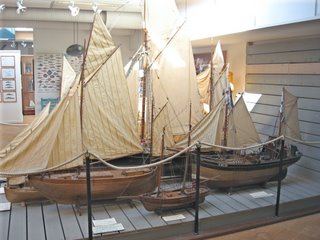 Model fishing boats in the museum of the Norwegian fishing industry
The museum also included information on where the markets for Norwegian fish could be found around the world, how the fish was dried or salted and the social background of those involved in the industry until quite recent times. The exhibition appears to have been sponsored and housed by the Norwegian fish marketing company LeRöy who have their offices in the same building.
 Logo of one of Norway's leading fish exporters
Included specially for our French friend Joël LeRoy who fishes the Breton coast for mackerel, crabs and lobsters
This had an unexpected advantage when we discovered the company's staff canteen where we were able to eat lunch at staff rates! So we enjoyed freshly cooked baked fish with salad, coleslaw and roasted potatoes for 25 NOK each! (about £2.15) Afterwards a cup of fresh filter coffee cost us 50 pence each! Rather better value than a £7 roll or £12 for fish and chips in the market! Anyone coming to Bergen, this is the place to eat! You don't even have to go round the museum but you'd be daft not to, it's so interesting. As retired folk we were only charged 10 NOK each to get in anyway!
Next we explored Håkon's Hall and the Rozenkrantz Tower where we were again offered very advantageous entry prices as retired people even though it was not advertised. It's always worth asking. Among the many wooden buildings in Bergen these two massive stone edifices stand out from their prominent position by the harbour. They reflect the period in mediaeval times when Bergen was the capital of Norway. Both were badly damaged when a German munitions ship moored nearby exploded in 1944 but have been carefully restored. Håkon's Hall was built by King Håkon Håkonsson between 1247 and 1261 as his palace, and the main hall is large and impressive. The undercroft is built directly into the uneven rock which in places emerges through the floor. The building reminded us of Dartington Hall in Devon, another mediaeval shell that has been fitted out with a timber roof, hung with beautiful modern tapestries and is used for concerts and other events.
 Håkon's Hall, Bergen
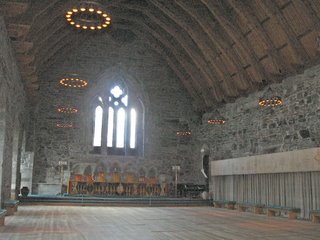 Interior of Håkon's Hall
Perhaps more interesting, and certainly with much more to see, was the nearby Rozenkrantz Tower, a complex structure completed by the castle governor Erik Rozenkrantz in 1567 and incorporating two earlier defensive towers in a baffling maze of spiral staircases leading up to rooms with mullioned windows and massive stone fireplaces where the evidence of earlier floor levels was clearly visible in the walls. In one of the upper halls was a fascinating exhibition on the urban code of laws drawn up by King Magnus Lagobøte (the lawmaker) in the 1270s. Covering all aspects of shipping, town planning, theft and inheritance it drew both on earlier Norwegian codes and similar codes drawn up in southern Europe. It was particularly interesting to see from excavations in the Bryggen, Bergen's wooden waterfront buildings, how the code had been followed across the centuries, with regulation widths for streets and water cisterns provided by each building, as required by the code, to help fight fires.
At least one of those drawing up the code had studied law in Bologna, evidence of the wide intellectual, trading and cultural links of Norway in medieval times. Our own travels in Modestine fall into a more modest perspective compared with these earlier travellers. Finally we emerged on the roof of the tower, almost on the level with the top decks of the massive liner moored alongside, and with wonderful views over the harbour.
 Rosenkrantz Tower, Bergen
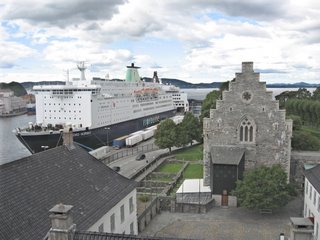 View from the top of the Rozenkrantz Tower showing Håkon's Hall and ship of the Fjord Line fleet
From this quay we will soon be departing for home on a similar Fjord Line ferry
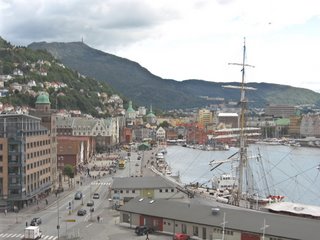 View from the top of the Rozenkrantz Tower back towards the city of Bergen
By now the thought of pancakes and coffee lured us to the marketplace, only to discover there was no sign of the stall we had found on Monday. Nearby though was the tourist information centre, worth a visit just to see the 1920s frescoes covering the internal walls of what used to be the mercantile exchange, depicting the fishing industry around Lofoten, north Norway where fish is prepared and dried on frames before being transported south to Bergen to be sold. Other walls show ships arriving in Bergen loaded with cereals from foreign ports, and the construction of modern ships in Norwegian shipyards.
 Frescoes in the Bergen tourist information office
Walking through backstreets towards the bus station we found the public library, a surprisingly old fashioned place reminiscent of our early days working in Croydon Public Libraries, full of tall, dark wood shelving with a galleried main reading room. Here we used the internet briefly but there were queues of students waiting, so time was limited. In any case, our bus was nearly due.
 At last! We've finally found some real Nordic walkers!
Thursday 31st August 2006, onboard Fjord Norway
We have been heading south along the Norwegian coast all day, threading our way between the hundreds of islands, calling at Haugesund during the afternoon. As we approached the harbour we could see our former campsite near the base of the monument to Harald Fairhair, who united Norway during the 9th century. Soon we will be approaching Stavanger, where we originally intended to board the ship before we got tempted into travelling on to Bergen. We are glad we did. It has given us the chance to experience so much of Norway's beautiful scenery - its coastline, islands, fjords, mountains, clear lakes and glaciers. We have also been able to see some of the country's typical wooden towns - old Stavanger, the back streets of Bergen as well as tiny isolated hamlets on the islands or along the edges of inland fjords. Today's journey has allowed us to see the length of the coastline from the sea without it costing anything as the fare back to Newcastle is the same wherever the journey commences. Norway is predominantly green, its banks covered in dark green fir trees right to the edge of the grey rocks that plunge down into the sea. Beaches do not seem to exist at all. Overhearing other passengers returning from the classic trip northwards from Bergen, through the fjords and round the North Cape to Kirkenes, the scenery continues very similar the entire way. It seems we have been fortunate to experience at least a part of what is reputed to be the world's most magnificent journey.
 Looking back to Bergen
 Offshore islands south of Bergen
 Arriving at Haugesund
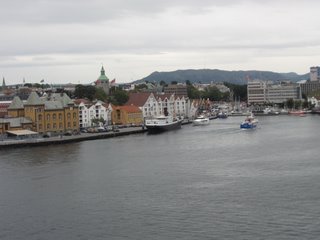 We arrive at Stavanger
 A German submarine arrives at Stavanger
Since the 19th century the company of Hurtigruten has been trading between Bergen and the whalers, sealers and fishermen of the wilder and more remote parts of Norway right up into the Arctic Circle, running a regular service through the fjords and calling off at the islands to deliver grain, foodstuffs, medicines, tools and textiles to the islanders while collecting dried fish, cod liver oil, whale meat, animal skins and dried reindeer and elk flesh. It also carried passengers starting or returning from their travels through the port of Bergen. At some stage the company began to carry tourist passengers. It has now developed into a major tourist attraction carrying passengers for either a part of its total route, or up as far as Kirkenes and back again, calling off for a visit to the North Cape, and, depending on the season, a view of the Aurora Borealis or the midnight sun. Travellers are luxuriously accommodated on board ship and this must certainly be the most comfortable and convenient, if rather expensive, way of enjoying to the full the many splendours of this empty, lonely landscape.
Last night we slept in Modestine very near to the ferry terminal where we were kept awake for much of the night by the rain and the waves from passing ships slapping against the sea wall just feet from where we slept. We had no electricity so we are using that of the ferry company today to complete the events of our last day in mainland Europe which we spent around Bergen, visiting several of its museums, exhausting the last of our remaining kroner.
In the morning we visited the Hanseatic Museum housed in one of the old wooden buildings in Bryggen, the whole area being formerly the enclosed quarter of the German merchants. The Hanseatic League, with its headquarters in Lübeck, dominated trade in the northern seas from the 14th century until the 16th, and German influence in the northern outpost in Bergen lingered until the mid 18th century. The house with its heavy timbers was fitted out with many original features including the rows of bunks with sliding doors in which apprentices slept on straw mattresses. More senior staff actually had beds with hinged doors – even with pin-ups painted on the panels! It struck us that the traders of those days spent most of their life surrounded by timber beams – in their cabins on board ship, in their houses, even in their beds. There was some attempt at comfort with crudely painted decorations on the walls, portraits, and the odd piece of stylish furniture. There was also a passion for washing hands, with ewers, basins and roller towels in almost every room – very necessary when they spent so much time handling dried and salted fish, cod liver oil and pelts.
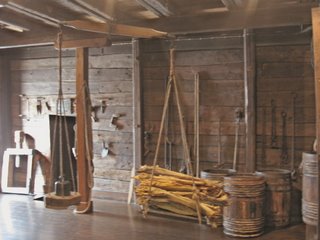 Stockfish being weighed, Hanseatic Museum, Bergen
 Room in the Hanseatic Museum, Bergen
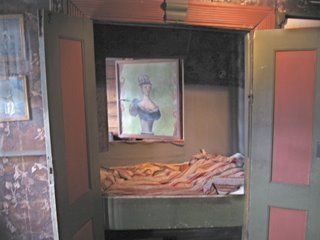 Bed with 18th century pin-up, Hanseatic Museum, Bergen
Life generally seems to have been hard and at the mercy of the sea. Ships from Lofoten, near the Arctic Circle, would deliver goods to Bergen and carry back necessities and more luxurious goods which had been received from Germany. Journeys south to Bergen could take anything from ten to 30 days and the journeys onward to Lübeck from 35 to 50 days. The small ships were often depicted on the seals of the towns with which the Hanseatic League traded.
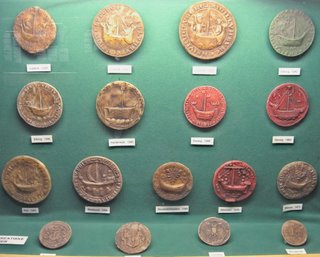 Ships depicted on civic seals, Hanseatic Museum, Bergen
We were also able to visit the Schøtstuene, the Hanseatic assembly rooms. Because of the danger of fire in the wooden buildings of the Bryggen, cooked food was prepared and hot meals were taken communally in a separate building. Some of the dues paid to merchants on cargoes in the port at Bergen were actually used to subsidise their annual feasts. The men, who had to be unmarried while they remained in Bergen, ate together on benches at long tables and some of the proceedings must have been quite rowdy. We saw pinned to the walls, the strict regulations, with fines for contravention, which were drawn up to regulate life in the assembly room.
 Schøtstuene or Hanseatic assembly rooms, Bergen
 Interior of the Schøtstuene, Bergen
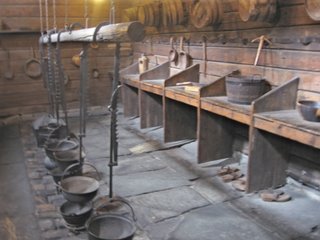 Communal kitchen in the Schøtstuene, Bergen
Later in the afternoon we made our way to the Museum of Fine Art where we visited a couple of the galleries, one, the Rasmus Meyer Collection, containing works solely by Norwegian artists, the other, Lysverket, showing how the work of some was influenced by changing trends in Europe, particularly France, at the end of the 19th century. The first gallery included many 19th century paintings of towns and landscapes by Johan Christian Dahl and of course works by the world renowned painter Edvard Munch. Both these artists amazed us by the complete change of style between their early and later works. Dahl started with works that seemed to our untrained eye rather flat, pleasant but with no sign that he was a particularly talented painter. Then quite suddenly there was a transition to exquisitely executed landscapes showing great skill, depth and use of colour.
 19th century view of Bergen by J. C. Dahl
Munch on the other hand, started in his 20s with portraits showing complete realism and character. Suddenly, around 1900, his style changed with him producing canvases of bright solid colour influenced by Expressionism. Both were excellent but difficult to realise they were the work of the same artist. He was greatly influenced during his time in Paris by the works of the French Impressionists and this is also reflected in certain works where the colours are less dense and the outline far softer. It is interesting to note that he seemed capable of painting in completely different styles at the same period of his work.
Later, we crossed to the galleries of 20th century art where again there were examples of the work of both these artists. Here the flowing, impressionistic lines in Munch's paintings showed the development of his artistic style that lead to the searing anguish expressed so vividly in the Scream.
STOP PRESS… We are writing this in the lounge on the ship. The Norwegian news broadcaster on the overhead TV has just announced that Munch's world famous painting of the Scream which disappeared several years ago after being stolen from Oslo's art museum, has been recovered!!! Brilliant news and how strange that such news should reach us out on the North Sea as we write about the artist! We have verified our understanding with a member of the ship's crew who seems really delighted with the news.
The 20th century galleries also included several paintings by Miro and Picasso, including Picasso's 1960 depiction of the Bull Fight where the simple, vivid use of black and red caught Jill's attention across a room full of masterpieces.
Having spent most of the afternoon appreciating the zenith of Scandinavian culture, it ended with us experiencing its nadir when we investigated the inner depths of one of the tourist shops in the quayside. Here stuffed fluffy reindeer clutched tiny umbrellas (oh no, it looks like rain deer!), stuffed fluffy moose wore Scandinavian patterned woolly jumpers embroidered with "I love Norway", and large stuffed fluffy trolls sold for over £1,000 each." One of the trolls, realising we would soon be leaving Norway, asked Jill if he could have his photo taken with her wearing the new hat she's just bought. He assured us that the trolls of Scandinavia would always remember us with affection and though he was now too corpulent to pop down trollholes, some of his fellow trolls were already eagerly anticipating a cultural exchange with the pixies of Devon and might soon be seen popping up from beneath the manholes on Exeter quay.
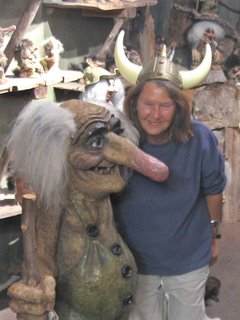 Jill (right) with troll
As we made our way back to Modestine at the end of the day we passed a young girl of about 12 with her mum busy removing cigarette stubs from one of Bergen's decorative manhole covers and photographing it. They came from Russia and were delighted to see such wonderful street art. In Russia, the young girl explained in delightful English, they do not have such beautiful things. When we told her we had photos of about 60 that we have seen in different towns, her eyes grew large with wonder and envy! So we, and the director of the museum in Comachio, are not alone in this new-found obsession!
Tomorrow morning we arrive in Newcastle. Originally Belgium was on our list of countries to visit during our gap-year, to see Ian's sister and family in Brussels. However, before we got around to it, fate intervened and they moved back to England to live in Kendal. So we still have one more visit to make on our way south as we return to our home in Exeter.
And so our year in mainland Europe finally comes to an end. It is a year that has taken us to 17 different countries stretching from Portugal in the west to Hungary in the east and from Gibraltar in the south to Norway in the north. We have seen many old friends along the way and made several new ones. Throughout we have been supported by the interest of friends and family who, with a regular flow of emails, have ensured we never feel homesick. Modestine has behaved superbly suffering no more than a couple of punctures, two dud light bulbs and a burned-out glow plug.
We leave behind us a scattering of Ian's mislaid sunhats and a final message that says it all, written in the soft sand beside the boathouse on the furthest tip of Norway's island of Holsnøy.
 Modestine, the end of a journey
Today has turned out to be very enjoyable despite it starting with some poor soul in the gents' loo suffering chronic diarrhoea and vomiting. Such can be the hazards of campsites and this is not the most savoury we have used. Concerned at the thought of crossing the North Sea feeling sick we have become neurotic about hygiene avoiding the shower block as much as possible and doing all our washing up in Modestine rather than the communal kitchens.
We took the bus down into Bergen where, near the port we have discovered a parking area for camping cars complete with facilities. It costs the same as our present campsite but is walking distance from Bergen centre. From our present site the bus fare into town is dearer than the campsite fees. Sri Lanka and Hungary provide the cheapest public transport we have ever found while Bergen is undoubtedly the most expensive. We will move Modestine down into town tomorrow morning. The new site will also be really convenient for the ferry terminal on Thursday morning. Nearby we found an old wooden corner of the city with a bronze statue commemorating the Bergen Boys' Brigade. (We saw the home of one of its founders on Monday.) This particular organisation is apparently unique to Bergen and has existed for well over 100 years. Each area of the town used to have its own brigade and the boys would drill regularly with their bows and arrows. Now the numbers have diminished but several brigades still exist around the town.
 Bergen Boys' Brigade statue and hall
 Pretty residential corner of Bergen
Today we have visited the museum of the Norwegian fishing industry down on the quay near the ferry terminal. It was a fascinating little museum with some excellent large scale model fishing and sailing boats, fishing nets, tools and equipment, historic photographs and an enormous amount of information on the different types of fish and methods used for catching them.
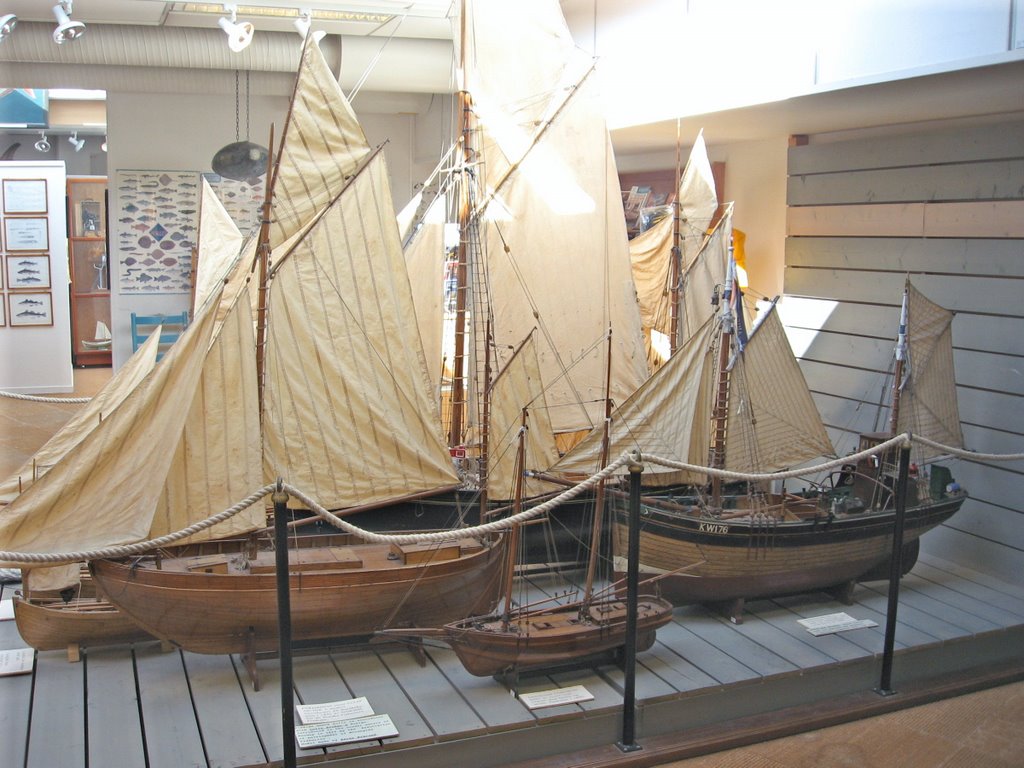 Model fishing boats in the museum of the Norwegian fishing industry
The museum also included information on where the markets for Norwegian fish could be found around the world, how the fish was dried or salted and the social background of those involved in the industry until quite recent times. The exhibition appears to have been sponsored and housed by the Norwegian fish marketing company LeRöy who have their offices in the same building.
 Logo of one of Norway's leading fish exporters
Included specially for our French friend Joël LeRoy who fishes the Breton coast for mackerel, crabs and lobsters
This had an unexpected advantage when we discovered the company's staff canteen where we were able to eat lunch at staff rates! So we enjoyed freshly cooked baked fish with salad, coleslaw and roasted potatoes for 25 NOK each! (about £2.15) Afterwards a cup of fresh filter coffee cost us 50 pence each! Rather better value than a £7 roll or £12 for fish and chips in the market! Anyone coming to Bergen, this is the place to eat! You don't even have to go round the museum but you'd be daft not to, it's so interesting. As retired folk we were only charged 10 NOK each to get in anyway!
Next we explored Håkon's Hall and the Rozenkrantz Tower where we were again offered very advantageous entry prices as retired people even though it was not advertised. It's always worth asking. Among the many wooden buildings in Bergen these two massive stone edifices stand out from their prominent position by the harbour. They reflect the period in mediaeval times when Bergen was the capital of Norway. Both were badly damaged when a German munitions ship moored nearby exploded in 1944 but have been carefully restored. Håkon's Hall was built by King Håkon Håkonsson between 1247 and 1261 as his palace, and the main hall is large and impressive. The undercroft is built directly into the uneven rock which in places emerges through the floor. The building reminded us of Dartington Hall in Devon, another mediaeval shell that has been fitted out with a timber roof, hung with beautiful modern tapestries and is used for concerts and other events.
 Håkon's Hall, Bergen
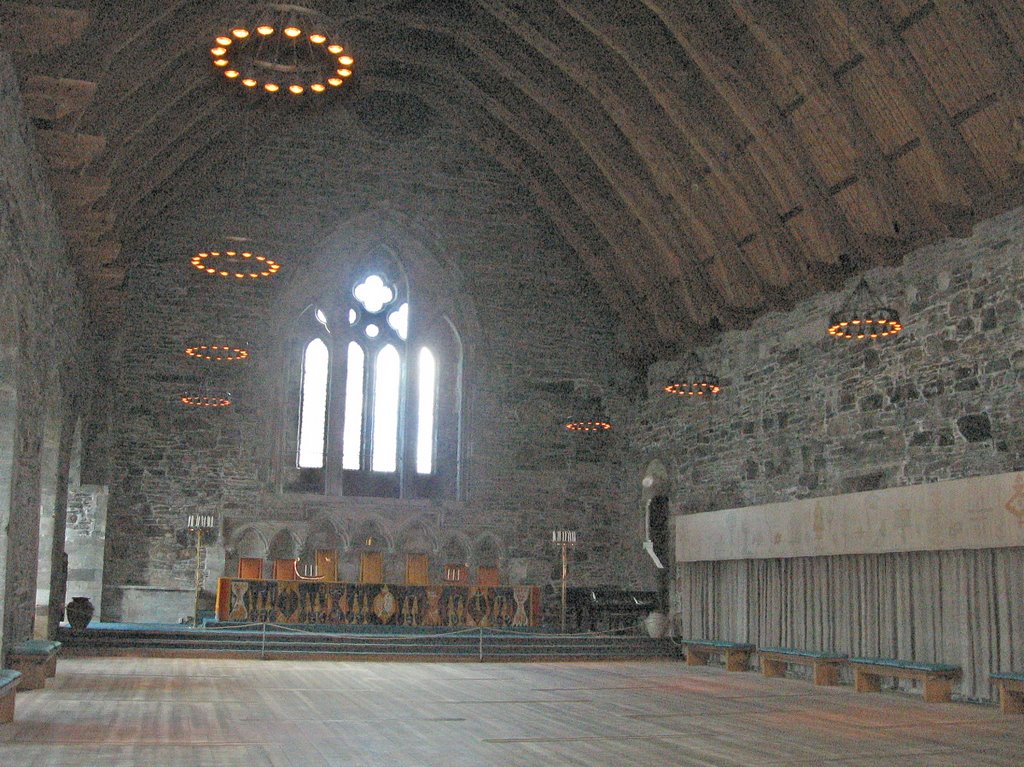 Interior of Håkon's Hall
Perhaps more interesting, and certainly with much more to see, was the nearby Rozenkrantz Tower, a complex structure completed by the castle governor Erik Rozenkrantz in 1567 and incorporating two earlier defensive towers in a baffling maze of spiral staircases leading up to rooms with mullioned windows and massive stone fireplaces where the evidence of earlier floor levels was clearly visible in the walls. In one of the upper halls was a fascinating exhibition on the urban code of laws drawn up by King Magnus Lagobøte (the lawmaker) in the 1270s. Covering all aspects of shipping, town planning, theft and inheritance it drew both on earlier Norwegian codes and similar codes drawn up in southern Europe. It was particularly interesting to see from excavations in the Bryggen, Bergen's wooden waterfront buildings, how the code had been followed across the centuries, with regulation widths for streets and water cisterns provided by each building, as required by the code, to help fight fires.
At least one of those drawing up the code had studied law in Bologna, evidence of the wide intellectual, trading and cultural links of Norway in medieval times. Our own travels in Modestine fall into a more modest perspective compared with these earlier travellers. Finally we emerged on the roof of the tower, almost on the level with the top decks of the massive liner moored alongside, and with wonderful views over the harbour.
 Rosenkrantz Tower, Bergen
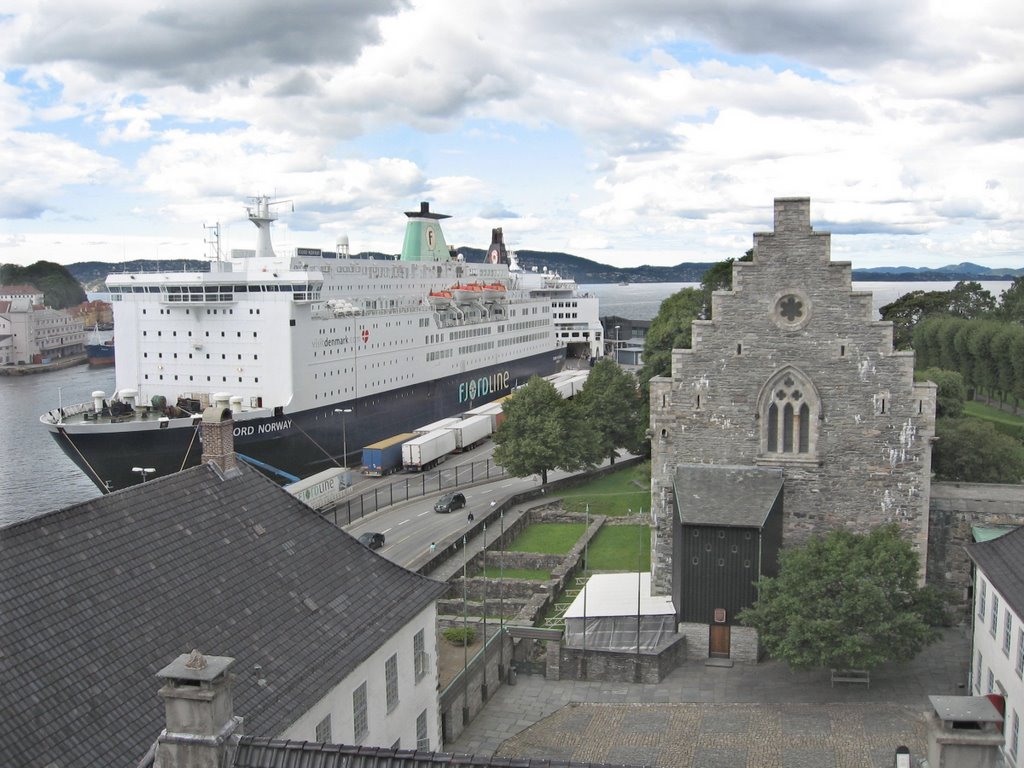 View from the top of the Rozenkrantz Tower showing Håkon's Hall and ship of the Fjord Line fleet
From this quay we will soon be departing for home on a similar Fjord Line ferry
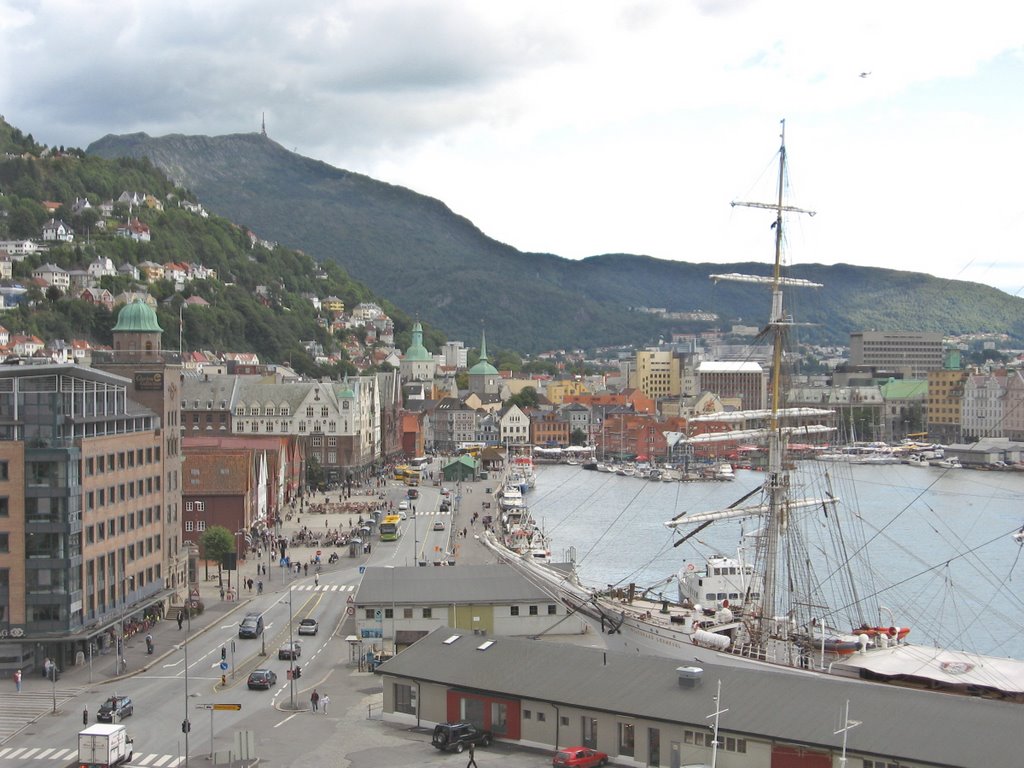 View from the top of the Rozenkrantz Tower back towards the city of Bergen
By now the thought of pancakes and coffee lured us to the marketplace, only to discover there was no sign of the stall we had found on Monday. Nearby though was the tourist information centre, worth a visit just to see the 1920s frescoes covering the internal walls of what used to be the mercantile exchange, depicting the fishing industry around Lofoten, north Norway where fish is prepared and dried on frames before being transported south to Bergen to be sold. Other walls show ships arriving in Bergen loaded with cereals from foreign ports, and the construction of modern ships in Norwegian shipyards.
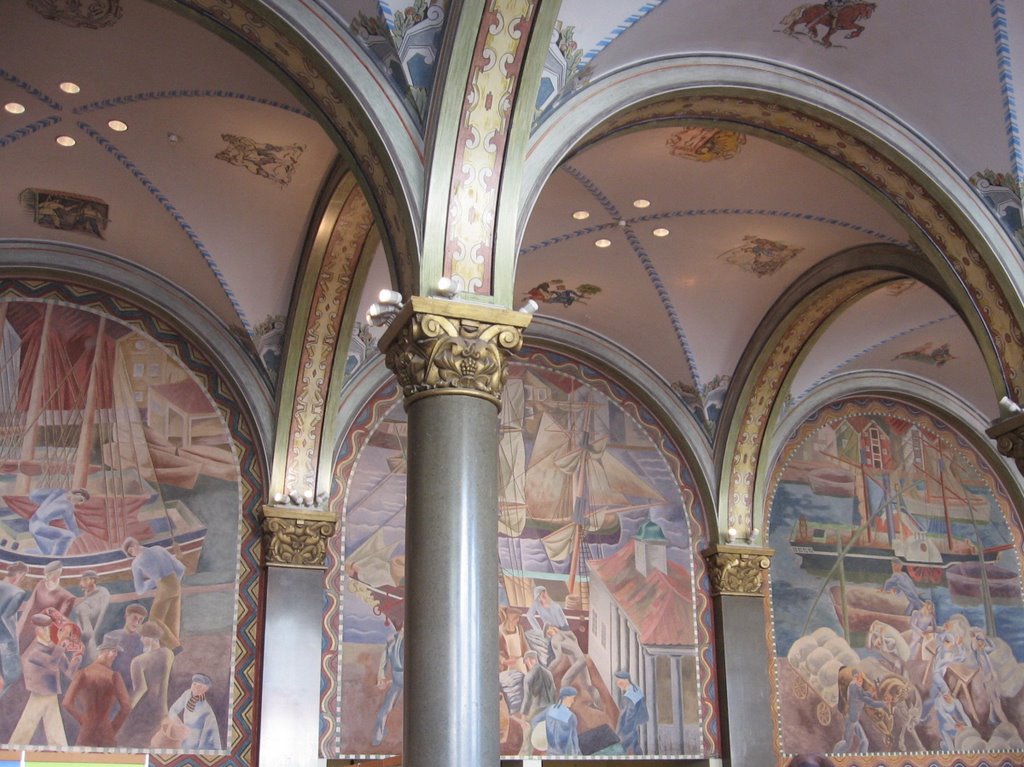 Frescoes in the Bergen tourist information office
Walking through backstreets towards the bus station we found the public library, a surprisingly old fashioned place reminiscent of our early days working in Croydon Public Libraries, full of tall, dark wood shelving with a galleried main reading room. Here we used the internet briefly but there were queues of students waiting, so time was limited. In any case, our bus was nearly due.
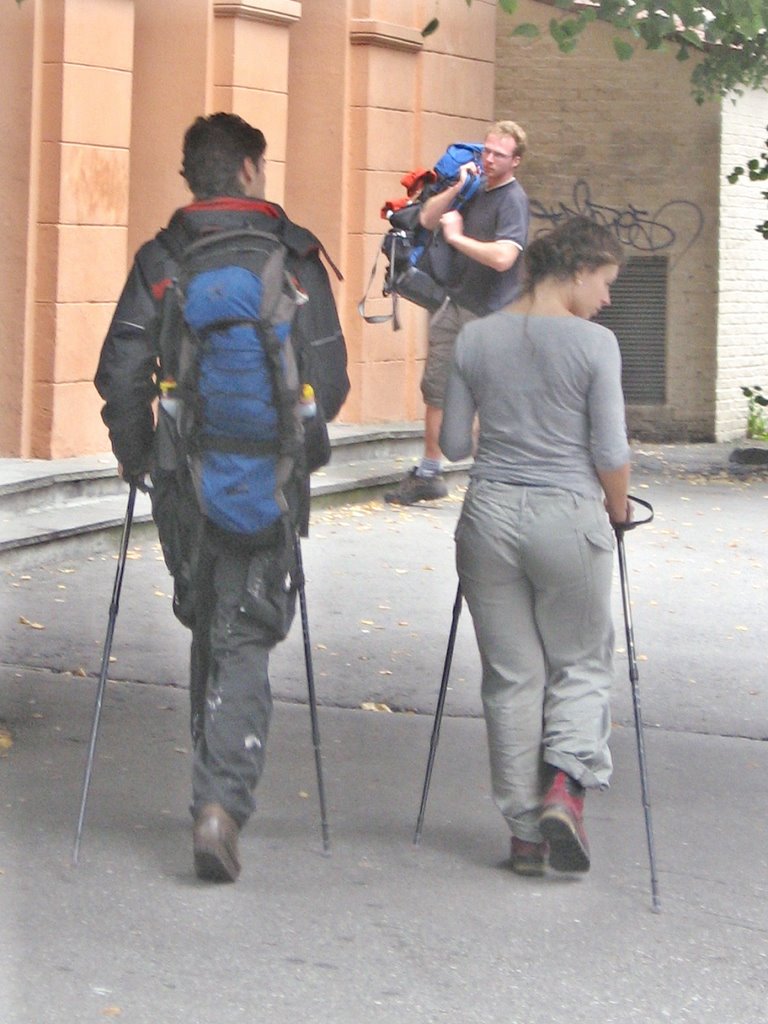 At last! We've finally found some real Nordic walkers!
Thursday 31st August 2006, onboard Fjord Norway
We have been heading south along the Norwegian coast all day, threading our way between the hundreds of islands, calling at Haugesund during the afternoon. As we approached the harbour we could see our former campsite near the base of the monument to Harald Fairhair, who united Norway during the 9th century. Soon we will be approaching Stavanger, where we originally intended to board the ship before we got tempted into travelling on to Bergen. We are glad we did. It has given us the chance to experience so much of Norway's beautiful scenery - its coastline, islands, fjords, mountains, clear lakes and glaciers. We have also been able to see some of the country's typical wooden towns - old Stavanger, the back streets of Bergen as well as tiny isolated hamlets on the islands or along the edges of inland fjords. Today's journey has allowed us to see the length of the coastline from the sea without it costing anything as the fare back to Newcastle is the same wherever the journey commences. Norway is predominantly green, its banks covered in dark green fir trees right to the edge of the grey rocks that plunge down into the sea. Beaches do not seem to exist at all. Overhearing other passengers returning from the classic trip northwards from Bergen, through the fjords and round the North Cape to Kirkenes, the scenery continues very similar the entire way. It seems we have been fortunate to experience at least a part of what is reputed to be the world's most magnificent journey.
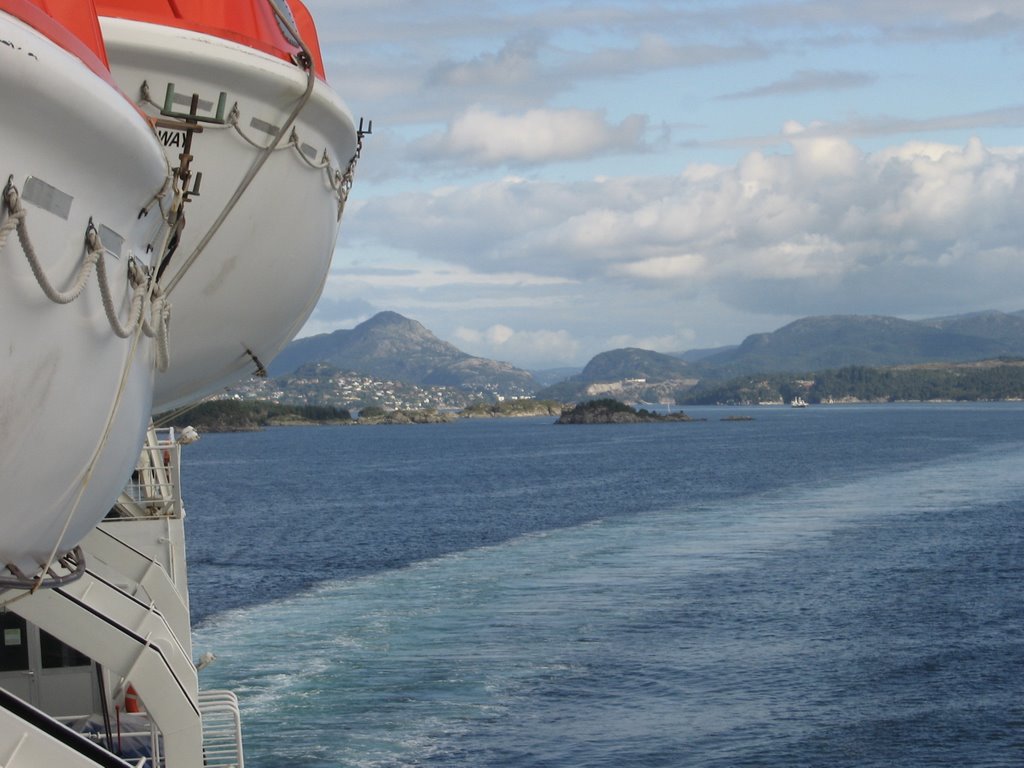 Looking back to Bergen
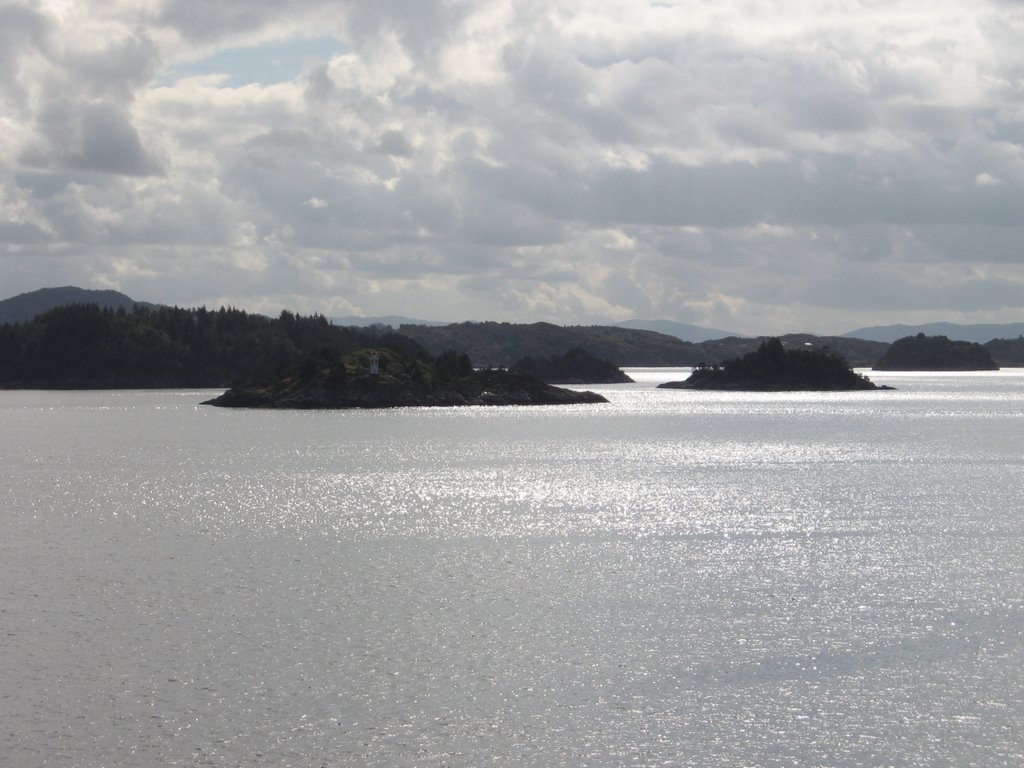 Offshore islands south of Bergen
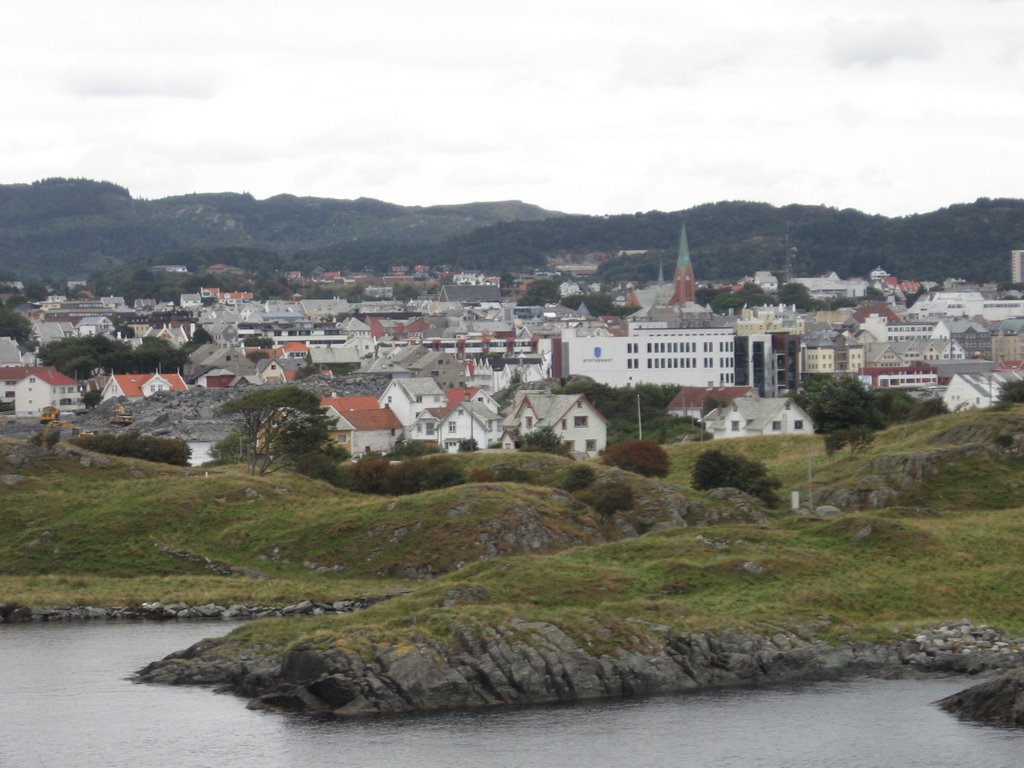 Arriving at Haugesund
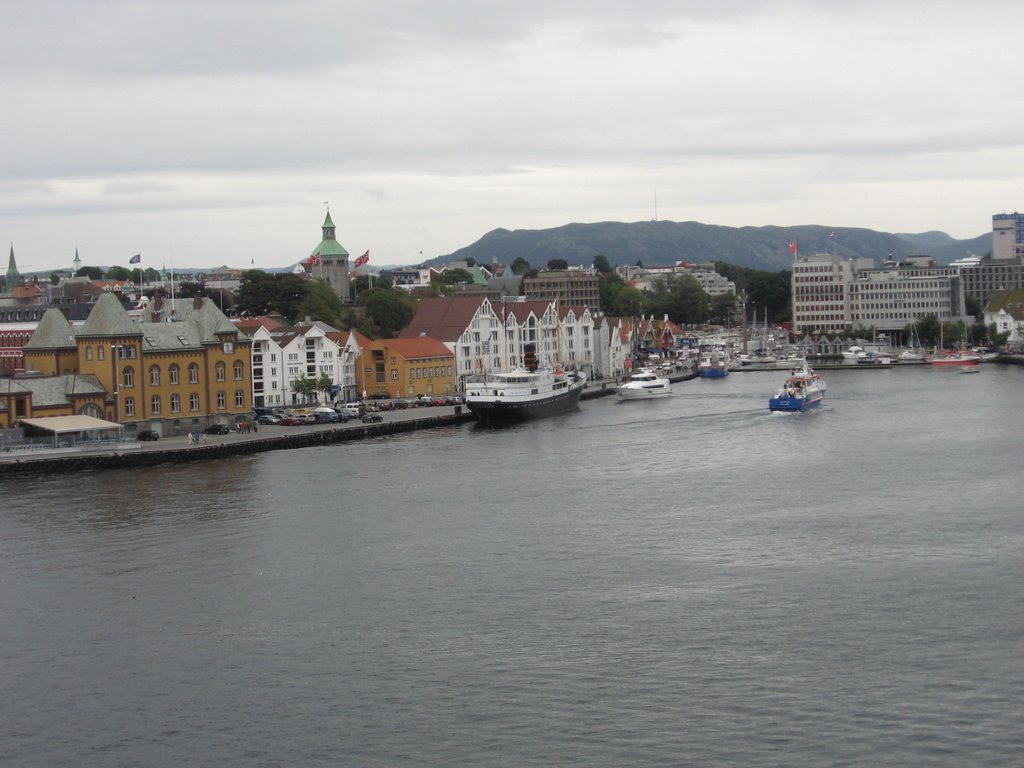 We arrive at Stavanger
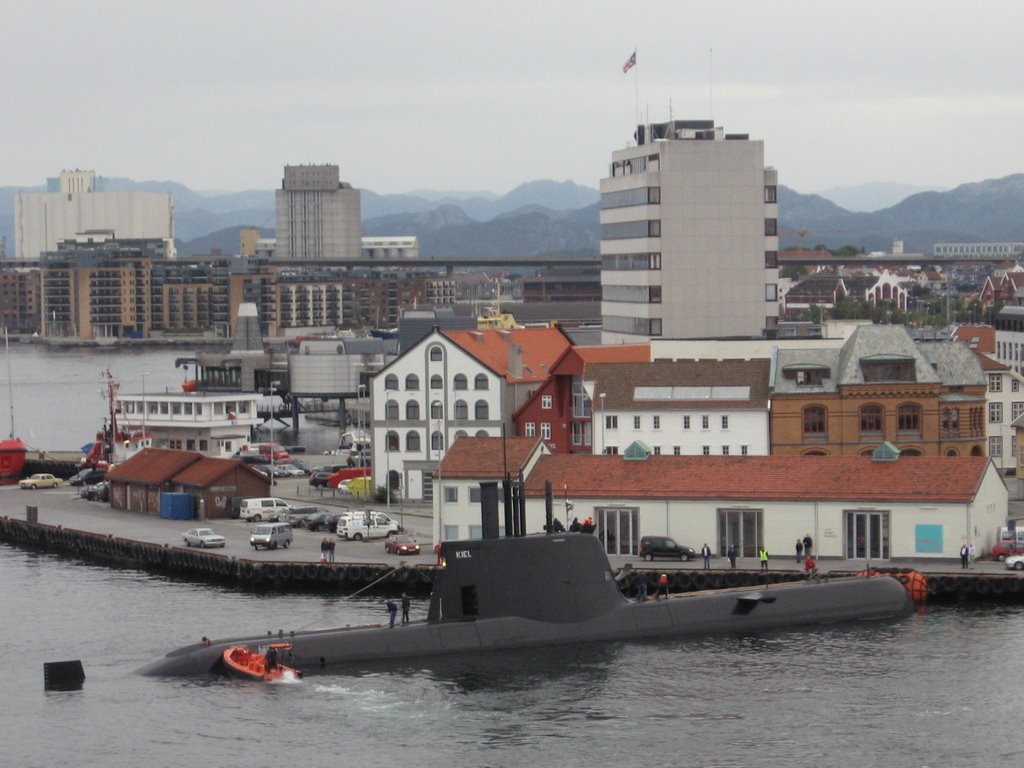 A German submarine arrives at Stavanger
Since the 19th century the company of Hurtigruten has been trading between Bergen and the whalers, sealers and fishermen of the wilder and more remote parts of Norway right up into the Arctic Circle, running a regular service through the fjords and calling off at the islands to deliver grain, foodstuffs, medicines, tools and textiles to the islanders while collecting dried fish, cod liver oil, whale meat, animal skins and dried reindeer and elk flesh. It also carried passengers starting or returning from their travels through the port of Bergen. At some stage the company began to carry tourist passengers. It has now developed into a major tourist attraction carrying passengers for either a part of its total route, or up as far as Kirkenes and back again, calling off for a visit to the North Cape, and, depending on the season, a view of the Aurora Borealis or the midnight sun. Travellers are luxuriously accommodated on board ship and this must certainly be the most comfortable and convenient, if rather expensive, way of enjoying to the full the many splendours of this empty, lonely landscape.
Last night we slept in Modestine very near to the ferry terminal where we were kept awake for much of the night by the rain and the waves from passing ships slapping against the sea wall just feet from where we slept. We had no electricity so we are using that of the ferry company today to complete the events of our last day in mainland Europe which we spent around Bergen, visiting several of its museums, exhausting the last of our remaining kroner.
In the morning we visited the Hanseatic Museum housed in one of the old wooden buildings in Bryggen, the whole area being formerly the enclosed quarter of the German merchants. The Hanseatic League, with its headquarters in Lübeck, dominated trade in the northern seas from the 14th century until the 16th, and German influence in the northern outpost in Bergen lingered until the mid 18th century. The house with its heavy timbers was fitted out with many original features including the rows of bunks with sliding doors in which apprentices slept on straw mattresses. More senior staff actually had beds with hinged doors – even with pin-ups painted on the panels! It struck us that the traders of those days spent most of their life surrounded by timber beams – in their cabins on board ship, in their houses, even in their beds. There was some attempt at comfort with crudely painted decorations on the walls, portraits, and the odd piece of stylish furniture. There was also a passion for washing hands, with ewers, basins and roller towels in almost every room – very necessary when they spent so much time handling dried and salted fish, cod liver oil and pelts.
 Stockfish being weighed, Hanseatic Museum, Bergen
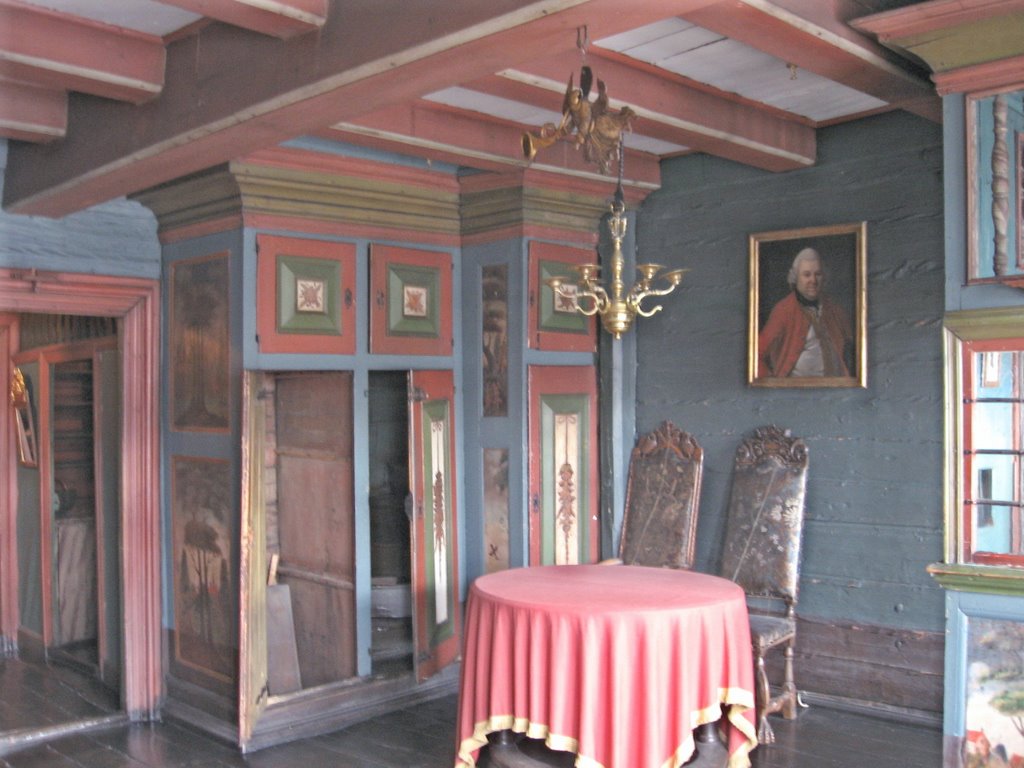 Room in the Hanseatic Museum, Bergen
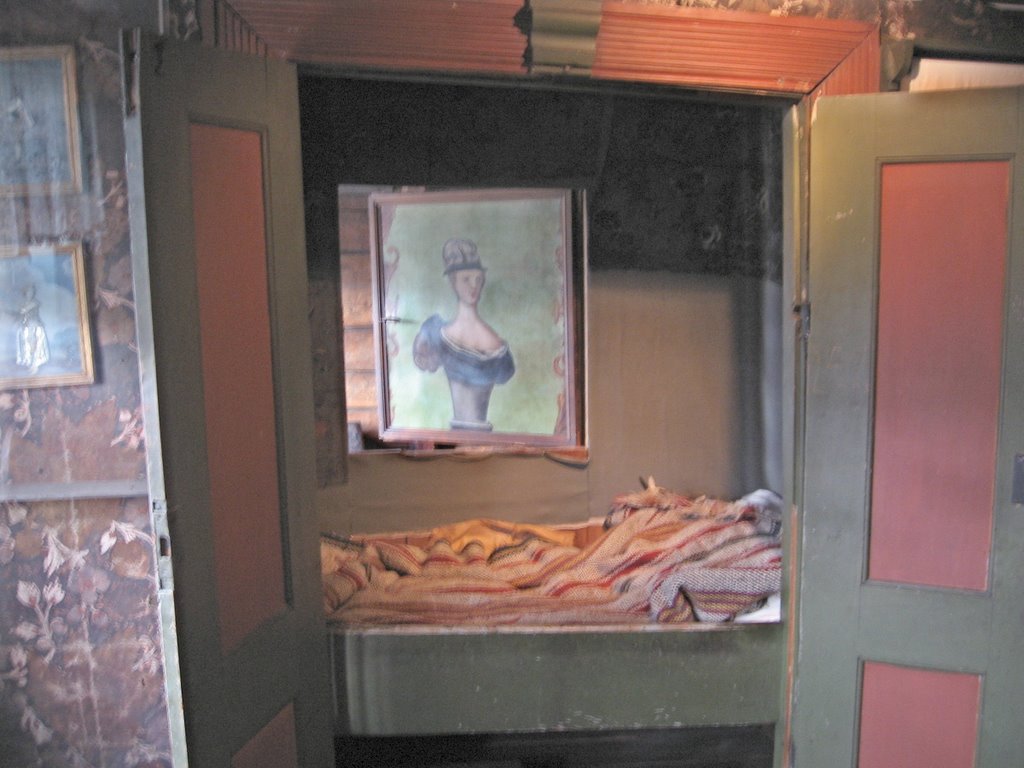 Bed with 18th century pin-up, Hanseatic Museum, Bergen
Life generally seems to have been hard and at the mercy of the sea. Ships from Lofoten, near the Arctic Circle, would deliver goods to Bergen and carry back necessities and more luxurious goods which had been received from Germany. Journeys south to Bergen could take anything from ten to 30 days and the journeys onward to Lübeck from 35 to 50 days. The small ships were often depicted on the seals of the towns with which the Hanseatic League traded.
 Ships depicted on civic seals, Hanseatic Museum, Bergen
We were also able to visit the Schøtstuene, the Hanseatic assembly rooms. Because of the danger of fire in the wooden buildings of the Bryggen, cooked food was prepared and hot meals were taken communally in a separate building. Some of the dues paid to merchants on cargoes in the port at Bergen were actually used to subsidise their annual feasts. The men, who had to be unmarried while they remained in Bergen, ate together on benches at long tables and some of the proceedings must have been quite rowdy. We saw pinned to the walls, the strict regulations, with fines for contravention, which were drawn up to regulate life in the assembly room.
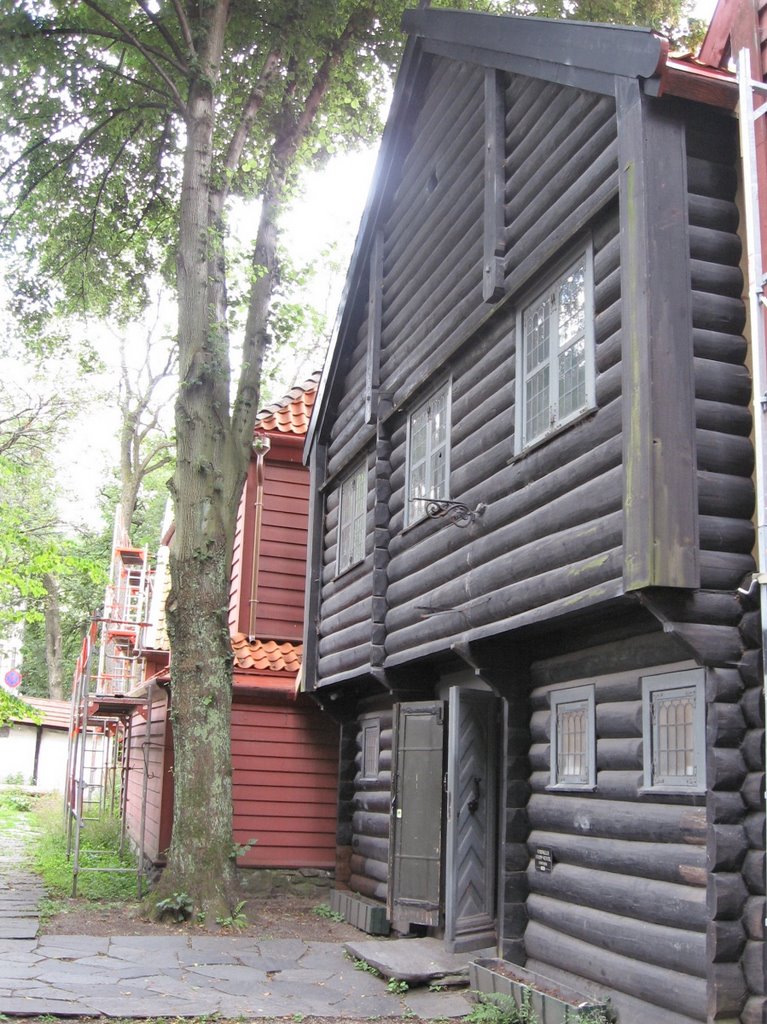 Schøtstuene or Hanseatic assembly rooms, Bergen
 Interior of the Schøtstuene, Bergen
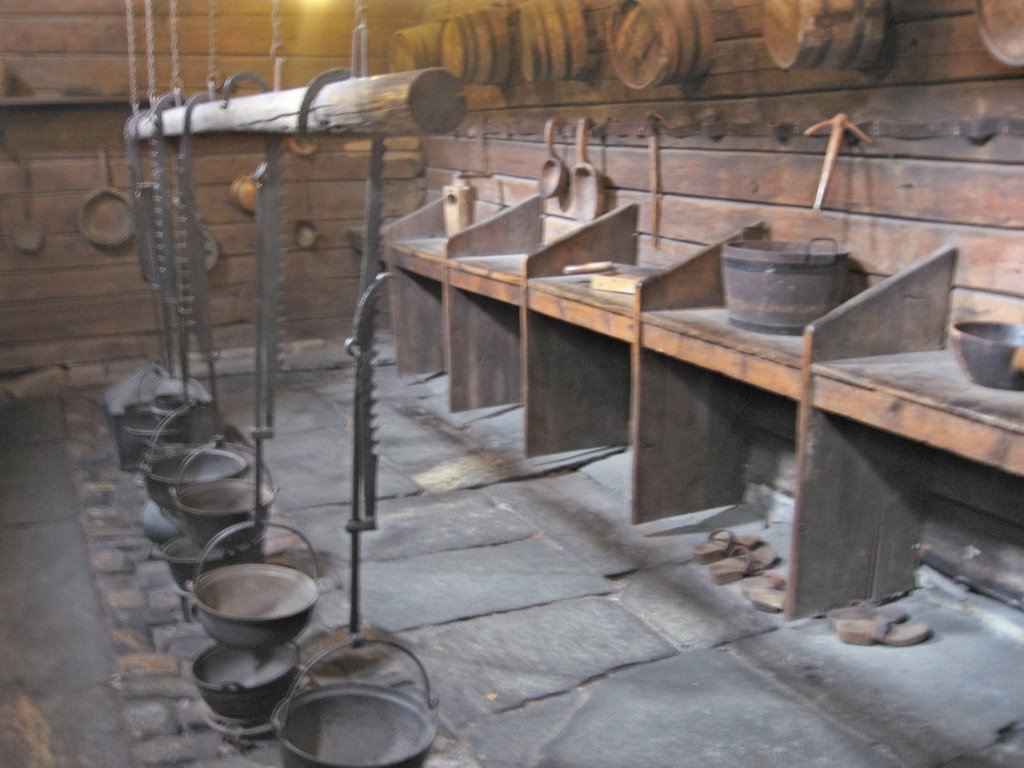 Communal kitchen in the Schøtstuene, Bergen
Later in the afternoon we made our way to the Museum of Fine Art where we visited a couple of the galleries, one, the Rasmus Meyer Collection, containing works solely by Norwegian artists, the other, Lysverket, showing how the work of some was influenced by changing trends in Europe, particularly France, at the end of the 19th century. The first gallery included many 19th century paintings of towns and landscapes by Johan Christian Dahl and of course works by the world renowned painter Edvard Munch. Both these artists amazed us by the complete change of style between their early and later works. Dahl started with works that seemed to our untrained eye rather flat, pleasant but with no sign that he was a particularly talented painter. Then quite suddenly there was a transition to exquisitely executed landscapes showing great skill, depth and use of colour.
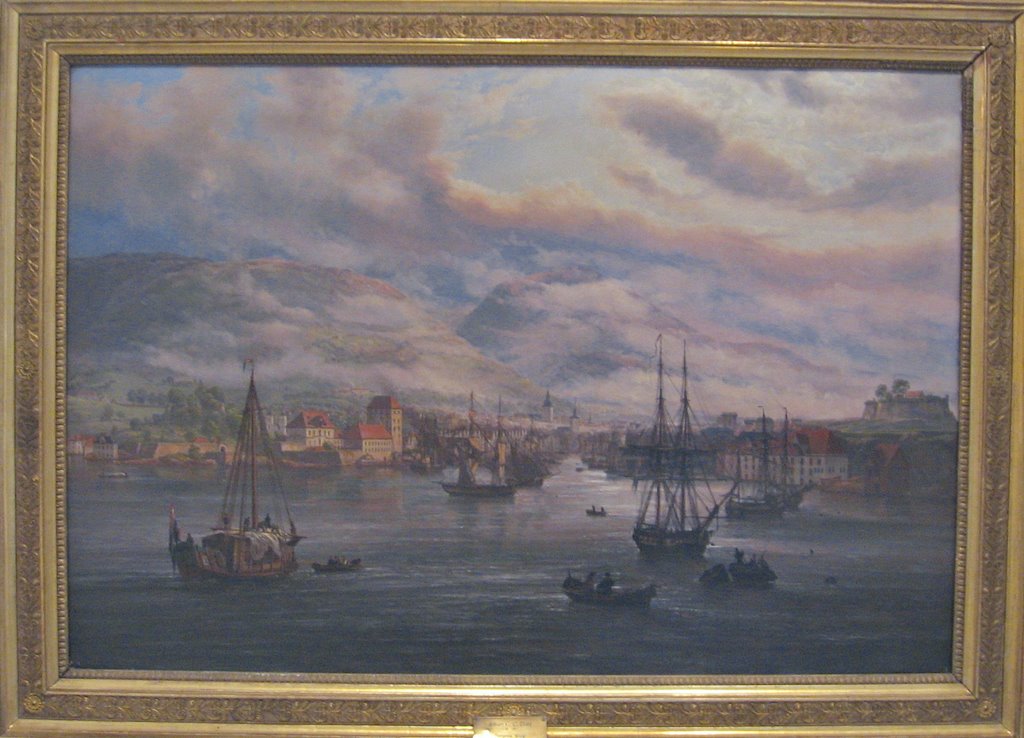 19th century view of Bergen by J. C. Dahl
Munch on the other hand, started in his 20s with portraits showing complete realism and character. Suddenly, around 1900, his style changed with him producing canvases of bright solid colour influenced by Expressionism. Both were excellent but difficult to realise they were the work of the same artist. He was greatly influenced during his time in Paris by the works of the French Impressionists and this is also reflected in certain works where the colours are less dense and the outline far softer. It is interesting to note that he seemed capable of painting in completely different styles at the same period of his work.
Later, we crossed to the galleries of 20th century art where again there were examples of the work of both these artists. Here the flowing, impressionistic lines in Munch's paintings showed the development of his artistic style that lead to the searing anguish expressed so vividly in the Scream.
STOP PRESS… We are writing this in the lounge on the ship. The Norwegian news broadcaster on the overhead TV has just announced that Munch's world famous painting of the Scream which disappeared several years ago after being stolen from Oslo's art museum, has been recovered!!! Brilliant news and how strange that such news should reach us out on the North Sea as we write about the artist! We have verified our understanding with a member of the ship's crew who seems really delighted with the news.
The 20th century galleries also included several paintings by Miro and Picasso, including Picasso's 1960 depiction of the Bull Fight where the simple, vivid use of black and red caught Jill's attention across a room full of masterpieces.
Having spent most of the afternoon appreciating the zenith of Scandinavian culture, it ended with us experiencing its nadir when we investigated the inner depths of one of the tourist shops in the quayside. Here stuffed fluffy reindeer clutched tiny umbrellas (oh no, it looks like rain deer!), stuffed fluffy moose wore Scandinavian patterned woolly jumpers embroidered with "I love Norway", and large stuffed fluffy trolls sold for over £1,000 each." One of the trolls, realising we would soon be leaving Norway, asked Jill if he could have his photo taken with her wearing the new hat she's just bought. He assured us that the trolls of Scandinavia would always remember us with affection and though he was now too corpulent to pop down trollholes, some of his fellow trolls were already eagerly anticipating a cultural exchange with the pixies of Devon and might soon be seen popping up from beneath the manholes on Exeter quay.
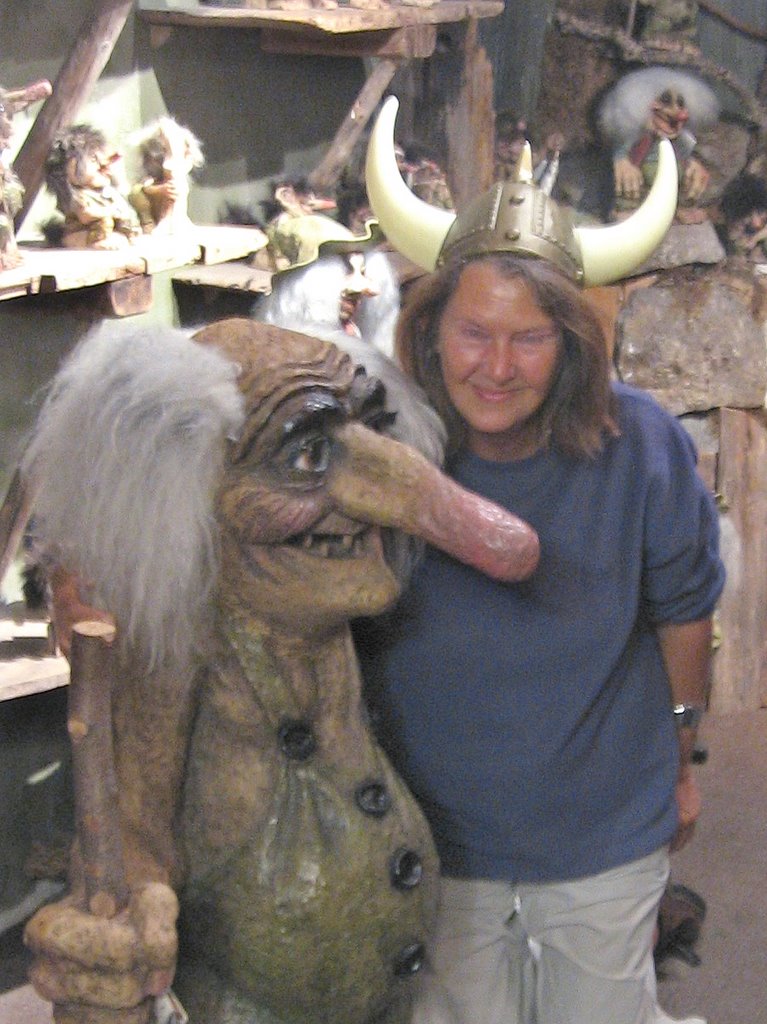 Jill (right) with troll
As we made our way back to Modestine at the end of the day we passed a young girl of about 12 with her mum busy removing cigarette stubs from one of Bergen's decorative manhole covers and photographing it. They came from Russia and were delighted to see such wonderful street art. In Russia, the young girl explained in delightful English, they do not have such beautiful things. When we told her we had photos of about 60 that we have seen in different towns, her eyes grew large with wonder and envy! So we, and the director of the museum in Comachio, are not alone in this new-found obsession!
Tomorrow morning we arrive in Newcastle. Originally Belgium was on our list of countries to visit during our gap-year, to see Ian's sister and family in Brussels. However, before we got around to it, fate intervened and they moved back to England to live in Kendal. So we still have one more visit to make on our way south as we return to our home in Exeter.
And so our year in mainland Europe finally comes to an end. It is a year that has taken us to 17 different countries stretching from Portugal in the west to Hungary in the east and from Gibraltar in the south to Norway in the north. We have seen many old friends along the way and made several new ones. Throughout we have been supported by the interest of friends and family who, with a regular flow of emails, have ensured we never feel homesick. Modestine has behaved superbly suffering no more than a couple of punctures, two dud light bulbs and a burned-out glow plug.
We leave behind us a scattering of Ian's mislaid sunhats and a final message that says it all, written in the soft sand beside the boathouse on the furthest tip of Norway's island of Holsnøy.
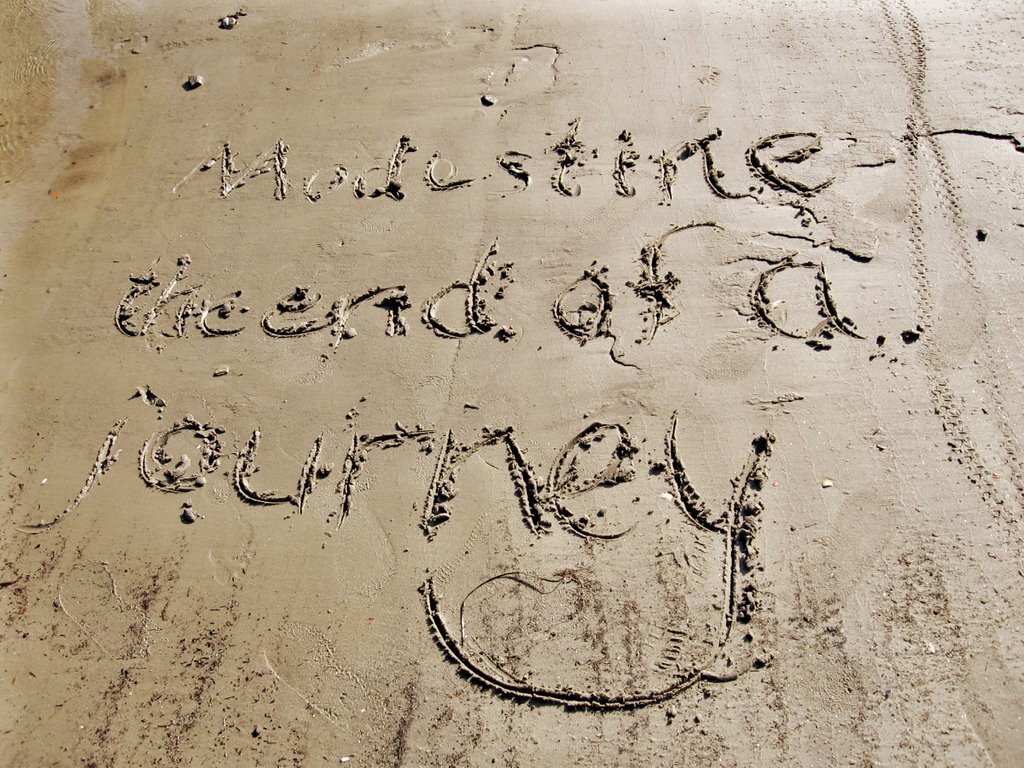 Modestine, the end of a journey
Subscribe to:
Posts (Atom)