We cycled back into Evora today to give it a closer look and confirm yesterday’s initial impression. The city still retains most of its medieval walls to which large bastions have been added, and these provide the location for attractive gardens, even at this time of year kept meticulously tidy, the paths raked and with a team of gardeners busy tending the flower beds. In the gardens were the romantic ruins of medieval royal buildings, where peacocks have now taken up residence, and the Palácio de D. Manuel in the so-called Manueline style of many buildings of the early 16th century in Portugal. Also in the gardens was a statue of the explorer Vasco da Gama. The Portugese are particularly fond of honouring their explorers, writers and other persons of note in this way.
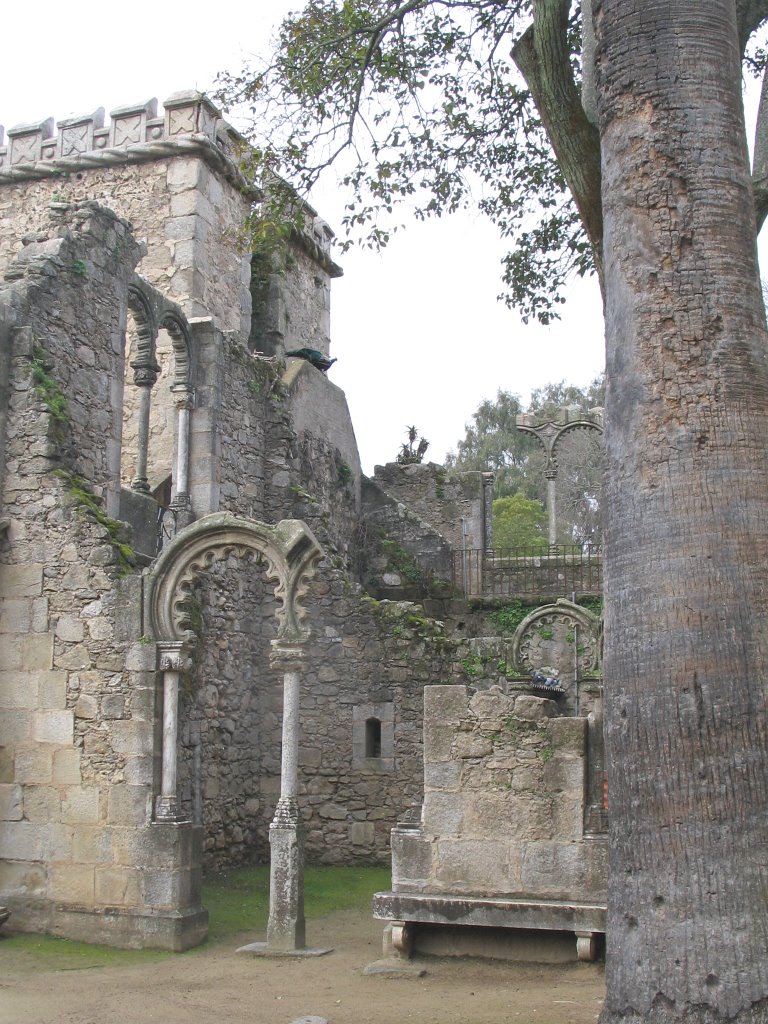 Ruins in the park, Evora
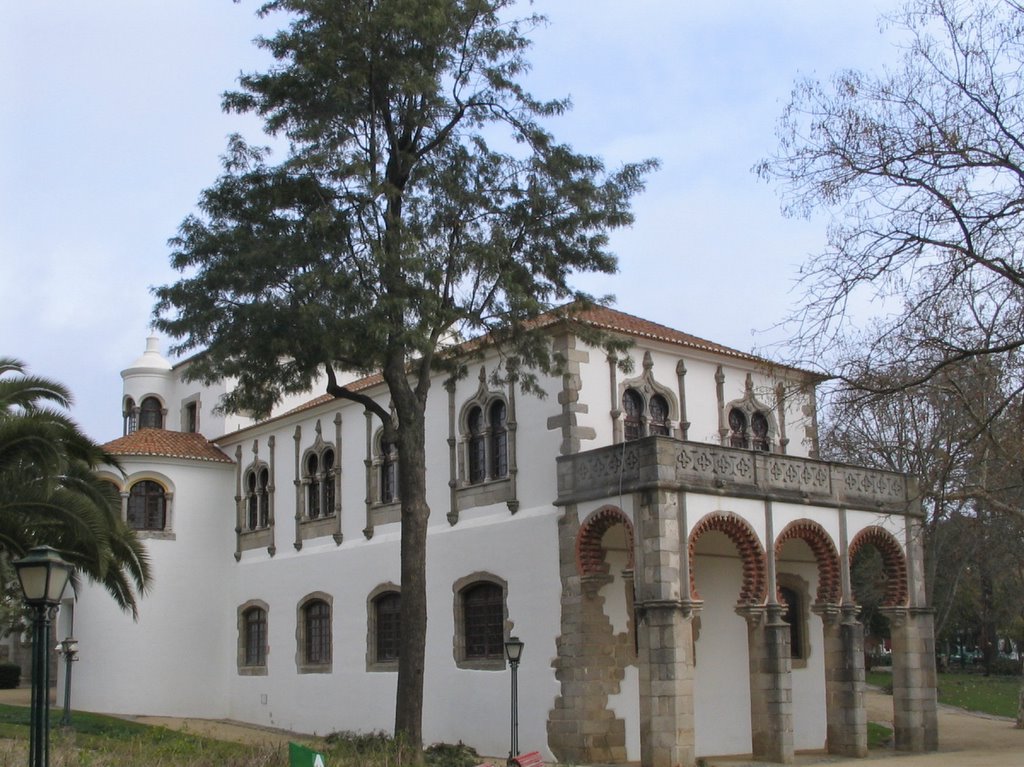 Palácio de D. Manuel, Evora
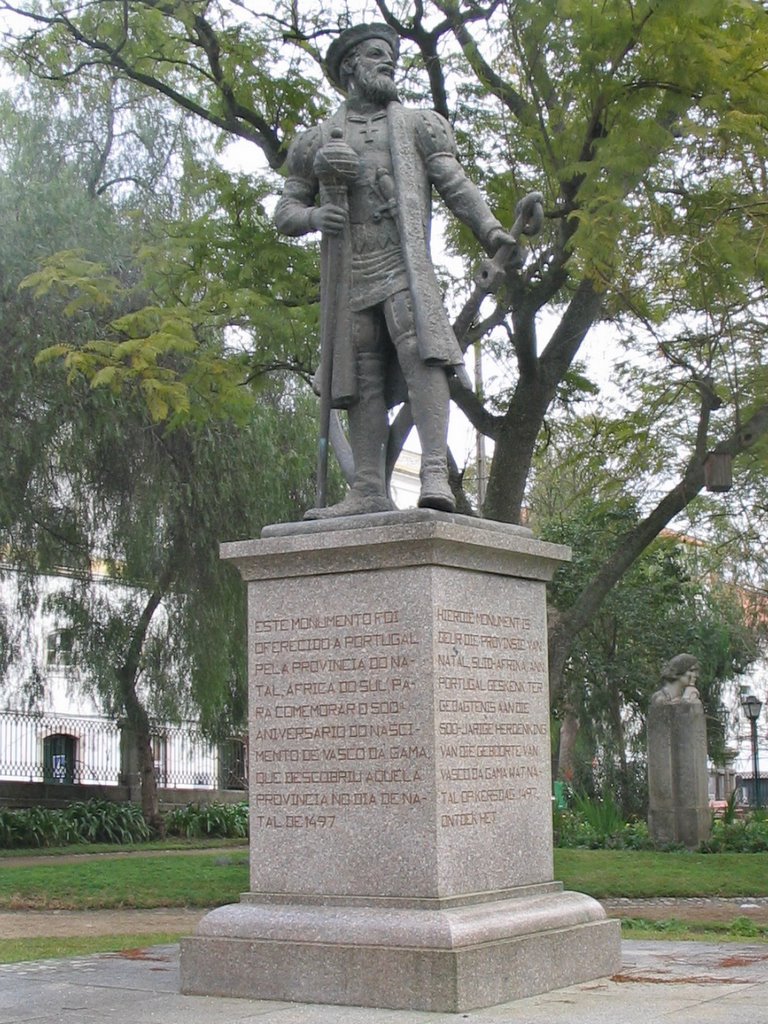 Statue of Vasco da Gama, Evora
We had noticed the rather stark São Francisco church yesterday and explored it more fully today. It is reputed to be one of the finest examples of gothic architecture in Portugal, very unified in style and simple, despite being built at the very end of the 15th century. The heavy baroque altars were neatly consigned to the side chapels. We had a macabre experience there when we visited the bone chapel. The Franciscans for some reason in the 16th century erected this chapel and cemented into its walls some 5,000 skulls and innumerable other skeletal parts. We were ushered into the chapel by a cadaverous attendant dressed in a cloak and greeted by the inscription over the door to the effect that “we bones who are here are waiting for you to join us”. Outside there were wax votive figures left by people who wanted divine favours of some sort. Hearts, legs, chests presumably indicated the diseased parts of the body for which cures were being sought. The occasional book was presumably hoping for success in studies or was it the librarians praying for the end of bookworm infestation? Not having the courage of Indiana Jones, we were glad to escape, even into the steady drizzle that had now set in.
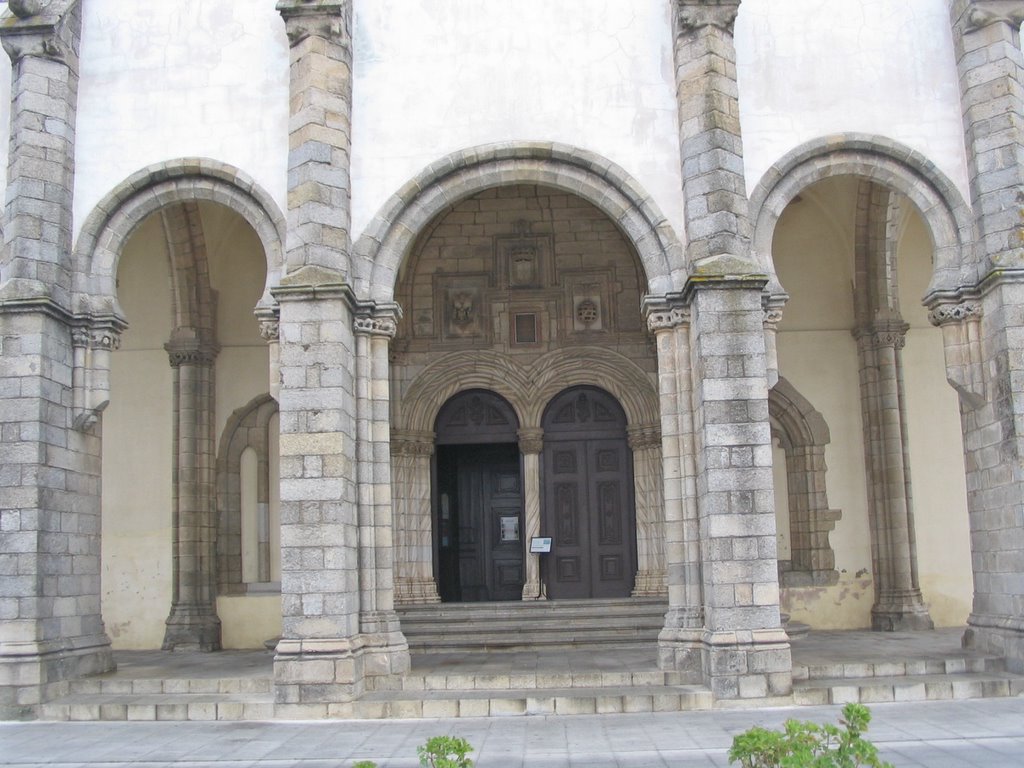 Portico of São Francisco church, Evora
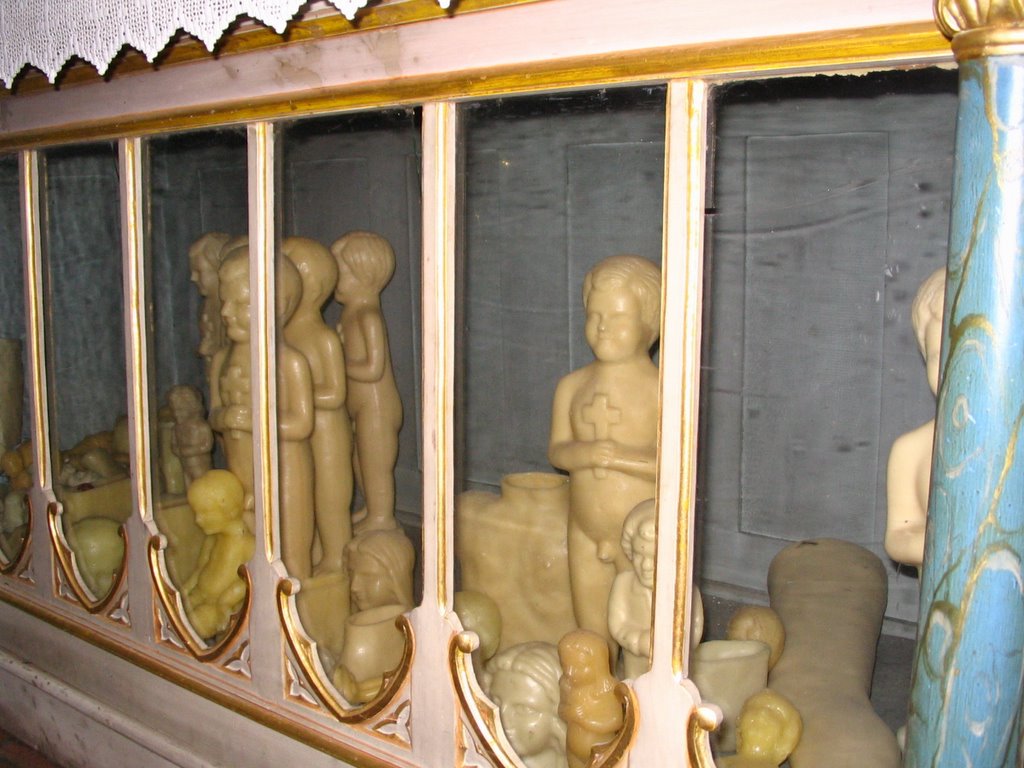 Wax votive figures, ossuary of São Francisco church, Evora
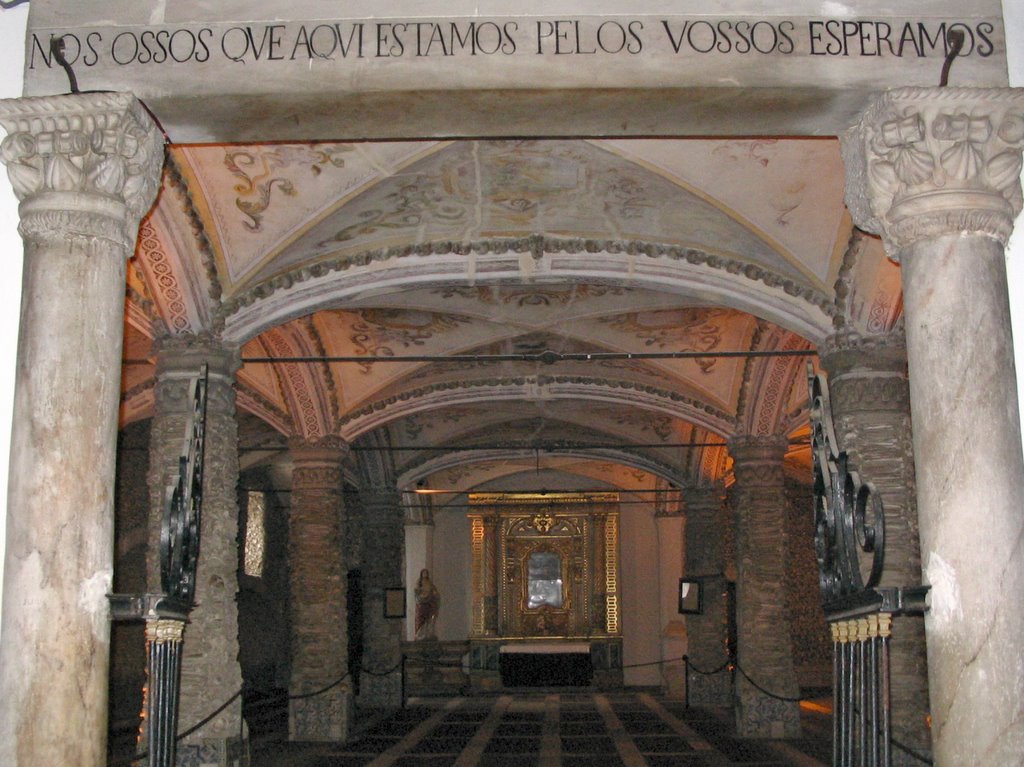 Entrance to ossuary of São Francisco church, Evora
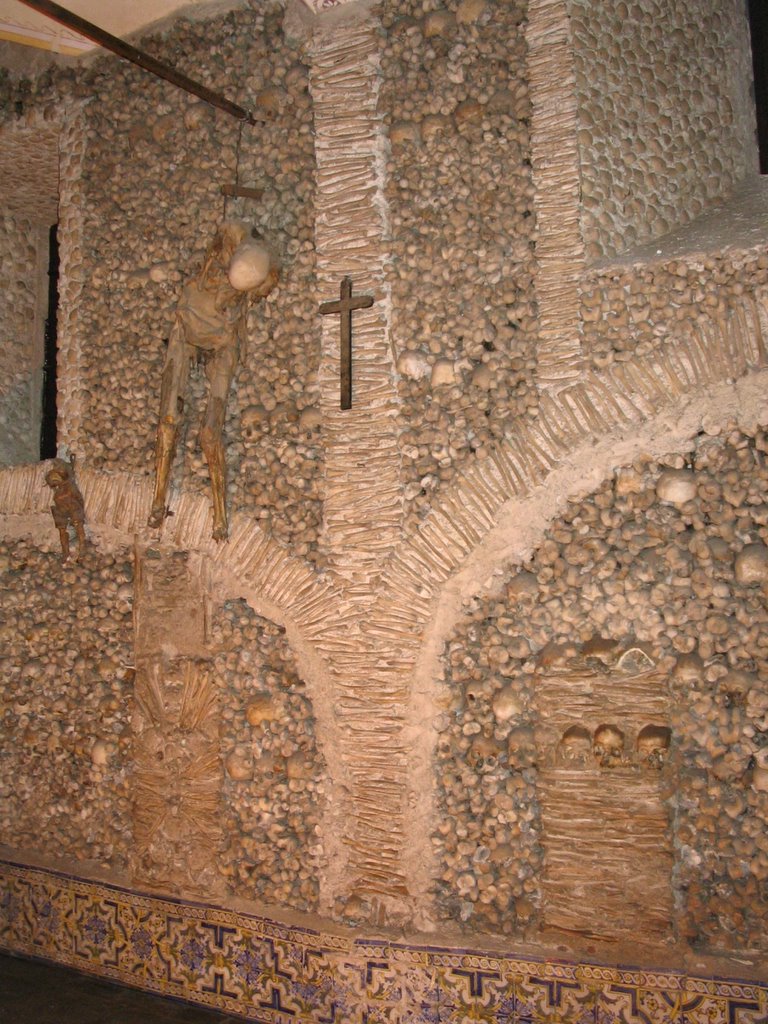 Cheerful corner of the ossuary of São Francisco church, Evora
After the church of São Francisco with its single airy nave, the Cathedral with its side aisles seemed cramped and squat. It was also very dark and many of the chapels could only be illuminated by purchasing tokens. We forewent that pleasure in favour of paying to see the gothic cloisters, which were as lofty as a church. We were able to climb onto the roof of the cloisters, which would have offered excellent views had it not been for the rain.
 In the Cathedral cloisters, Evora
 View down onto the Cathedral cloisters, Evora
The University building in Evora is a massive Renaissance and Baroque pile. The University was founded in 1559 and we wandered along the endless tiled corridors, soaking up the student atmosphere and almost tempted to use their canteen for lunch. We looked at the notices for courses, Erasmus opportunities, lodgings on offer or sought, much like university notice-boards everywhere and quite nostalgic in many ways. The tiles do make it very different from a British university though. They decorate many public buildings and monuments in Portugal and Spain and, while many of the more modern ones are quite garish, the older tiles are often very attractive.
 A small section of the main University building, Evora
 Courtyard in the University, Evora
 17th century tiles , Evora
Eventually the rain forced us into a restaurant where we tried two of the fish dishes for which Portugal is famous. Nothing very exciting, we felt, but perhaps we should have chosen a seaside location for this gastronomic experience.
By the time lunch was over the rain had stopped and we explored more of Evora’s past. The city was known as Ebora in Roman times and from even earlier periods there are extensive remains in the region, especially phallic dolmens from the Neolithic period. Ian of course managed to run one of these to earth tucked away in a courtyard, and in the bowels of the town hall he found part of the Roman baths, complete with a bathing beauty.
 Phallic dolmen from the region of Evora
 Roman baths, Evora
Evora’s aqueduct, while it does not rival the Pont du Gard or Segovia is quite a remarkable structure. Built in the 1530s it was praised by the poet Camões, Portugal’s answer to Shakespeare. We stumbled across it where it ends in the city centre, quite modestly at chest height, then followed it as it gained in stature until houses could be built under its arches and, once outside the walls, we saw it striding majestically across the countryside.
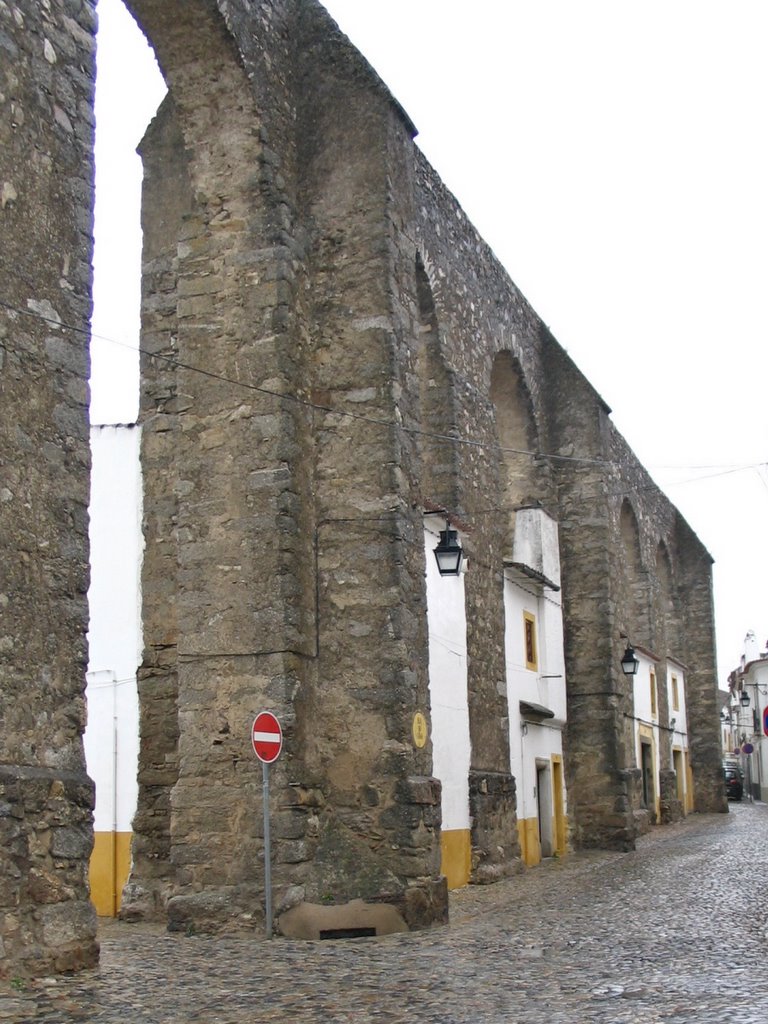 Houses built under the aqueduct, Evora
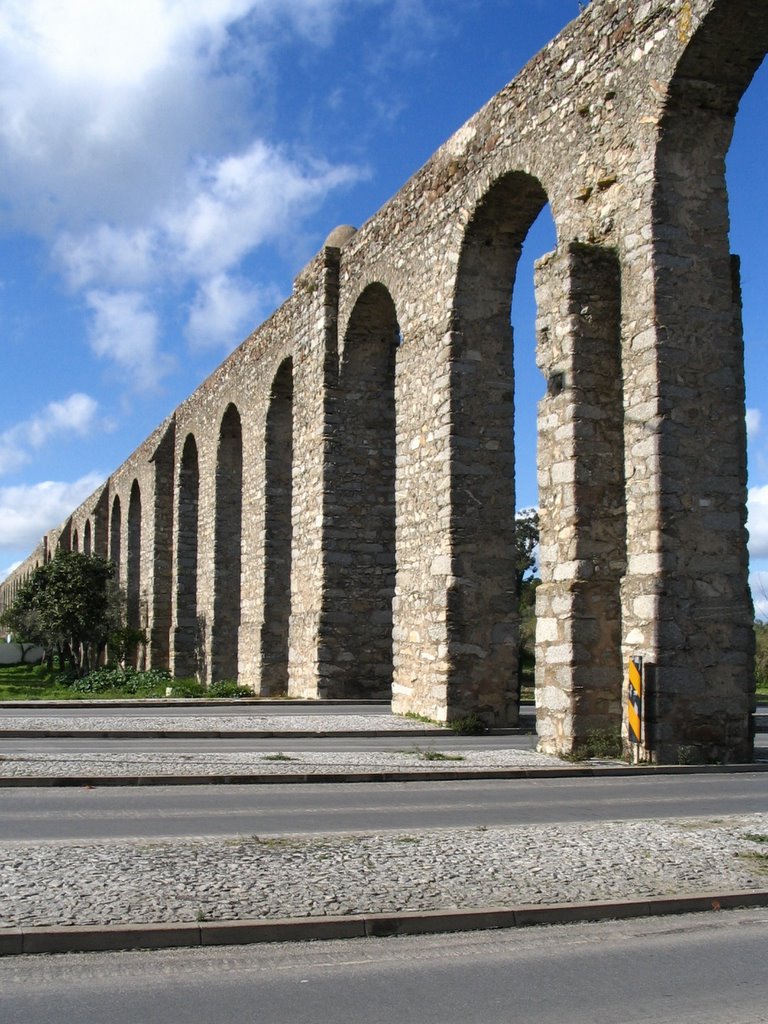 Aqueduct outside the city walls, Evora
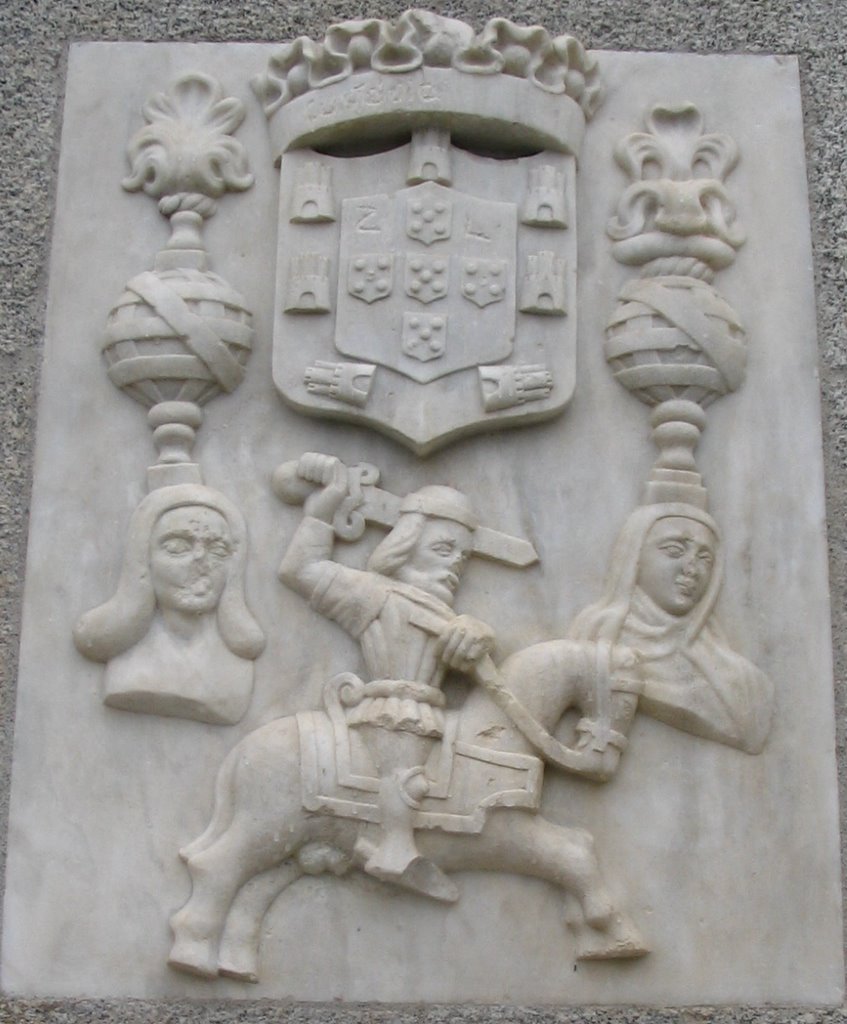 Blason on a cistern of the aqueduct, Evora
Remembering that we have one less hour of daylight in Portugal, we finally cycled back to the campsite with Jill so exhausted that she actually allowed Ian to write today’s blog!
Friday17th February 2006, Coimbra, Portugal
Fortunately after a good night’s sleep Jill was fighting fit again and capable of facing the long 300 km drive up from Evora to Coimbra. Having seen enough baroque churches, holy pictures, gilded altars and human bones in Evora to last her a few days, Jill would actually have preferred to potter along the coast looking at fishing villages but Ian was adamant that Coimbra is one of the cultural hotspots of Portugal and cannot be missed.
Actually the journey was not too bad except for the condition of the roads. They are frequently broken and potholed by the amount of very heavy traffic they contend with and there is never anywhere safe to pull in for a brief rest – or to shut the fridge door which we frequently overlook before we start - it is astonishing how much mess a lid coming off a jar of runny honey can make in the back of a camper van!
There were frequent stretches of today’s route where we had the countryside to ourselves. And very pretty countryside it was with green fields, hedges, sheep and cattle – all the things we had missed in Spain. We passed through more of Portugal’s famous forests of cork oaks where, as in Spain, the bark had been removed from the lower trunks. Apparently this can be done roughly every twelve years, by which time it has regenerated. We passed several bark treatment factories and saw a number of lorries piled high with lumpy sheets of cork bark en-route for the processing factory. We would have loved to see one of the factories more closely but, as already said, there is never any possibility of stopping.
We passed through huge forests of eucalyptus trees. What do they use them for? Does the wood make good timber? In contrast to the cork oaks, the bark of the eucalyptus trees was hanging in shreds from the trunks. Broken fresh leaves smell very medicinal but these huge trees are surely not grown for their oils alone.
 Cork oak forest with bark removed, near Coruche
We stopped for a picnic lunch beside a barragem (reservoir). It was the only official parking place we found all day! The countryside is a working tool and there is no idea of people using the roads for any form of leisure activity. Why would anyone want to stop?
So by the time we finally reached Coimbra we were exhausted. The dual carriageways and roundabouts around the city were a chaos of traffic, the whole place seemed nothing but modern high-rise buildings and there did not appear to be a campsite for another 20 kilometres. As we were leaving the city the rain was teeming down and we were feeling frustrated and tired. Suddenly we discovered a sign to a brand new campsite in the middle of a building development. It has only been open a few weeks and looks very bare and austere but any port in a storm. We seem to be virtually the only people here and it is all rather ugly and bleak outside. However, there is hot water at the washbasins – a first in Portugal, and toilet paper in the loos – practically a first in Spain, Portugal or France. Of course you cannot put it down the loo or it blocks the sewers so every toilet cubicle includes a discrete bucket. The ultimate accolade for this site is that there are plugs at the washbasins – well, most of them! Nowhere else have we seen a single plug and have learned to carry our own with us.
Once the rain had subsided we walked off towards the city centre. This seems miles away along busy and boring roads so we contented ourselves with essential shopping at the suburban hypermarket, gaped with wonder at the mountains of dried salt fish the Portuguese are so fond of, and made our way back through renewed wind and rain to our dark, cold, wet, deserted campsite where we are gradually drying out in Modestine over glasses of Portuguese wine and fish salad.
 Dried cod piled high, Coimbra
Tomorrow we will try again to discover the delights of Coimbra but in the meantime our appetite has been whetted by the English text of the city guide we have acquired:
“In May the University dazzles with the colours of all faculties when the student’s (sic) festivities begin with the burning of the sprout and end with the students parade through the city.”
“... However, Coimbra owes sober monasteries and convents, where the light illuminated nude walls and the archs rised up to God, to the monks of the S.Bento and Cister orders.”
“… And if it is from the Patio of the University that the Mondego River seams (sic) more beautiful, it certainly is also because in Coimbra the river was always sung.”
“... and life is always there, on the squares in the late afternoon, where the smell of the flowers joins colourful fruits hanging on a doorway, and an accordion player seems to be stopping the time. And there is a violin concert in an ancient temple. And there are bookshops. And antiquarians. And the art galleries. And the Museums. And the geometric gardens. And the accurate designs of portuguese steep streets. And that’s how life turns into peaces (sic) of a city stuck to our eyes.”
Ian was quite right. This really must be an amazing place!
Sunday19th February 2006, Viana do Castelo, Portugal
If you had any idea of how wet and soggy we were last night you would realise why we were unable to bring you our account of a day spent in Coimbra, fresh after the event! The Iberian Peninsular is the wettest place in Europe, we are quite convinced of that!
The new campsite we had discovered on the edge of Coimbra is, in Jill’s opinion doomed to failure. It has not yet been properly landscaped for starters, and after the last couple of days of torrential downpour, most of the terraces are now at least one level lower and the roads around the site have disappeared beneath bright red, slippery mud. The site has internet access but no telephone and as far as we can discover, there is no regular bus connection to the town centre.
So we set off on Saturday morning to discover the cultural highlights of this ancient university town. Yes, we discovered a number of stunningly beautiful sights but there is no real heart to this ugly city of some 70,000 inhabitants. It seemed a sprawling mass of high rise flats, roundabouts, dual carriageways and suburban shopping precincts. Everything a modern city could lust for except a transport infrastructure in fact. We ended up walking several miles into the city along bus-less but busy, unpleasant ring roads. By the time we finally reached the centre we were already weary and therefore an easy target for the Mormons who nobbled us at the tourist information office where we had sought refuge from the first of the day’s showers and advice about possible buses back to the campsite. Two charming young American ladies overheard us speaking English and homed in. They were quite sweet actually and seemed grateful to chat in English for a while saying they had been working here as missionaries for some time. Portugal, with its strong Catholic traditions seems an unlikely country to try to make converts to the Mormons. Since we have been out of England we have been approached by both Mormons and Jehovah’s Witnesses.
Next we enjoyed coffee in a pastry shop. These are very popular in Portugal and justifiably so. Here we were seduced by the many trays of interesting gateaux and succumbed to the attractions of what we thought were apple strudels. Actually they had some sort of apricot semolina inside but were delicious none-the-less.
One of the benefits of coffee shops is the use of the toilets. There are not many public ones around and we still haven’t easily mastered the art of strolling in to use those in the cafes. This shop not only provided impeccable facilities but had a revolving loo seat AND a bidet! Why would one have an urgent need for a bidet half way through a café duplo and a strudel? However, if one does, Portugal’s the best place to be!
Refreshed we climbed up the streets from the modern precincts, passing through the Moorish Almedina gateway into the old walled city and up to the University. Despite the eulogies of local publicity as cited earlier, we were rather disappointed in the town. Splendours there undoubtedly are, but they are widely scattered amongst some very unpleasant architecture. What can have possessed the University to juxtapose such charming renaissance building with hideous monolithic slabs of building that look like something straight from the third Reich? Perhaps the fascist dictatorship of Salazar has something to answer for here.
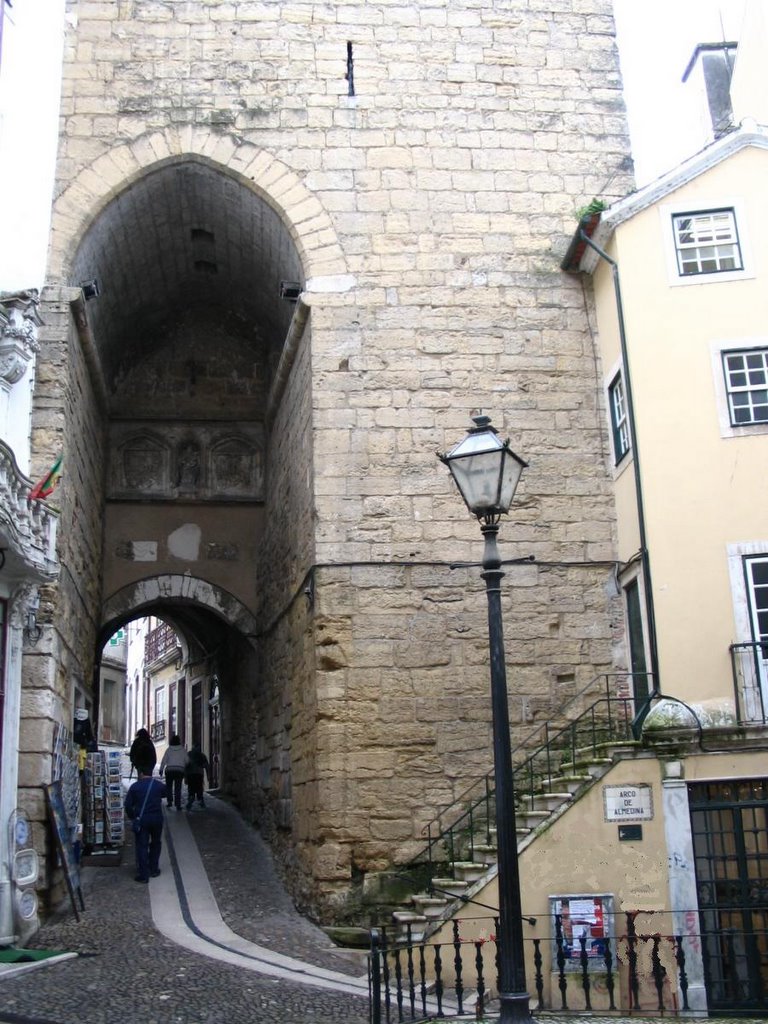 Almedina Gate, Coimbra
By now the rain had started in earnest. Steep, wet cobbled streets, too much traffic, absolutely no sign of the promised violin or accordion players, not a whiff of a burnt sprout, and much unsightly graffiti which did little to endear the town to us. However, once discovered, the old University complex is indeed beautiful. Through the ornate, flamboyant, renaissance gateway, the Porta Férreia, we found a wide cobbled courtyard with several beautiful doorways, one in Manueline style and another, ornate baroque entrance leading to the old library – a total contrast with the unpleasant architecture of the adjoining new University library.
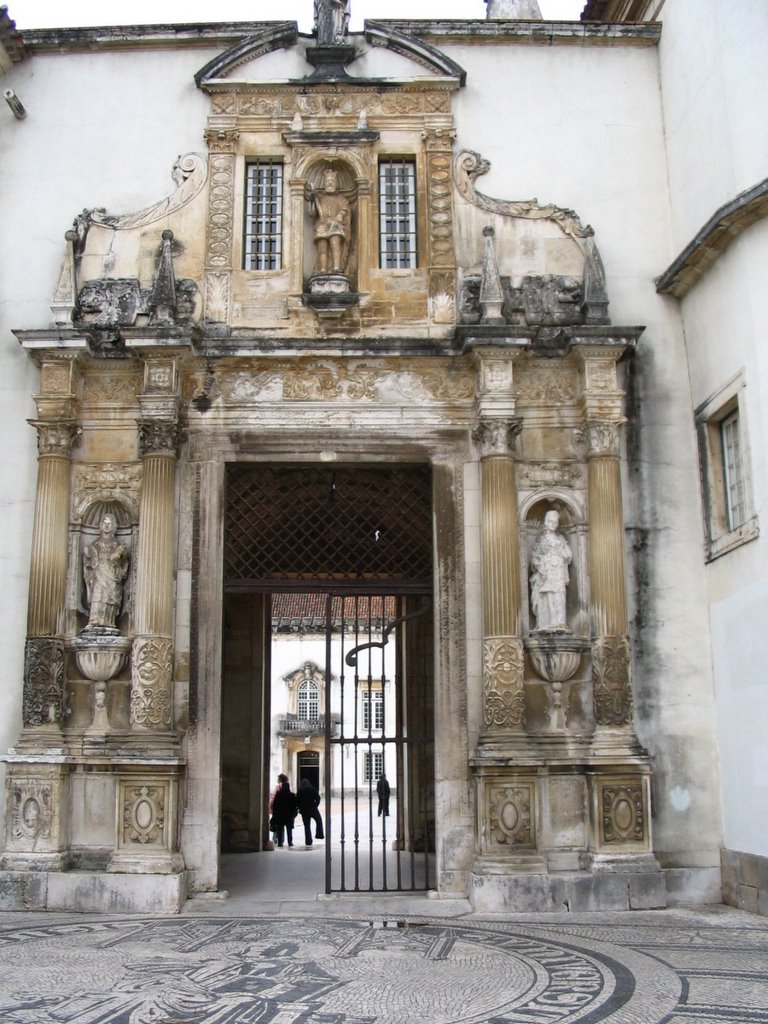 Porta Férreia, University, Coimbra
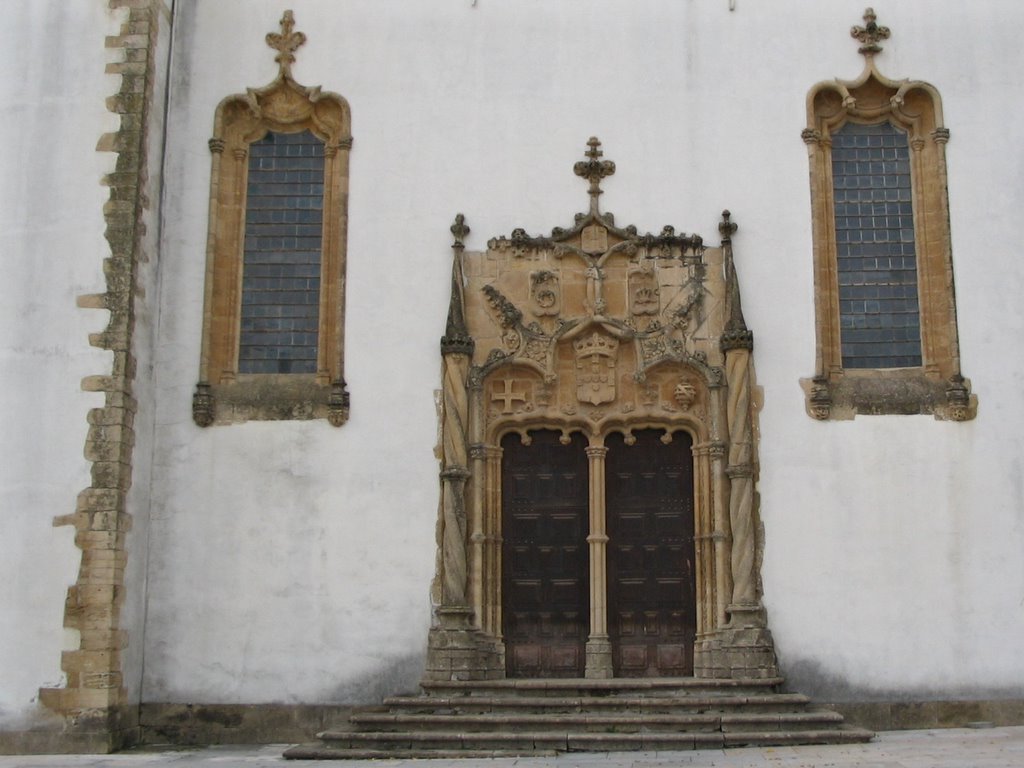 Manueline doorway to São Miguel Chapel, Coimbra
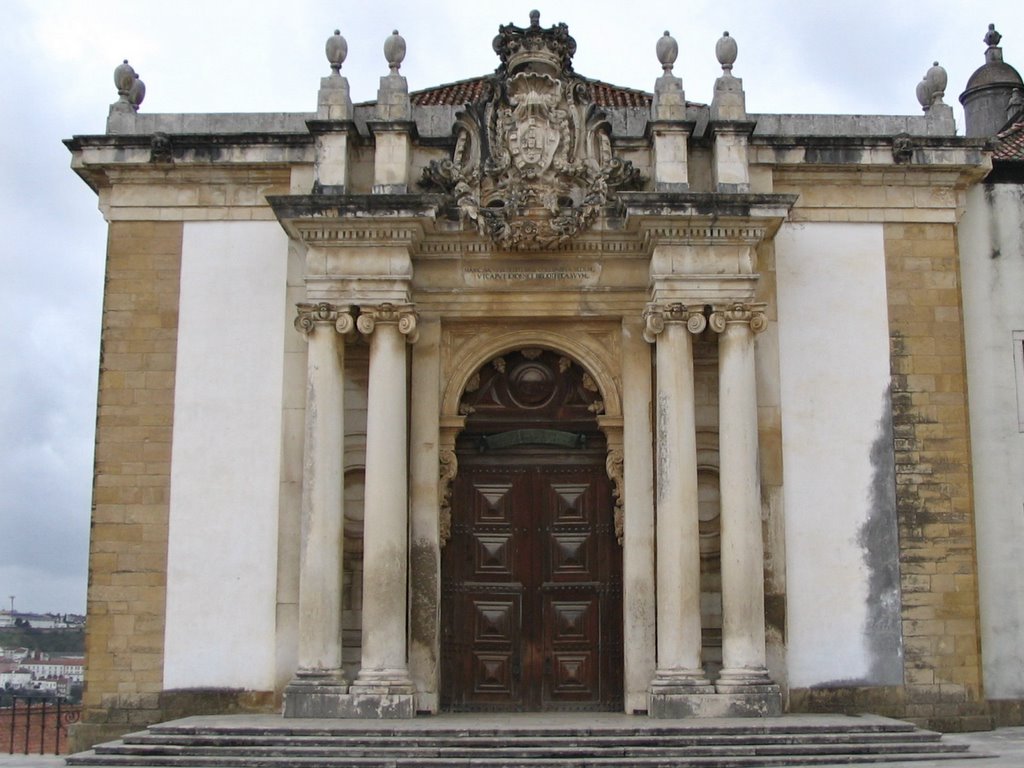 Doorway to the old University Library (Bibliotheca Joanina), Coimbra
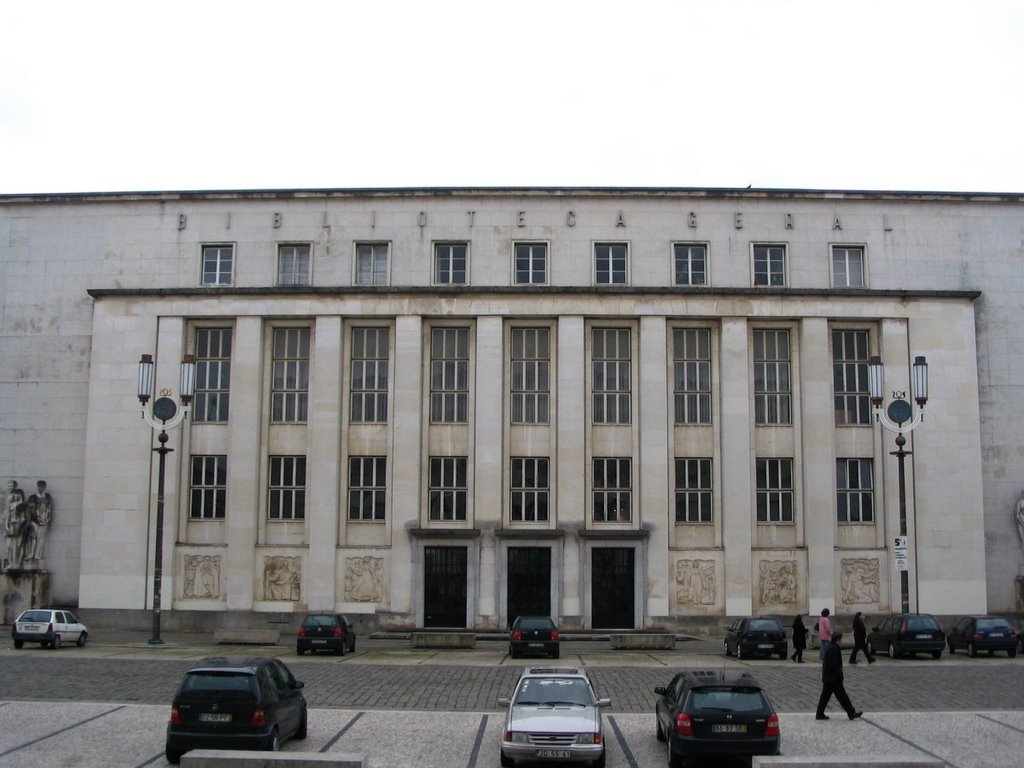 New University Library, Coimbra
The old library or Biblioteca Joanina was built between 1717 and 1728 in a spectacular Baroque style, its three rooms glittering with gold and the ceilings covered in trompe l’oeil paintings. The ornate bookshelves made the rows of books seem insignificant – almost an afterthought – although the library contains some 250,000 ancient tomes, mainly on law, philosophy and theology. Next to the Library the Capela de São Miguel, with its Manueline doorway was a delightful bright mixture of gilt woodwork, tiled walls and a ceiling in a rococo Chinoiserie design. Its highly decorated organ occupied a prominent position on the north wall.
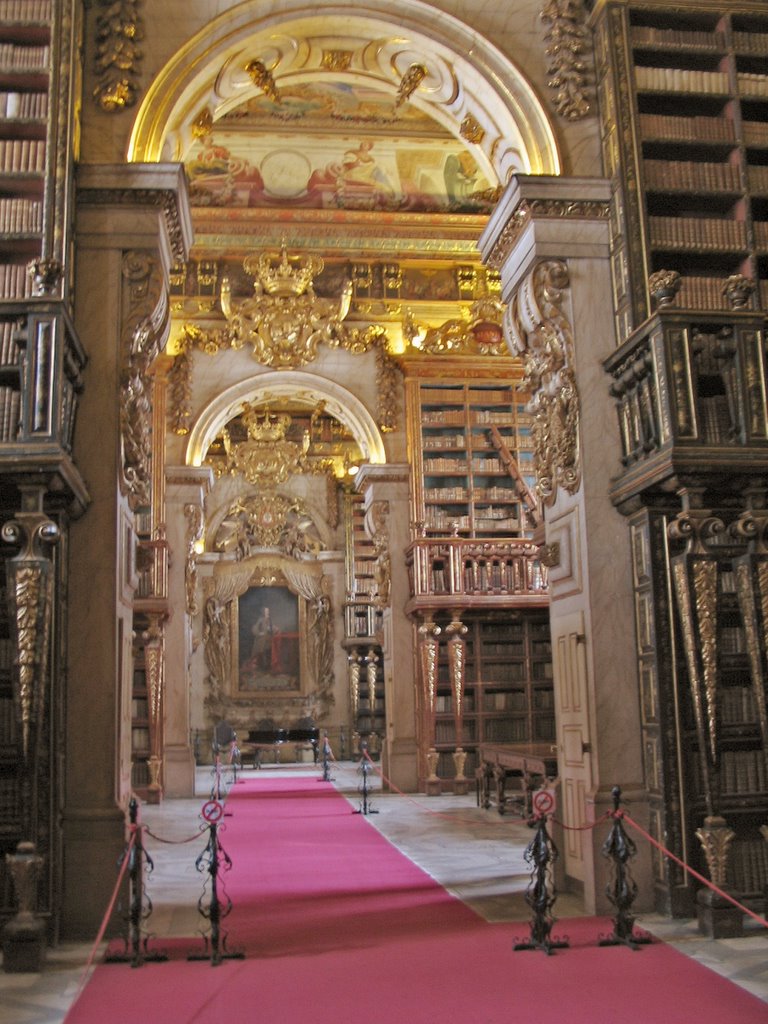 Interior of Biblioteca Joanina, University of Coimbra
 Interior of Capela de São Miguel, University of Coimbra
 Interior of Capela de São Miguel, University of Coimbra
In the corner of the large square was the clock-tower, baroque in style and built between 1728 and 1733 from which led the Via Latina, an 18th century colonnaded walk with access to the main university halls through a ceremonial entrance in the middle. These halls formed part of the medieval royal palace which was converted and used by the University from the 16th century. They included the Sala Grande dos Actos, where the major ceremonies were held, and the Sala do Exame Privado, where the private examinations for doctorates took place. Both were lined with full-length portraits, the former of Kings of Portugal and the latter of stern and self-important rectors of the University.
 Clock tower and Via Latina, University of Coimbra
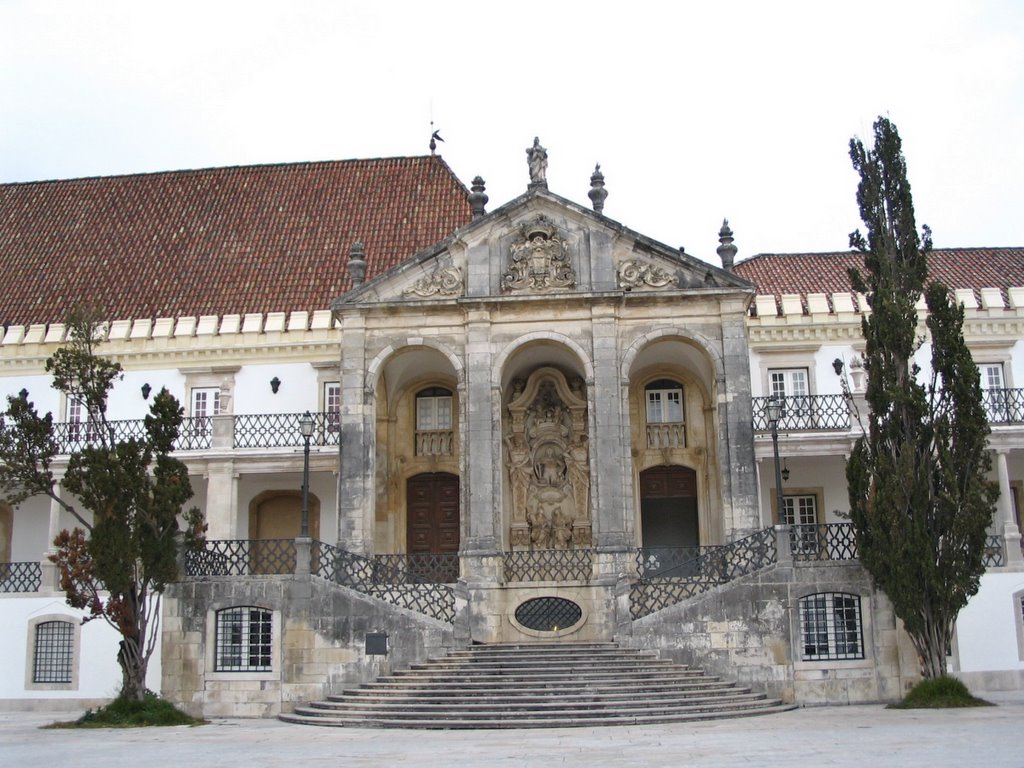 Entrance to the ceremonial halls, University of Coimbra
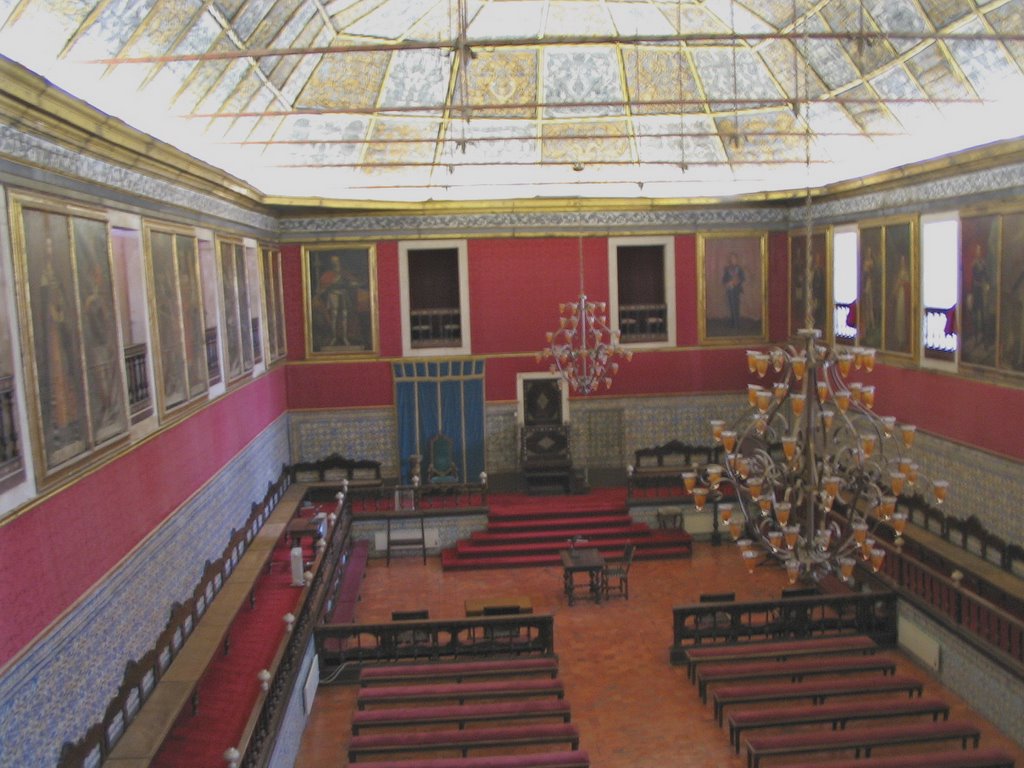 Sala Grande dos Actos, University of Coimbra
 Sala do Exame Privado, University of Coimbra
We decided to become students again for the day, so joined the short queue at the students’ bar for dish of the day and a glass of beer – a very pleasant way to avoid the rain. We also discovered we could wander around the corridors and explore the lecture theatres, lined with 17th century tiles, without being questioned.
Later, in the University complex, we visited the new Cathedral where a baptism was taking place The 16th century building itself was highly ornate with a baroque reredos and side chapels. Far too ornate, heavy and dusty for our tastes.
 New Cathedral, Coimbra
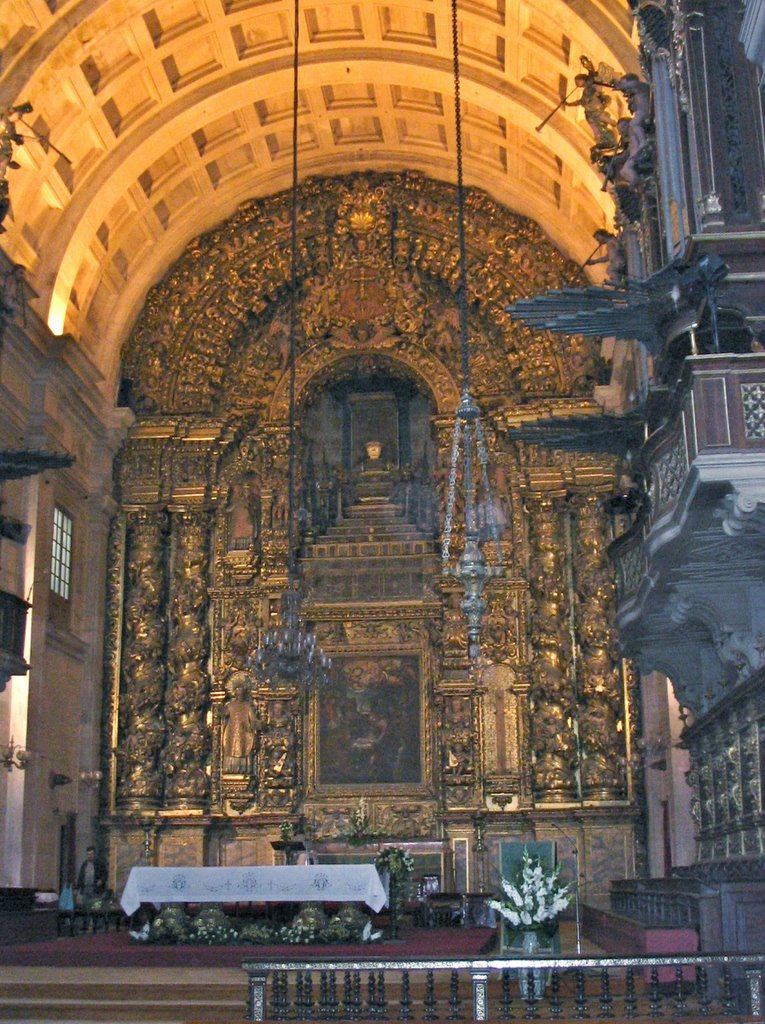 Reredos, New Cathedral, Coimbra
What did appeal however was the old cathedral. This was constructed during the 12th century in Romanesque style on the outside with battlements reminiscent of a Moorish fortress and within was delicate, exuberant gothic. This was just as elaborate as the reredos of the new Cathedral but far more delicate, without its heavy, oppressive gold columns, cherubs and overweight statues. Here too there were lovely cloisters with delightful carved capitals and orange trees growing in the central garden.
 Old Cathedral, Coimbra
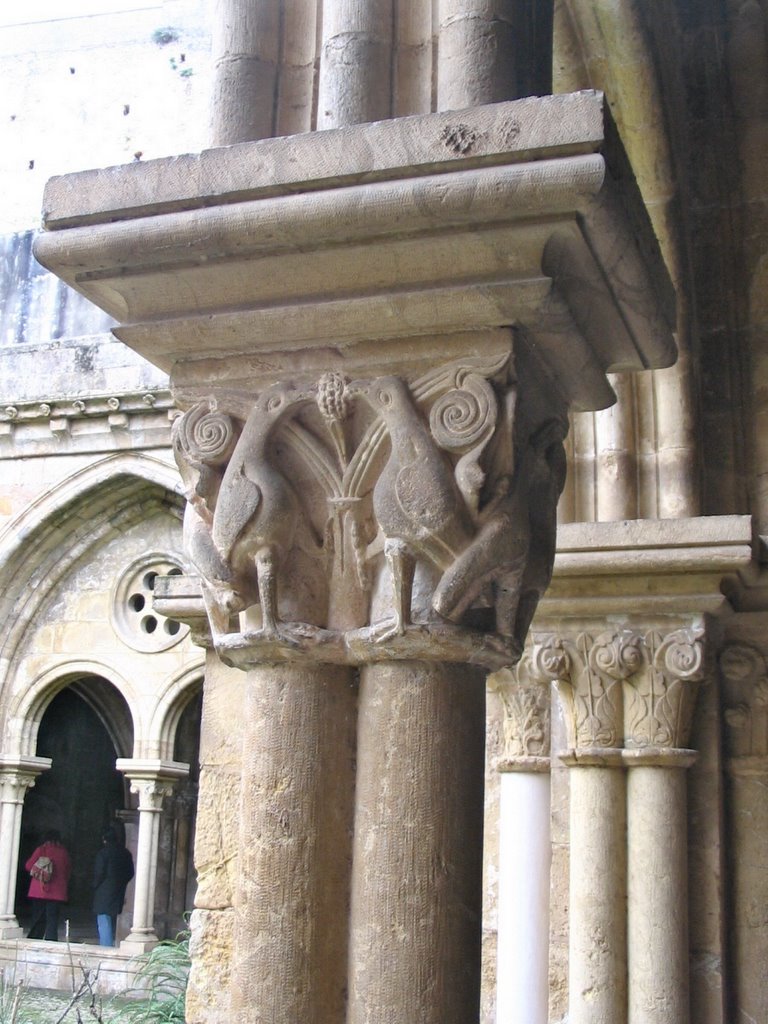 Carved capital in cloisters of the Old Cathedral, Coimbra
 Cloisters of the Old Cathedral, Coimbra
Finally we visited the church of Santa Cruz with its ornate façade and triumphal arch befitting a church which houses the tombs of several of the kings of Portugal. Originally an Augustinian foundation of the 12th century, it was extensively altered in the 16th and 17th centuries but we were unable to explore it fully as a service was in progress. In fact services were in progress in several churches this Saturday afternoon. The shops had closed at noon and people seemed anxious to clear their religious obligations so that they had Sunday free.
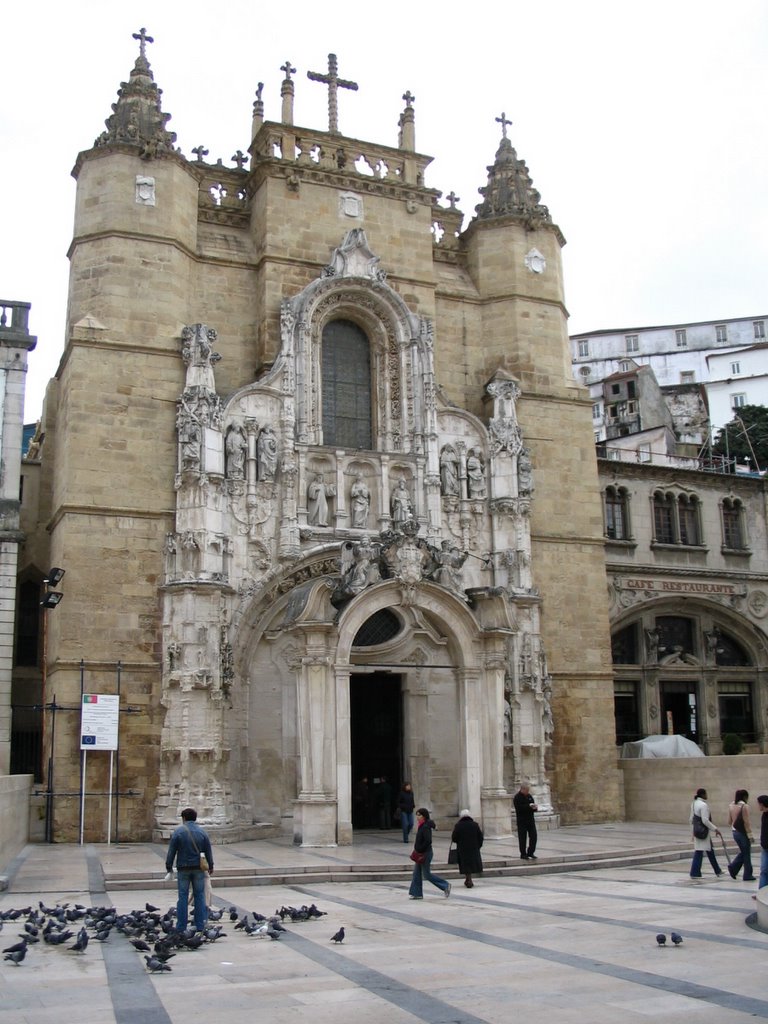 Santa Cruz, Coimbra
As the guidebook said, a wealth of wonderful treasures from the ecclesiastical and academic worlds, but in the rain it failed to appeal as much as it otherwise might have done. Jill certainly felt “churched out” and wouldn’t have minded too much if she didn’t see another cherub, saint, crucifix or pieta for several days. With Ian as a travelling companion however, this is highly improbable!
As we waited in the evening gloom at the bus stop where we had been assured we would find a bus back to the campsite the rain began to fall in real earnest, bouncing up from the pavements and flooding the roads. After thirty minutes it began to dawn on us that life was not going to be all “ha ha, hee hee” and a long wet walk was likely. It turned out the bus we needed stopped at lunch time on Saturdays. (As Jill says, the campsite is doomed to fail.)
So we walked for well over an hour through teeming rain along beside waterlogged highways with spray thrown over us from passing traffic. Roads were awash with water and we literally had to wade through flooded streets. We were soaked to the skin and at one point a violent cloudburst caused a river of water to rush downhill, flooding our feet as we sought shelter at a bus stop. During our entire journey we didn’t see a single bus! It was actually rather frightening, particularly as we watched vehicles aquaplaning on the nearby bend and realised we were vulnerable to skids standing in the bus shelter.
When we reached Modestine she stood amidst a chaos of red mud, a warm and welcome refuge on a dark, very wet and windy night. We changed into dry clothes, deposited everything we had been wearing into the campsite washing machine and left our soaking shoes in the shower room. This morning all our footwear was still soaking so Jill has been driving north with bare feet having nothing at all dry to wear!
Voltaire’s character Pangloss refers to Coimbra as a seat of learning in Candide - we cannot recall the context off-hand. However, Jill remains to be convinced that Coimbra is really worth the effort.
Today we woke to the ceaseless sound of rain that has continued pretty well all day. Gathering our still wet clothes and shoes into a bag we eventually left the campsite, with no regrets, and headed north along flooded and potholed roads. Portugal generally seems a pleasant, green country of small towns and villages but since we have left the Algarve it does seem to have been very cold and wet. We have been told today that Europe has experienced its worst winter for 20 years so we are probably just unfortunate to be confined to a tiny camping car in such poor weather conditions.
The roads of Portugal though are not good. Even in dry weather road markings are effaced and signing unclear. In the wet it is most unpleasant and road markings and numberings very difficult to follow. Fortunately for us there was little traffic, except around Porto where the roads really were very busy. Once north of the city though, we reached Viana de Castelo very easily and soon found this campsite which is part of a chain across Portugal. That means they are all similar – none have hot water for washing clothes, people or dishes; the showers are freezing with marble floors and open to the elements; all the facilities – shop, bar, leisure room, swimming pool, television etc. are closed and there no loo seats or toilet paper.
“What doesn’t kill you make you stronger” as our daughter Kate told us when she travelled round India. We’ve never encountered snakes, cockroaches or drug dealers but we are beginning to discover, in a mild way, just what she meant.
On the positive side, with the exception of a couple from Wales, we have the campsite to ourselves and this evening, in a brief lull in the rain, we took a walk to the local beach which is magnificent with rolling white crested breakers curling their way in from the Atlantic onto a beach of endless dunes covered in tussocks of marram grass and tiny purple flowers. Beyond, on the far side of the estuary of the river Lima, crossed by a bridge designed by Gustave Eiffel, the town of Viana de Castelo can be seen and awaits exploration.
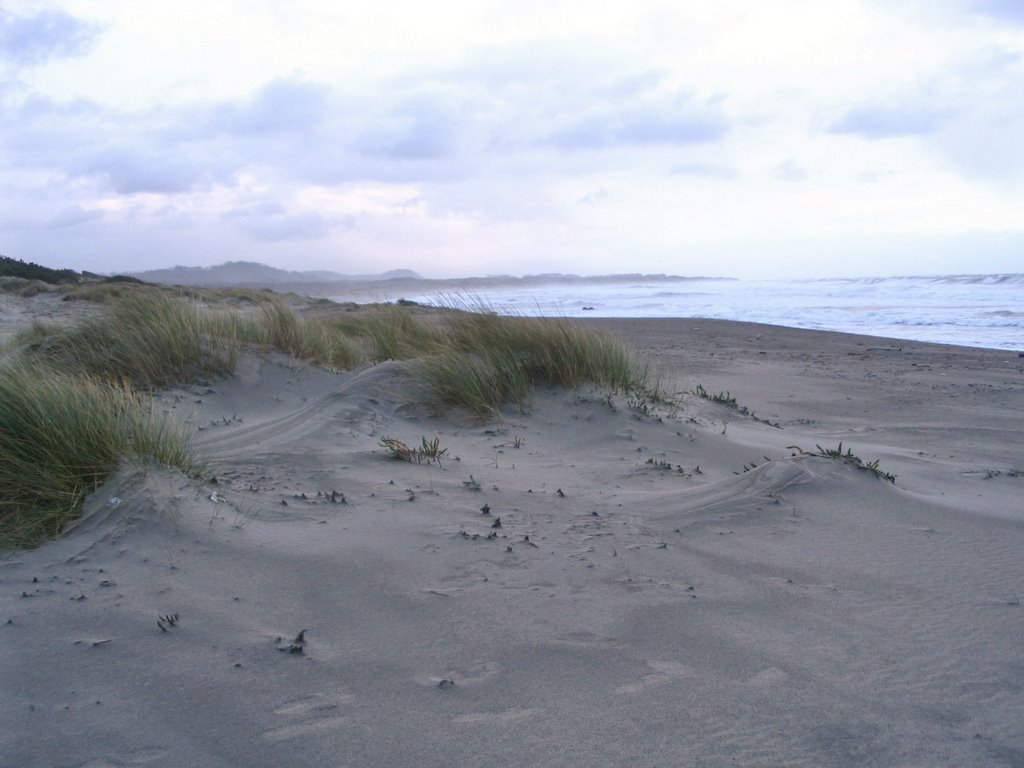 Praia do Cabedelo, Viana do Castelo
 Praia do Cabedelo, Viana do Castelo

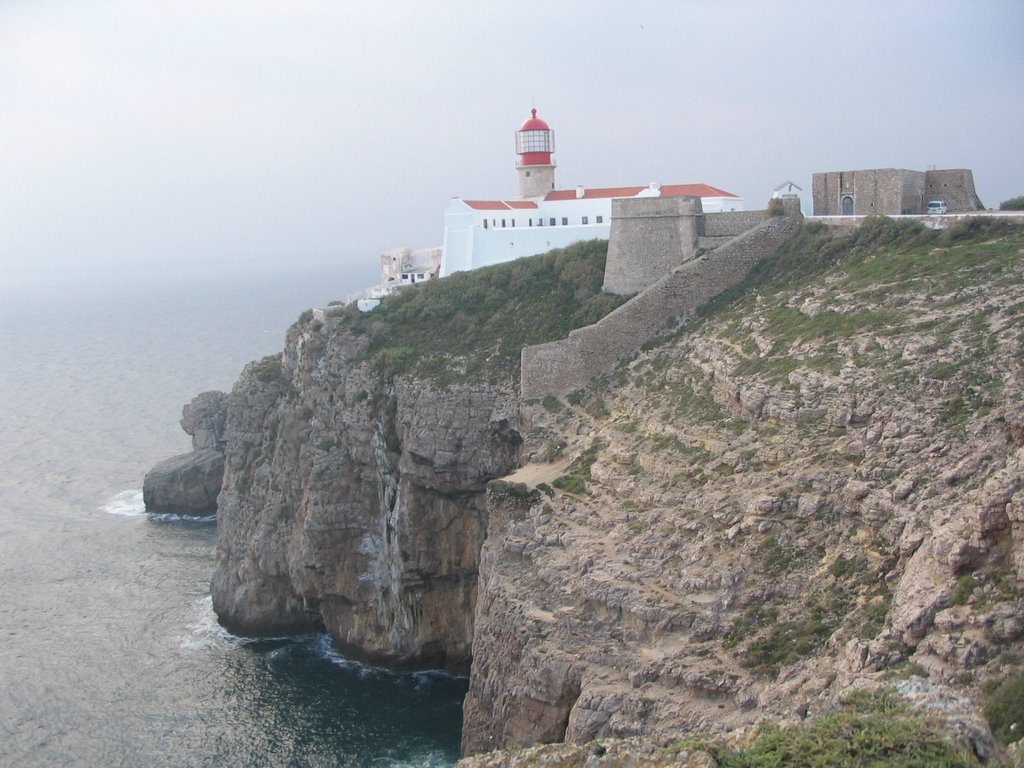 Cabo de São Vicente
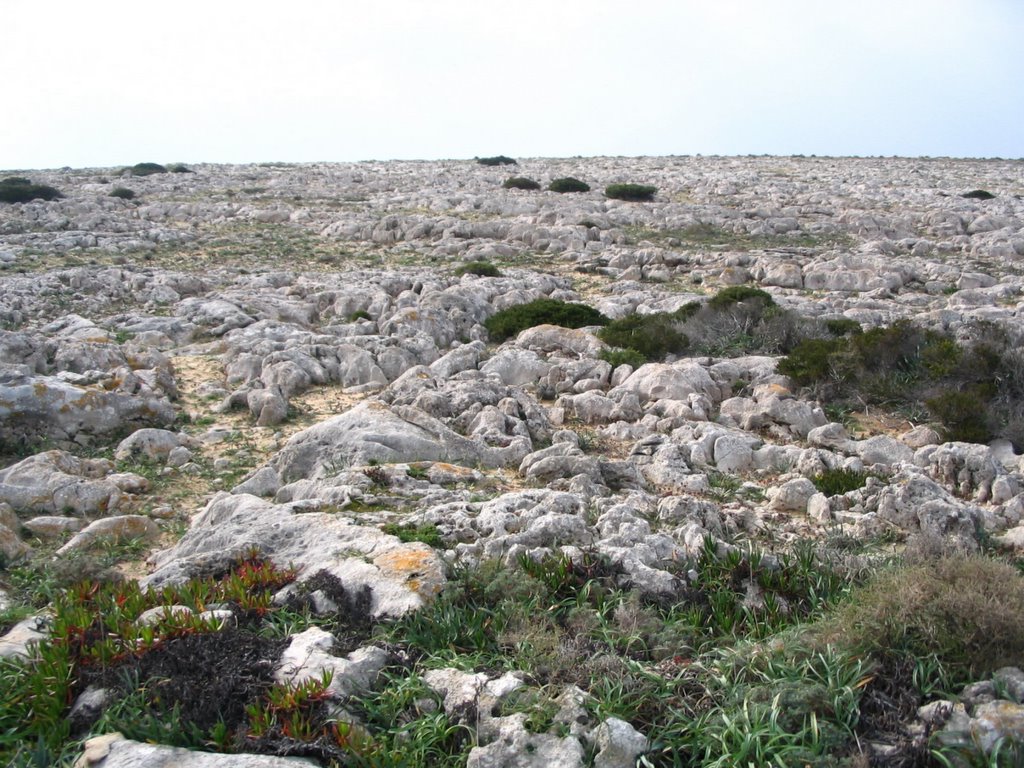 Cliff tops, Cabo de São Vicente
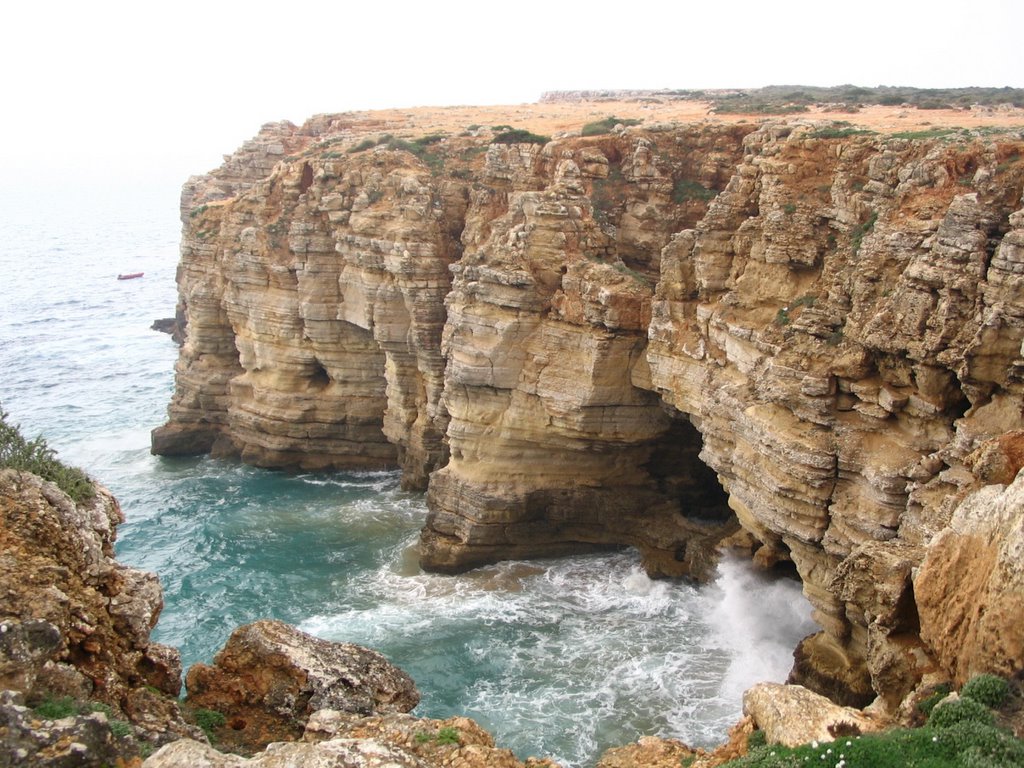 Atlantic waves pound the cliffs, Cabo de São Vicente
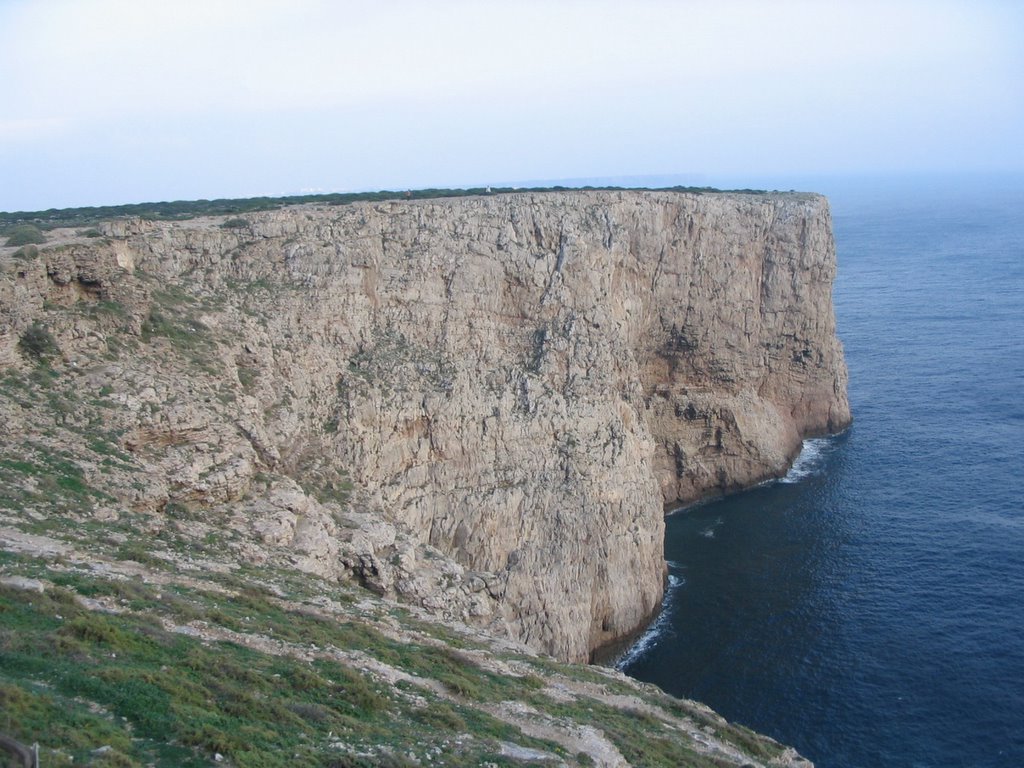 Sheer cliffs drop 40 metres to the sea, Cabo de São Vicente
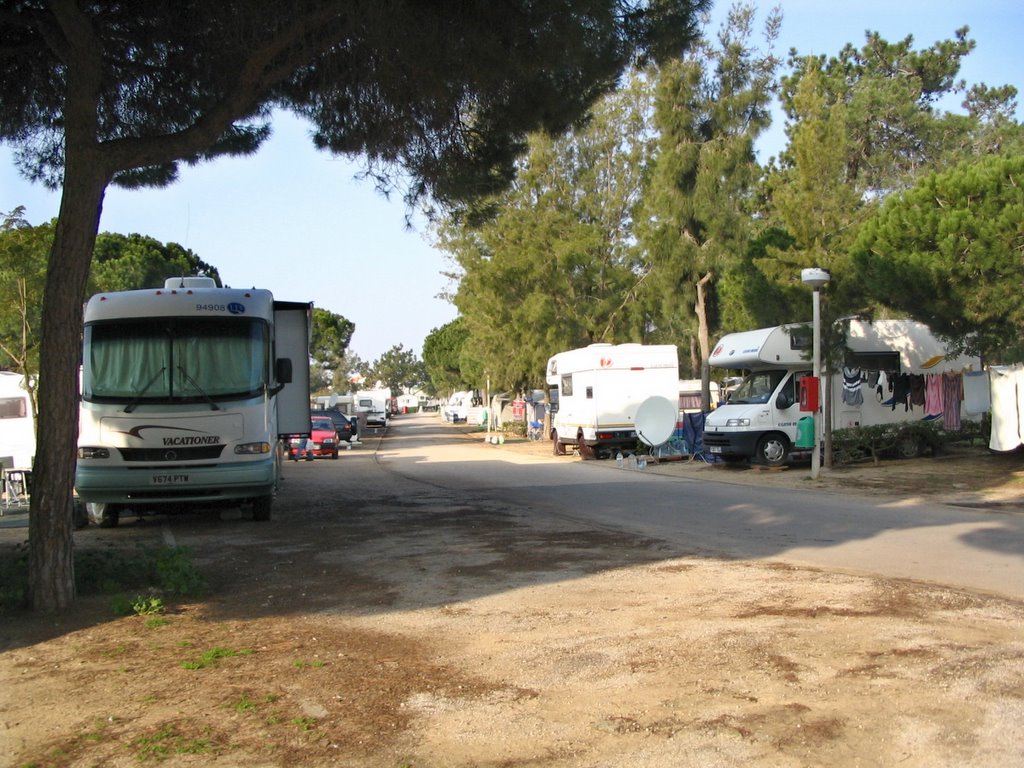 Typical campsite with over-wintering migrants from northern Europe, Olhão
 Sagres viewed from the fort
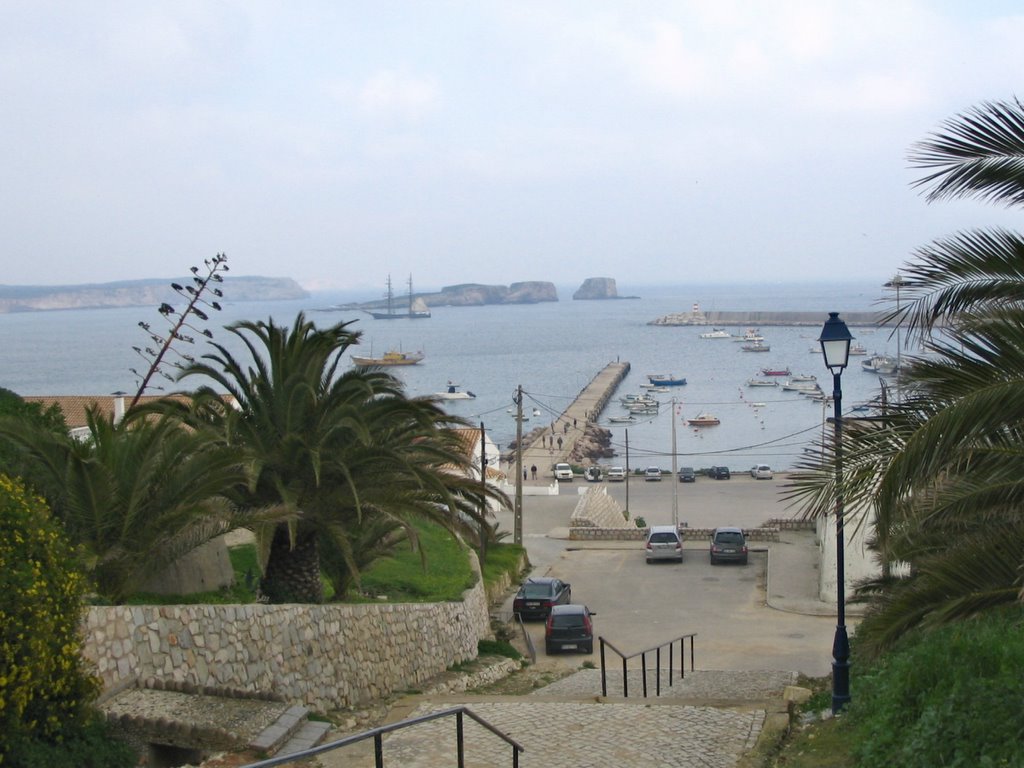 The harbour, Sagres
 Fishing boats and offshore islands, Sagres
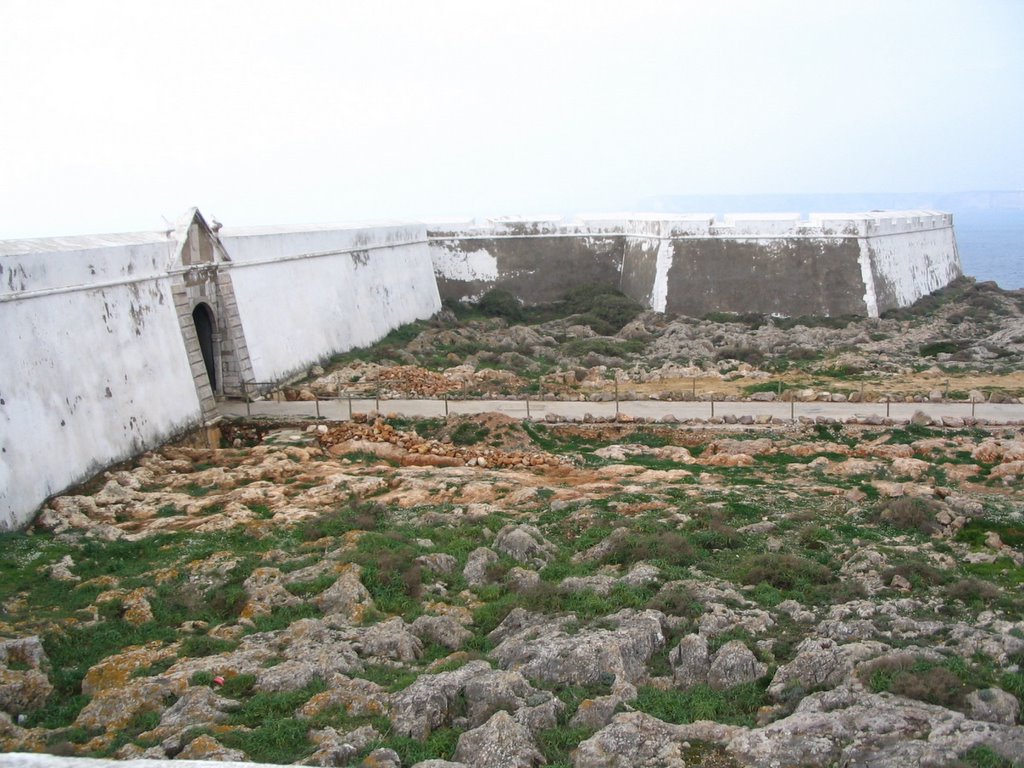 Fort used by Henry the Navigator as a training school for mariners, Sagres
 15th century compass rose, Sagres
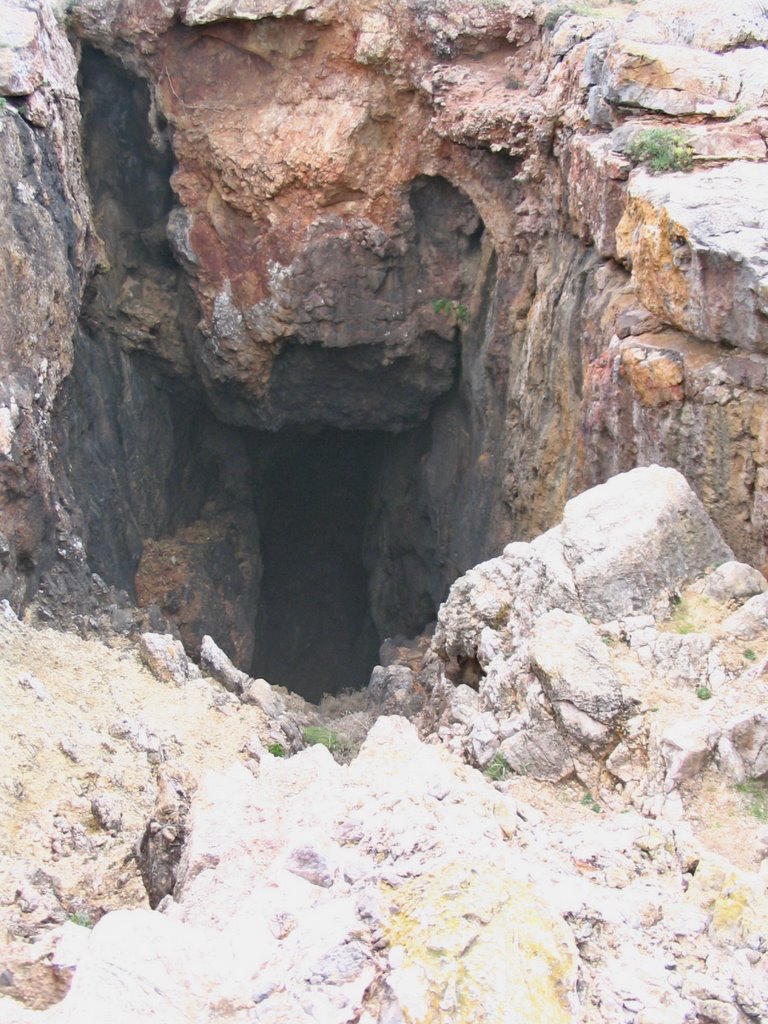 Blow hole on the cliffs, Sagres
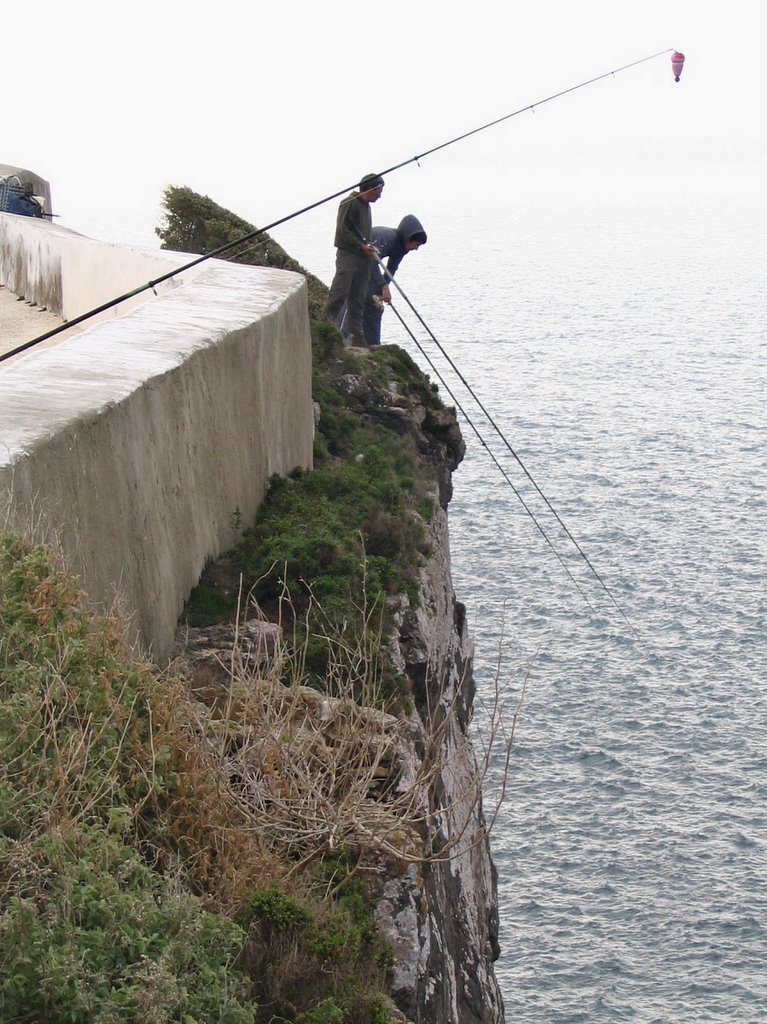 Fishermen above, Sagres
 Fishermen below, Cabo de São Vicente
 Cliff top and sandy beach near Lagos, Algarve
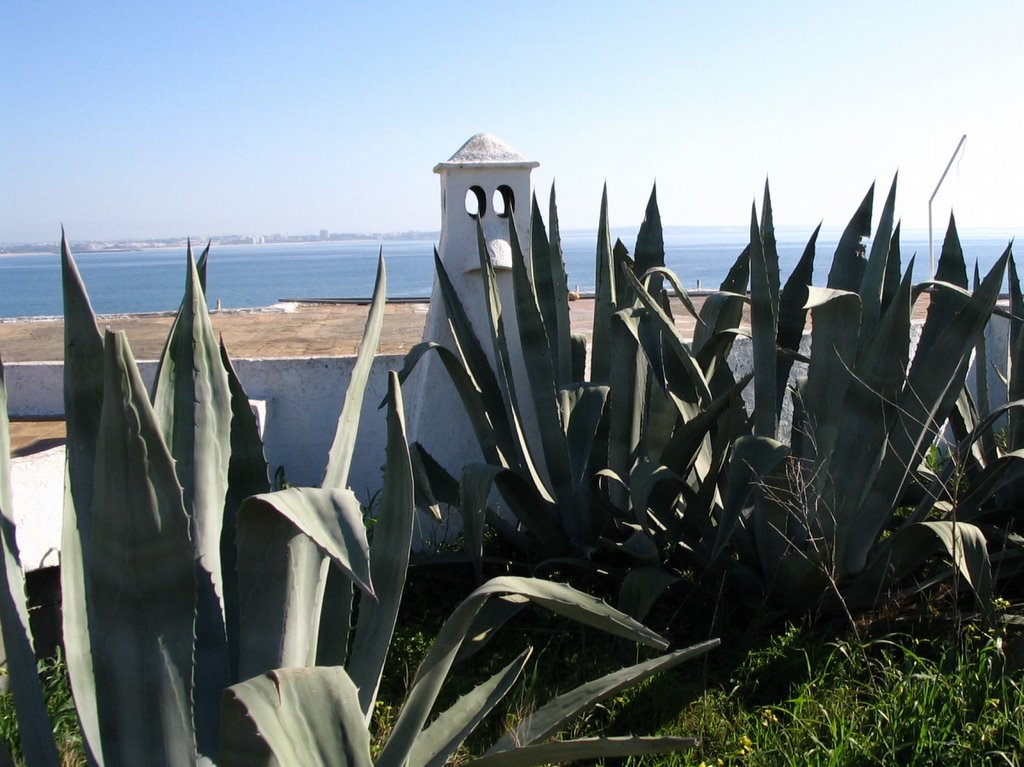 Aloe, aloe, aloe! Inquisitive chimney, Lagos, Algarve
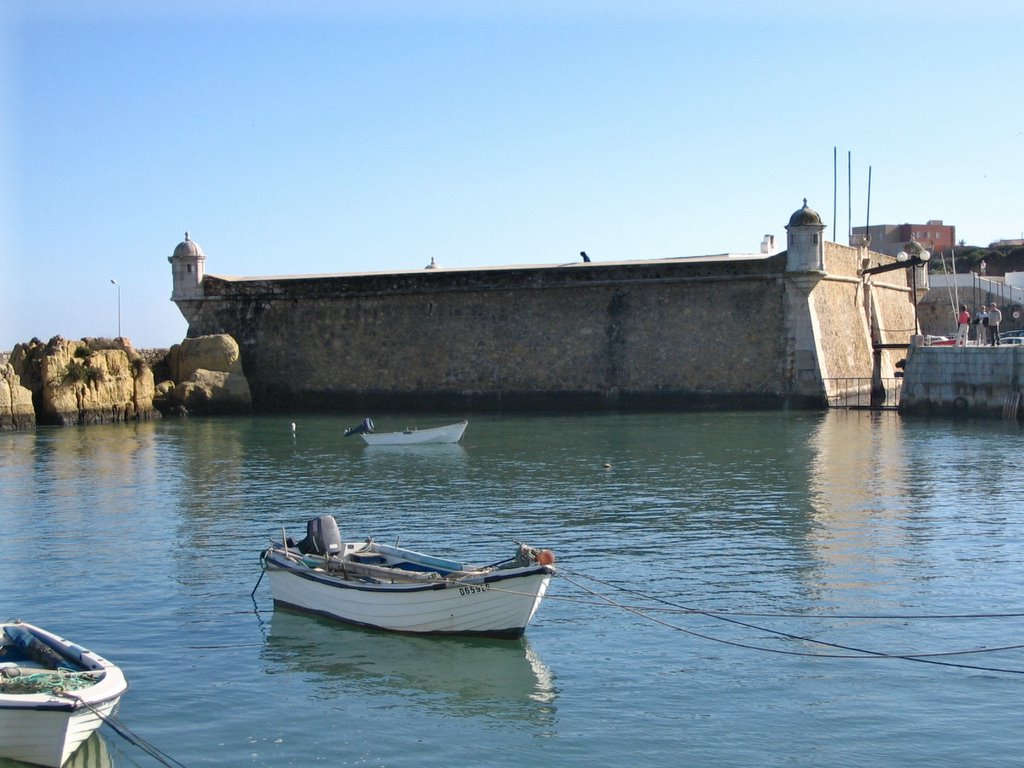 17th century fort, Lagos, Algarve
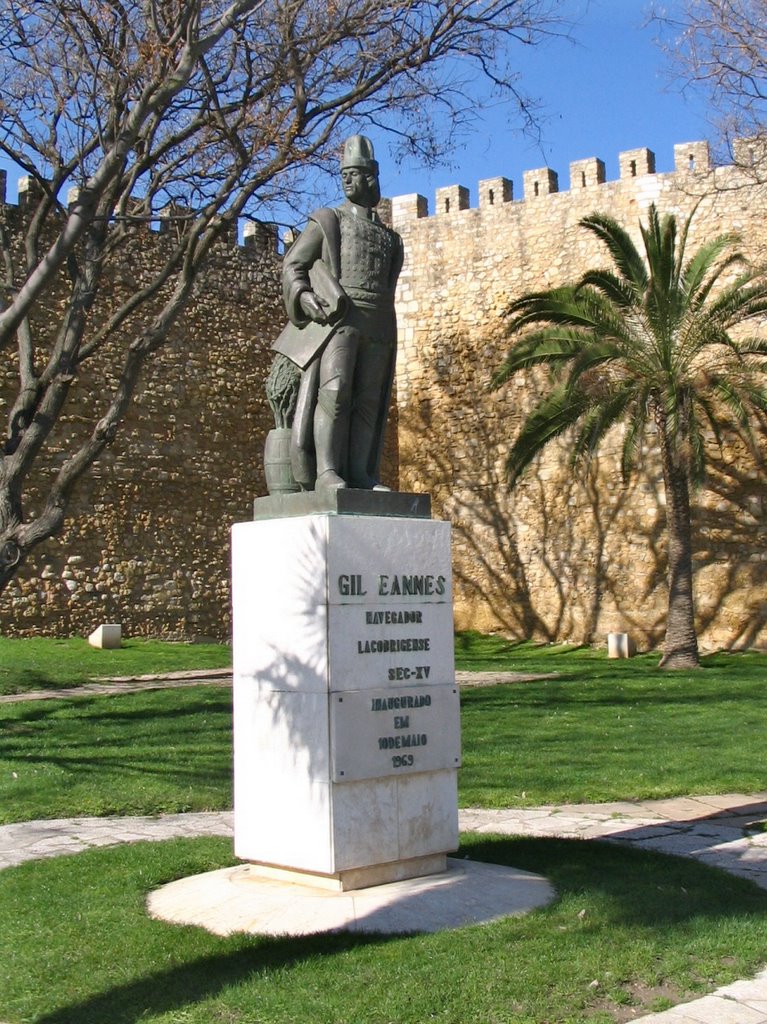 Gil Eannes, Lagos, Algarve
 King Sebastian of Portugal, Lagos, Algarve
 Moorish style gateway – Porta de São Gonçalo, Lagos, Algarve
 Coat of Arms and city walls, Lagos, Algarve
 City gateway, Lagos, Algarve
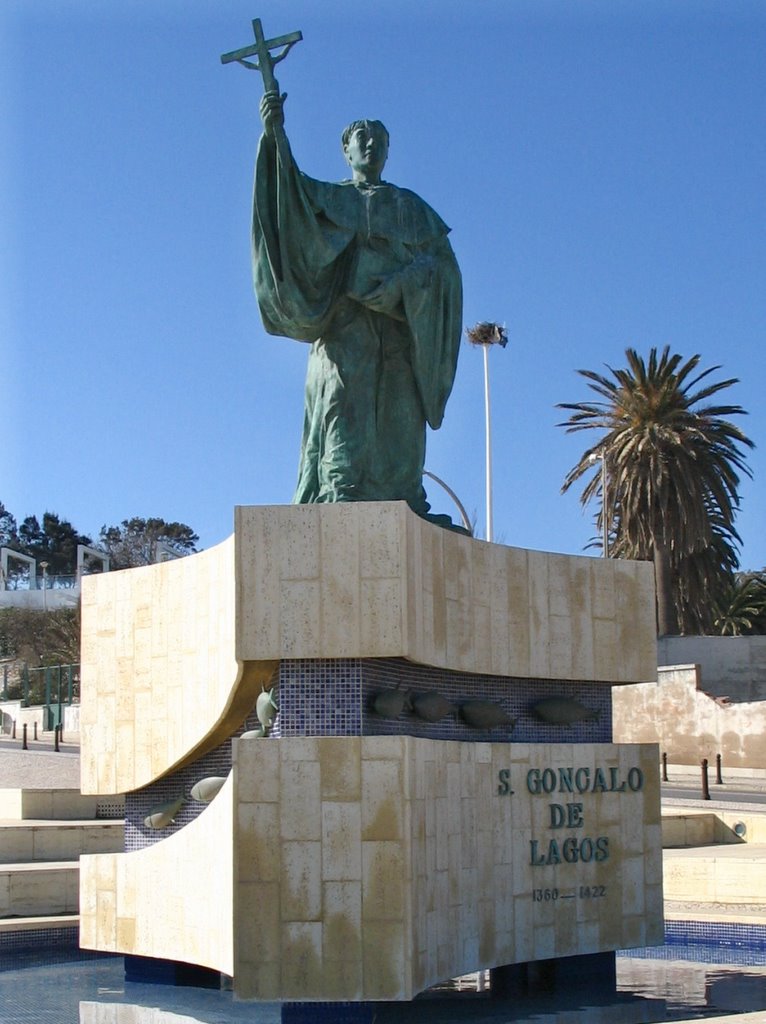 São Gonçalo, Lagos, Algarve
 Baroque church, Lagos, Algarve
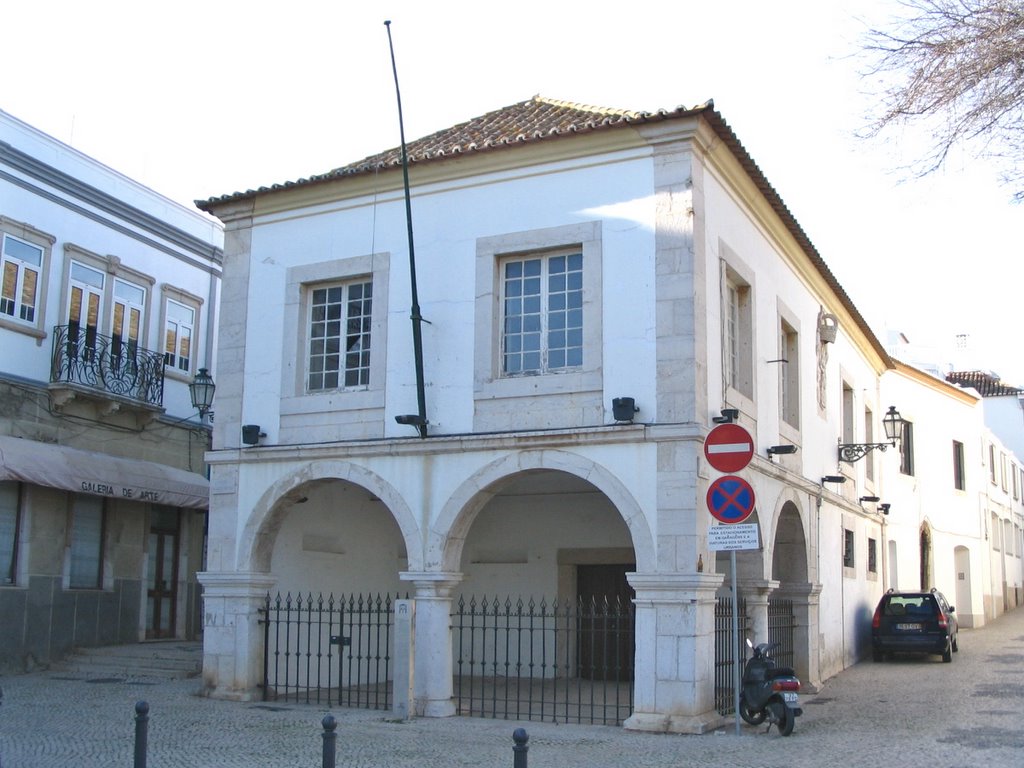 Former slave market, Lagos, Algarve
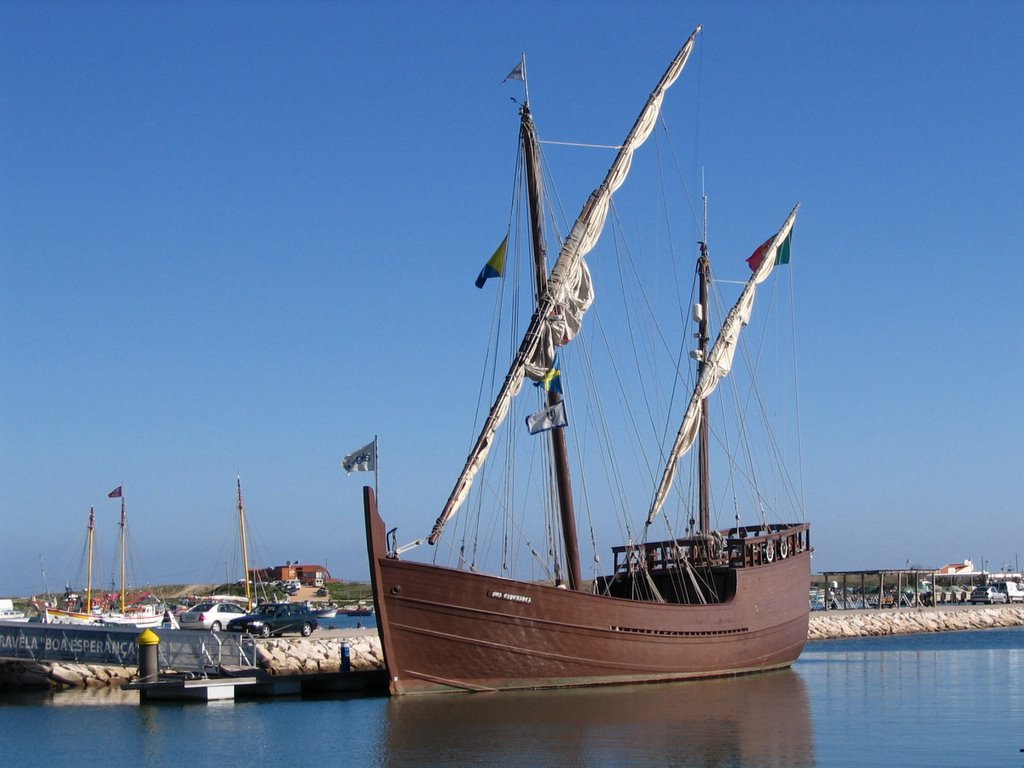 Portuguese caravel, Lagos, Algarve
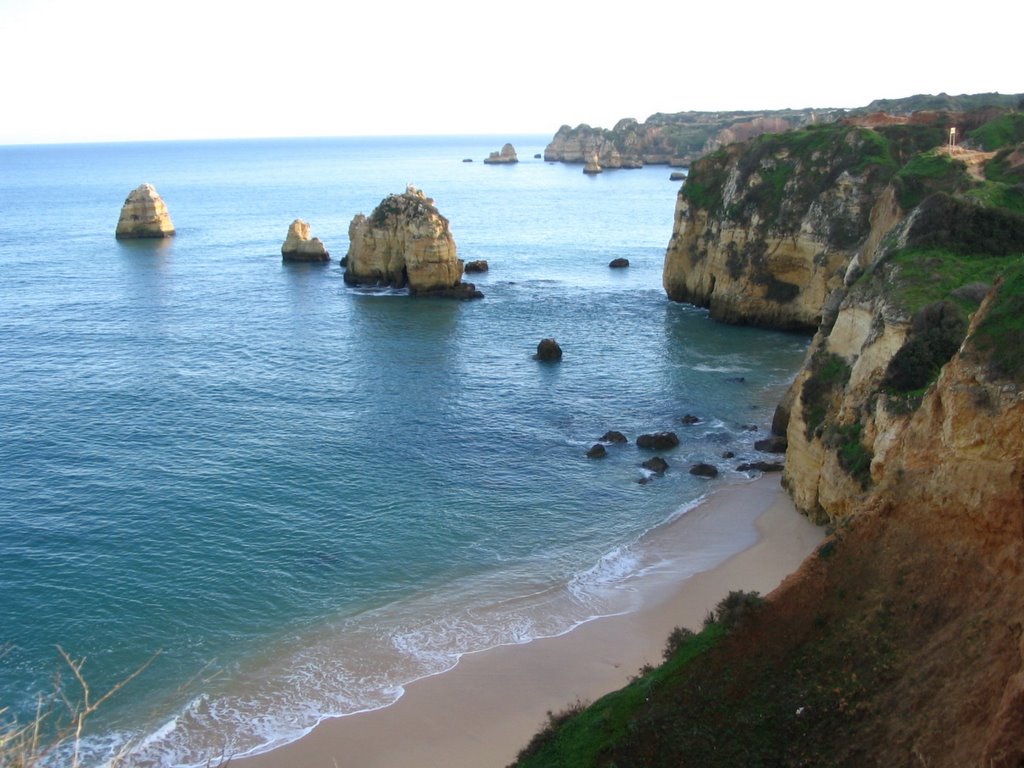 Returning across the cliffs, Lagos, Algarve
 Mountain hamlet, Monchique
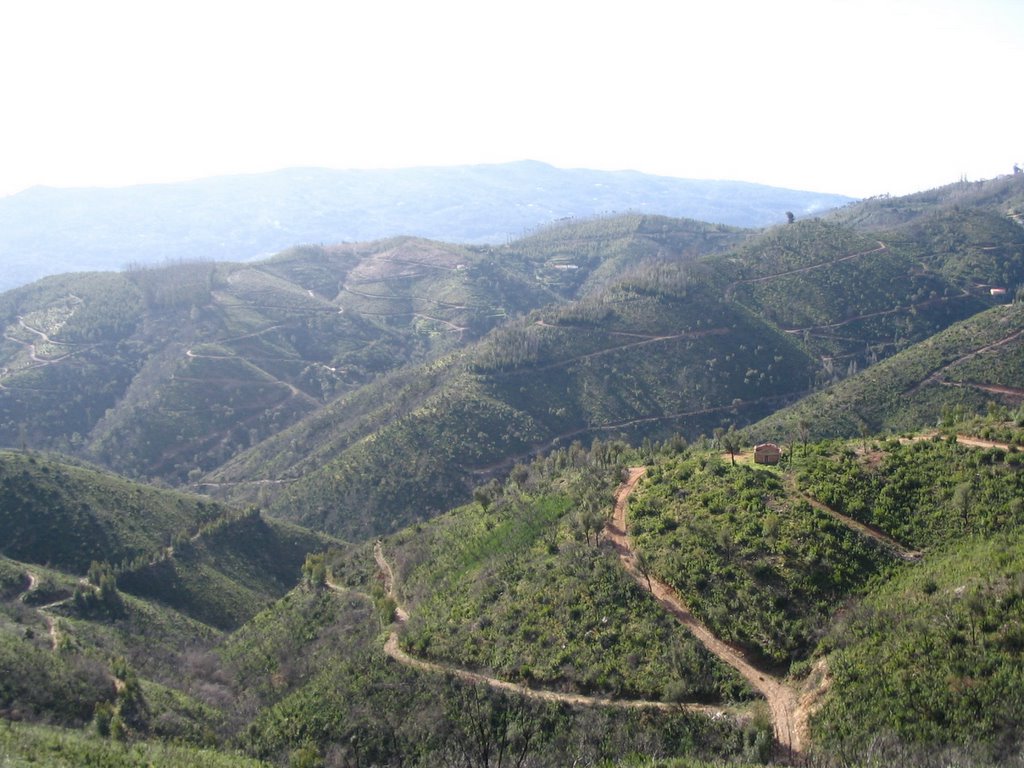 Dirt tracks out to distant hamlets, Monchique
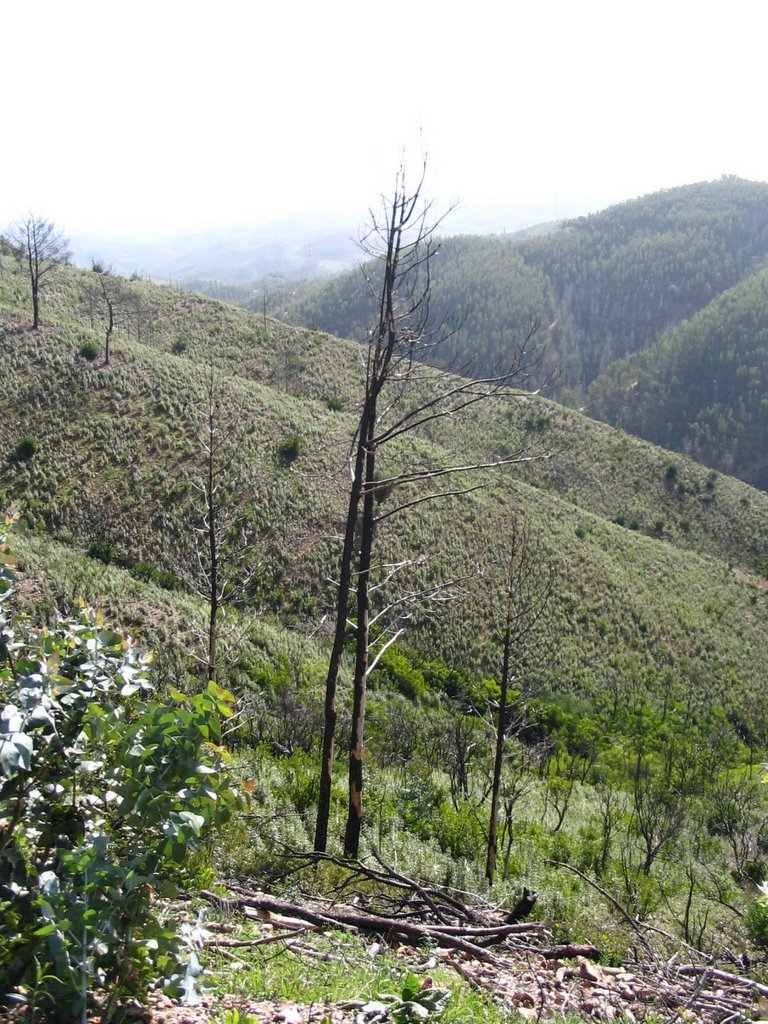 The result of forest fires, Monchique
 Colony of gregarious storks seen from the car window as we drove past
 Cathedral, Evora
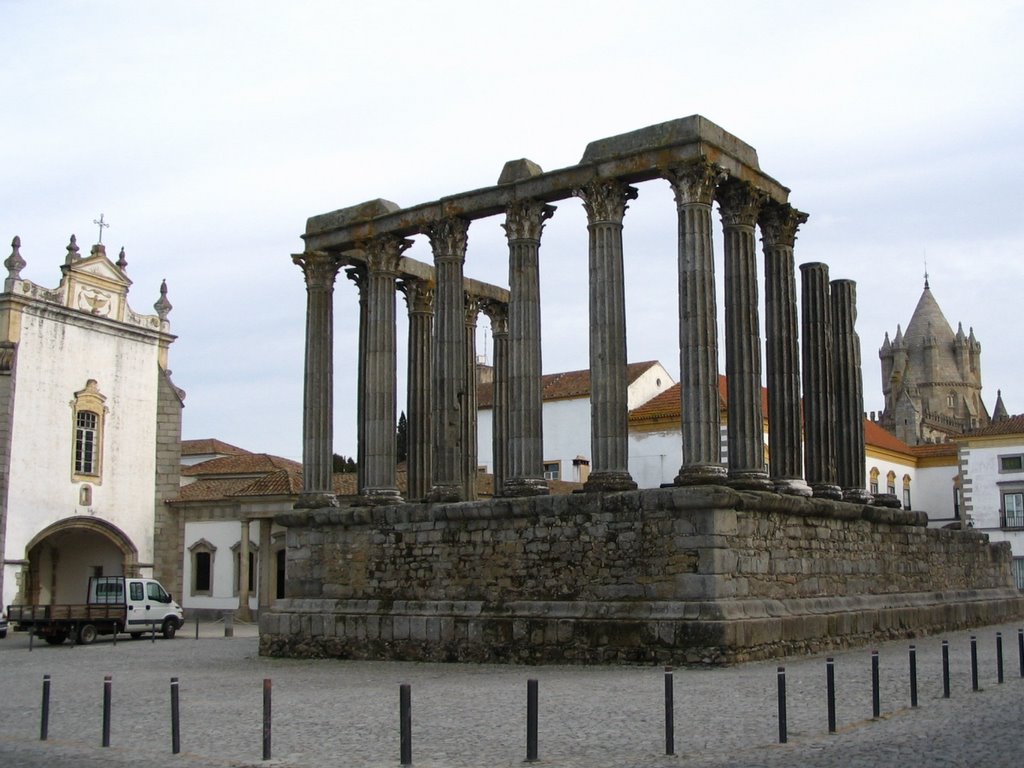 Roman temple, Evora
 Public Library, Evora
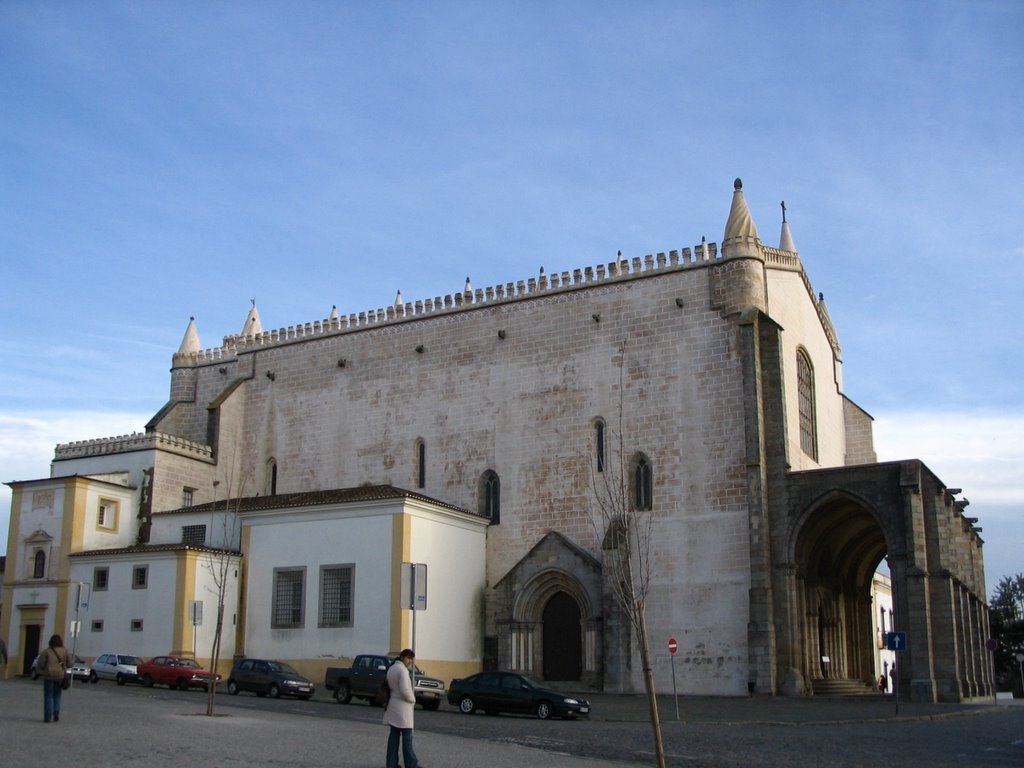 Church of São Francisco, Evora