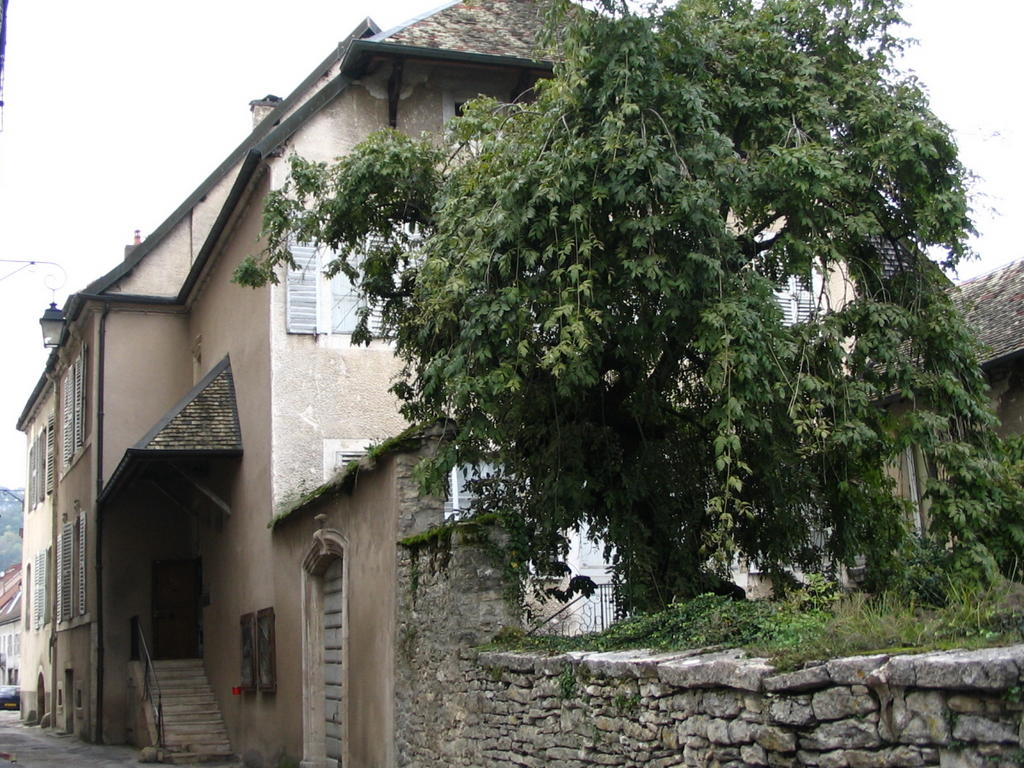
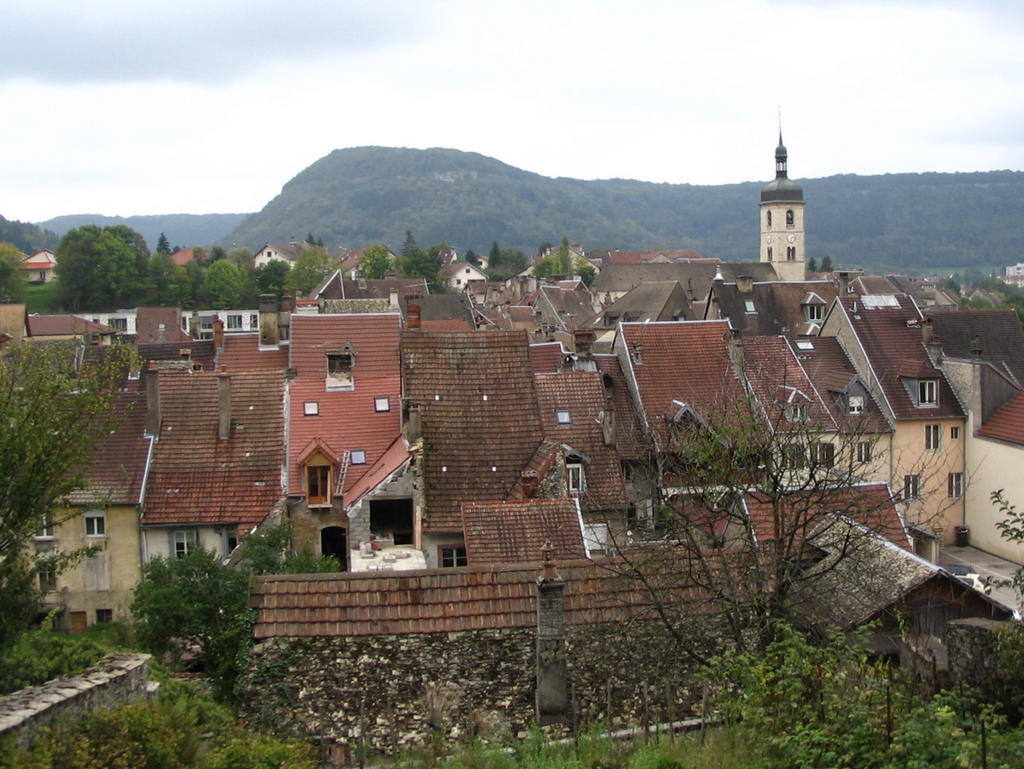
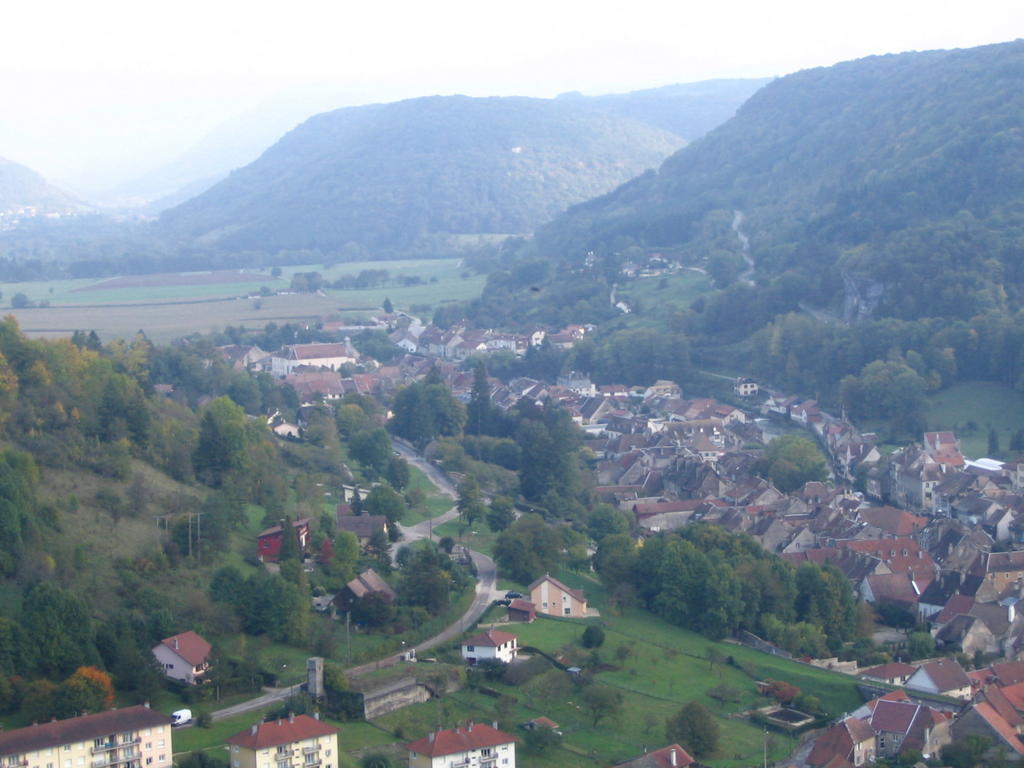
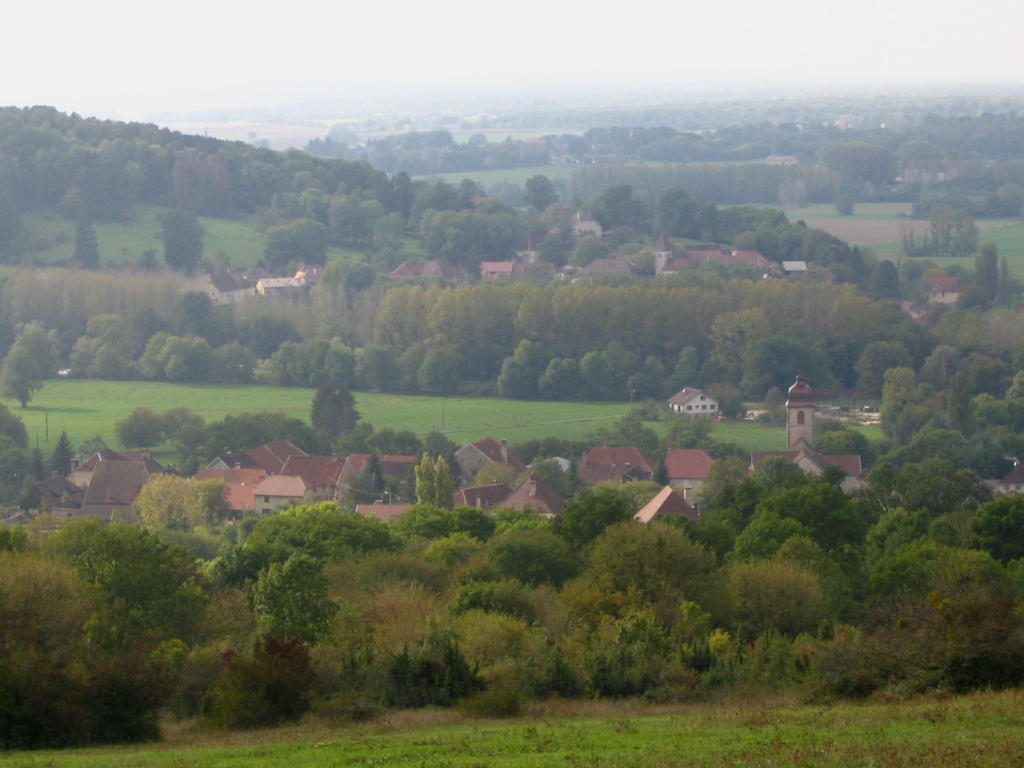
Showing posts with label Besançon. Show all posts

Back in the Jura

Sunday 2nd October 2005, Champagne-sur-Loue continued
This morning we woke refreshed. After setting the washing machine going we drove down to Arc et Senans to join the rest of the local population in the popular Sunday morning activity of shopping in the local supermarket. The rest of the day we have spent sorting ourselves out while the rain has teamed down ceaselessly. Hugues and Thibault have been over from Dôle and stopped by to ask about our visit to Germany. Otherwise, until this evening when the weather started to improve, we have been happily housebound, catching up on reading and computing. Around 5pm we took a walk to the bridge over the Loue which is now huge and very fast flowing. It seems unbelievable that just three weeks ago Jill was swimming lazily around in it. The happy holiday families have disappeared and the campsite on the river bank has now closed for the season. As we gathered fallen walnuts along the roadside we fell into conversation with a barefooted dog walker from nearby Buffard. He told us he came here from Italy thirty years ago and as he liked the cold winters and the place pleased him, he’d been here ever since.

Monday 3rd October 2005, Champagne-sur-Loue
It’s really good to spend a bit of time in the same place, watching village life and passing the time of day with the local people. Being Monday, and the holiday season officially ended, shops were closed and the countryside deserted. There is a definite chill in the air now and the leaves are turning colour. Along the roadside they have started to fall and gather in soft, wet, yellow drifts. Children here show absolutely no interest in conkers so thousands of then lie shining in the roads until crushed by passing tractors. The maize is steadily being cut for silage and the cattle are gradually being brought in from the fields. The landscape is starting to look bare and empty.

After lunch we drove to Dôle. Last time we were there, only four weeks ago, it was so hot all we could do was seek the shade. Today we shivered in our coats but it was certainly more comfortable for walking around. Dôle is a very attractive old town, filled with tiny cobbled passageways between imposing white stone buildings. There is a lovely park above the River and a very nice fountain in the main square symbolising the two main rivers of this region, the Doubs and the Loue. Of course its main claim to fame is as the birthplace of Louis Pasteur and all roads seem to lead to the museum that was his home. We still haven’t found time to visit but hopefully it won’t shut just yet for the season.
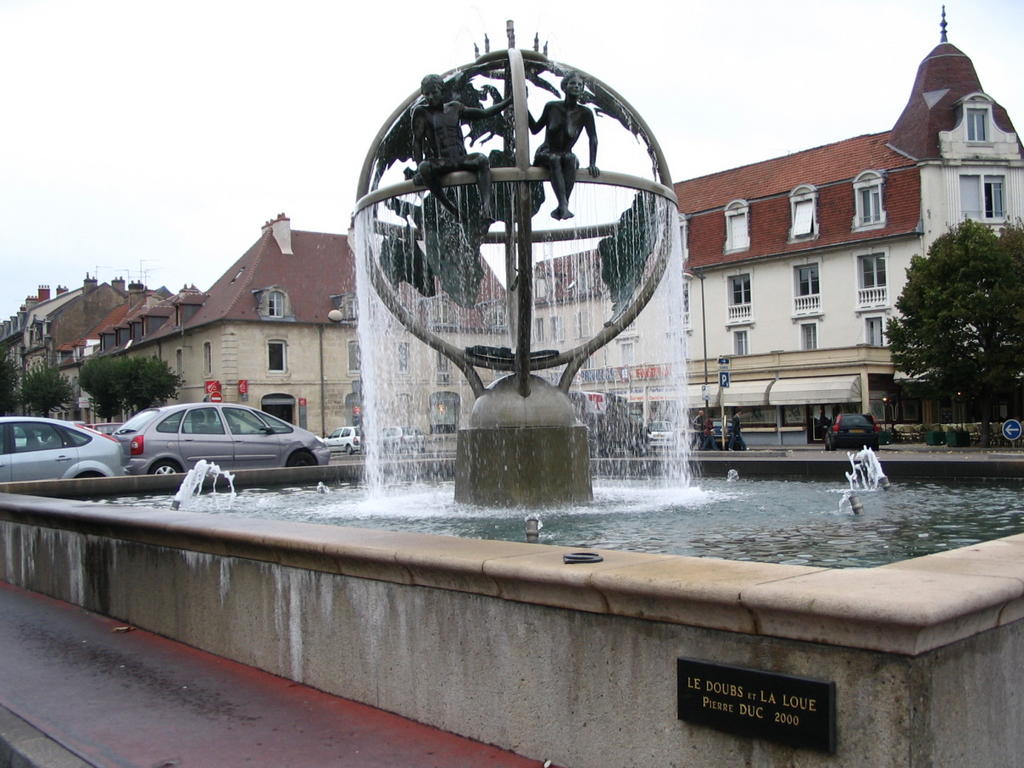
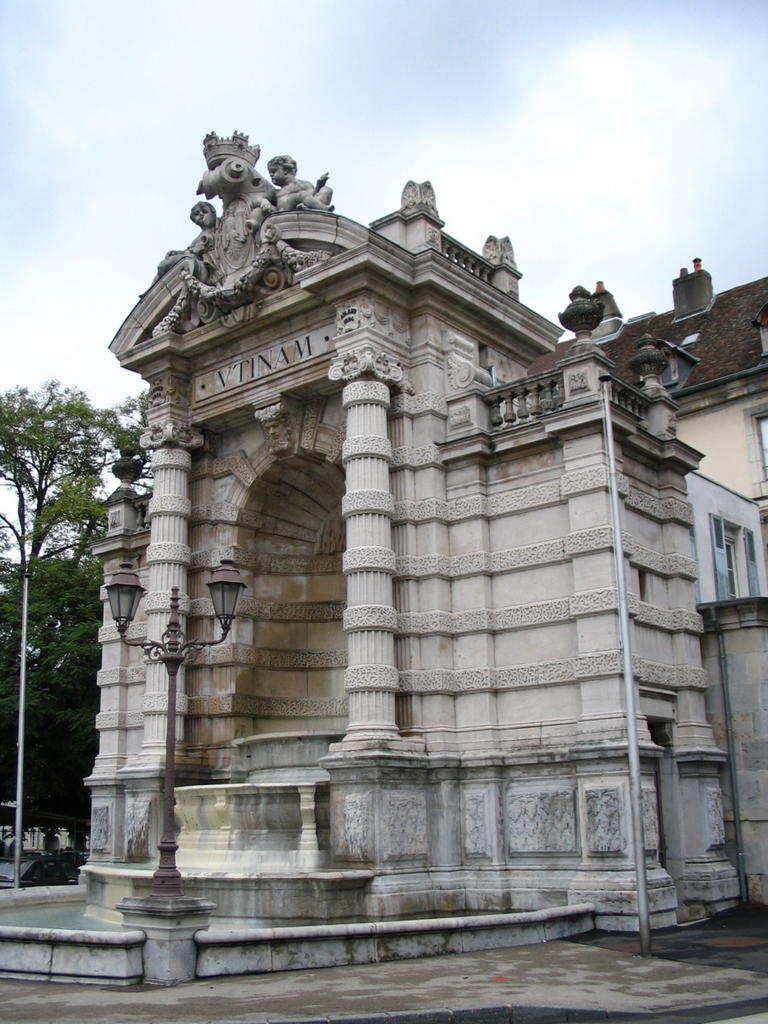
Fontaine du Doubs et de la Loue

There are more wonderful buildings in the town than can be put to good use. The beautiful former Hôtel Dieu or religious hospital with its cloistered courtyard has been turned into the town’s Médiathèque housing the public library and municipal archives. A truly stunning building for a library in a town of only 30,000 inhabitants!
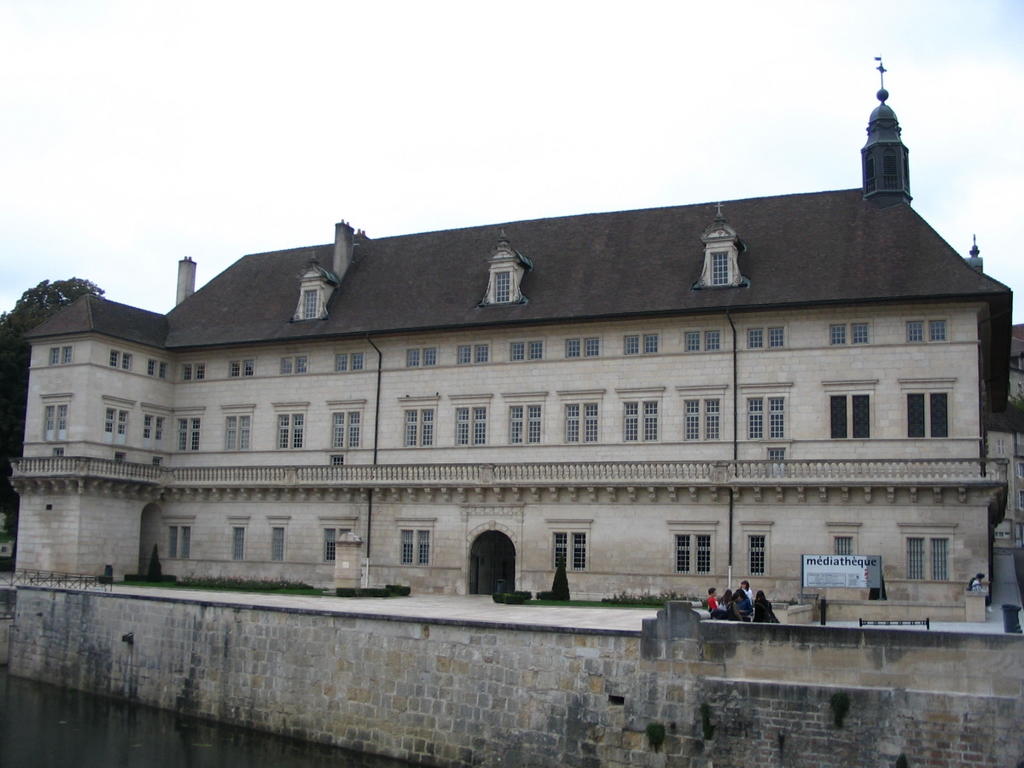
The Médiathèque in the former Hôtel Dieu
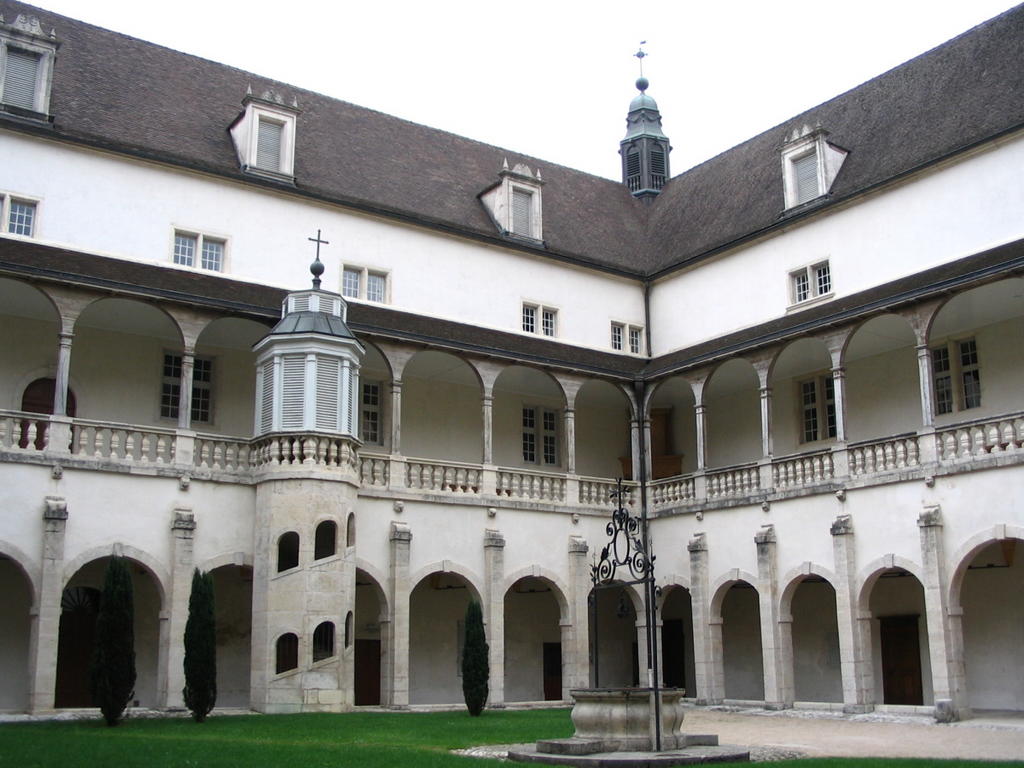
The courtyard of the Médiathèque

As dusk now falls around 6.30pm we did not linger too long, returning around the massive Forêt de Chaux rather than through the middle as it provided the chance to visit the rather dilapidated little town of Orchamps. It was here that for several years Jill’s late friend Soeur Martine was responsible for a small Dominican convent. As we had never visited her during her time here we were interested to see what it was like. It was rather a disappointment however and we continued on to Arc et Senans and home.

Tuesday 4th October 2005, Champagne-sur-Loue
Today France was enjoying one of its many strikes with at least 150 manifestions taking place across the country and Paris apparently bought to its knees with trains and buses running greatly restricted services. The most obvious effect of the strikes here was that the schools were closed. One young pupil was passing his unexpected day off helping customers in the internet shop in Salins where he seemed far more capable than the normal staff! We spent the entire morning there sorting out a backlog of emails and loading some of our recent pictures onto our website. By the time we came out everywhere had closed for lunch!

So we drove up into the hills above Salins to the Pont du Diable, (Devil’s Bridge) a narrow bridge linking the two sides of the valley across the deep ravine of a little river that later disappears into the limestone rocks to flow through subterranean caverns to reappear at the source of the River Lison.

The name of the bridge, according to local legend, relates to a pact made between the builder and the Devil that in exchange for the soul of the first person to cross, the Devil would complete the bridge overnight, otherwise he would put a curse on the bridge so that it would never be built. Once completed the builder sent the local priest across carrying the sacrament. The Devil was so horrified he jumped over the bridge into the river far below, where if you look carefully you can just see his tail disappearing into the water to this very day!!

It was certainly very impressive and quite deserted with the river flowing far below the parapet amongst the brightly coloured autumn trees. We were astonished to see a sign forbidding bungee-jumping. You’d need to be stark crazy to even consider it!

The Pont du Diable

You’d need to be stark crazy to even consider it!

The Jura is a karstic landscape. As already mentioned elsewhere, most rivers here come out of the limestone cliff face as waterfalls from subterranean water courses that may well have flowed underground for many miles and gathered water from a variety of different sources. Rivers may emerge and then disappear again, or only appear at all during periods of heavy rain or melting snow. After the recent rains the source of the River Lison is most impressive as it cascades out of the rocks in a white torrent wreathed in a haze of spray where it swirls and swishes violently along to eventually join up with the River Loue.

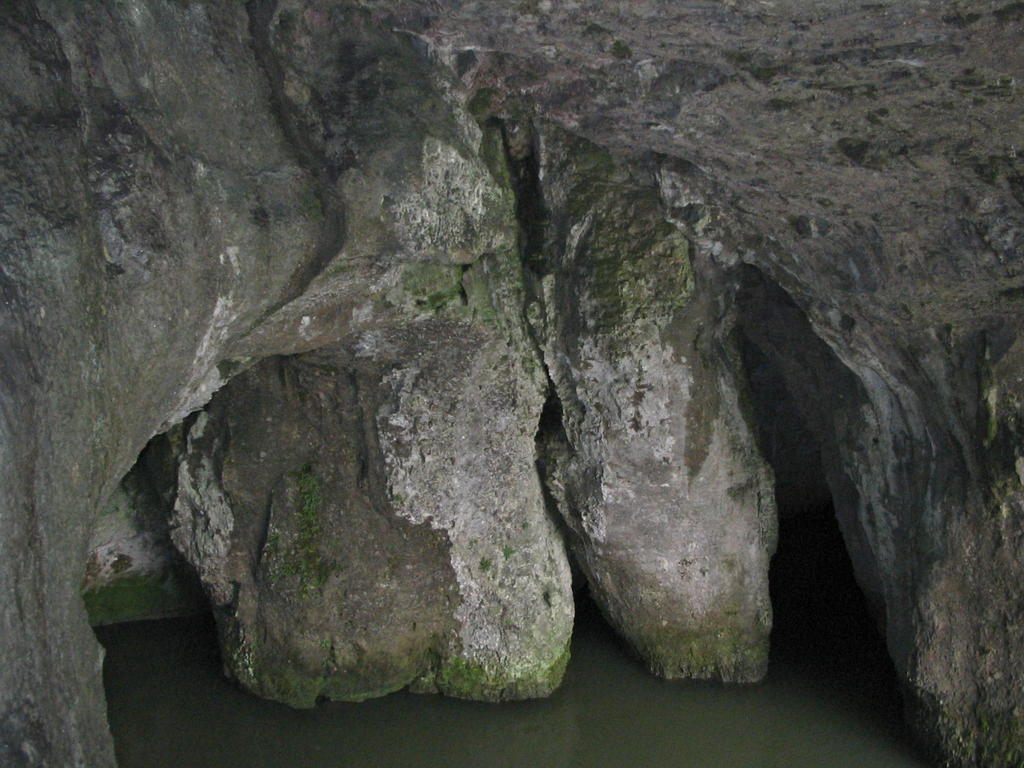
Having seen the cascade from below we scrambled up through wet woodland to the entrance to the cave and up a dark, slippery, rocky tunnel to emerge above the cascade well inside the cave where we could look down on the black waters as they flowed silently “through caverns measureless to man” to drop suddenly over the edge in a crescendo of sound. It was an awesome experience, the more so as the area was quite deserted.
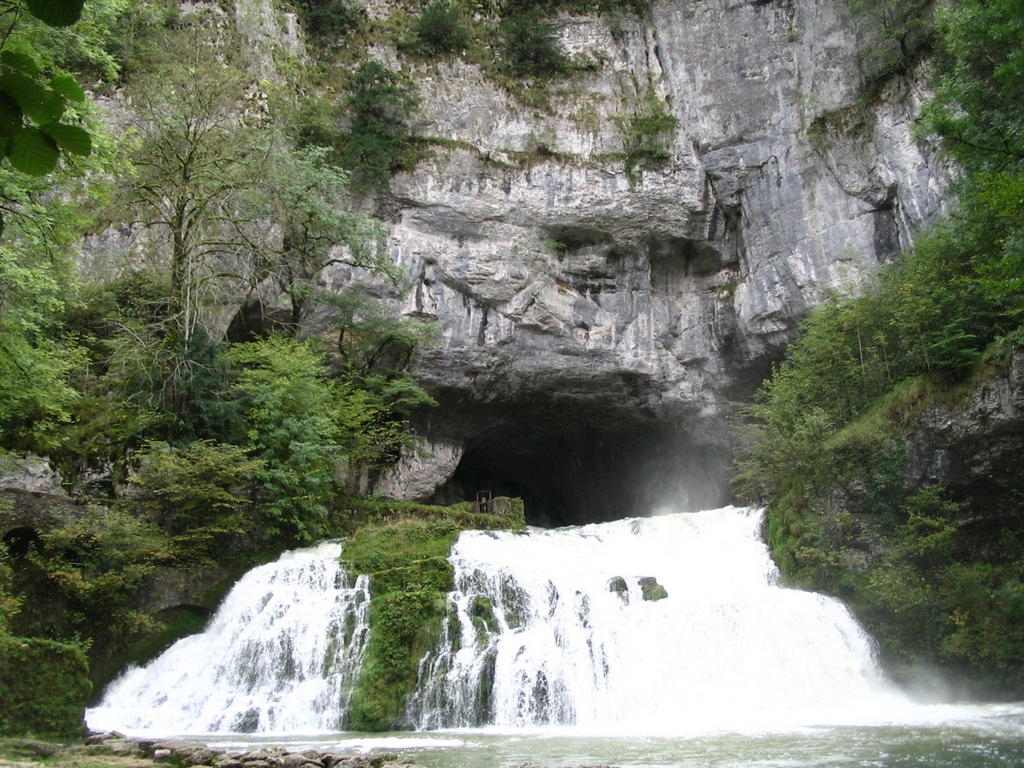
The Source du Lison

”Caverns measureless to man”

Returning to the woodland we followed a steep, narrow track up through bushes and wet grass, where a few pink flowers still added spots of colour. Here we found ourselves in the Creux Billard, a huge grey limestone hole about 50 metres deep which was originally a massive underground cavern before the roof collapsed. At the bottom is a lake formed from the outfall of the several water courses that emerge on the rockface. The waters of the lake then continue underground to feed the Lison.

The Creux Billard

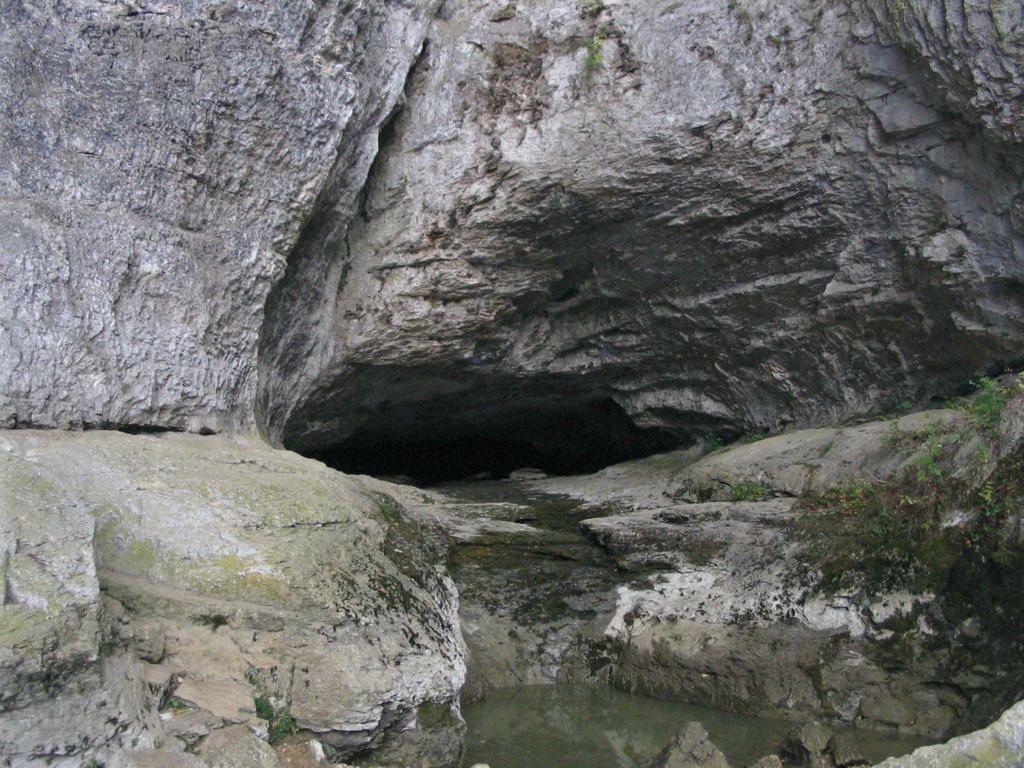
Feeling very small and insignificant we returned through the woods to see yet another wonder. The Grotte Sarrazine is a natural cave 90 metres high at the back of which is a small cave from which, in times of extreme flood, the river flows. The rest of the time it is dry. The flow can be sudden and unpredictable and although the passage continues way back into the cliff, its dangers mean only very experienced speleologists attempt to explore it. The arch itself is stunning in size and grandeur. St.Paul’s Cathedral would fit comfortably inside.
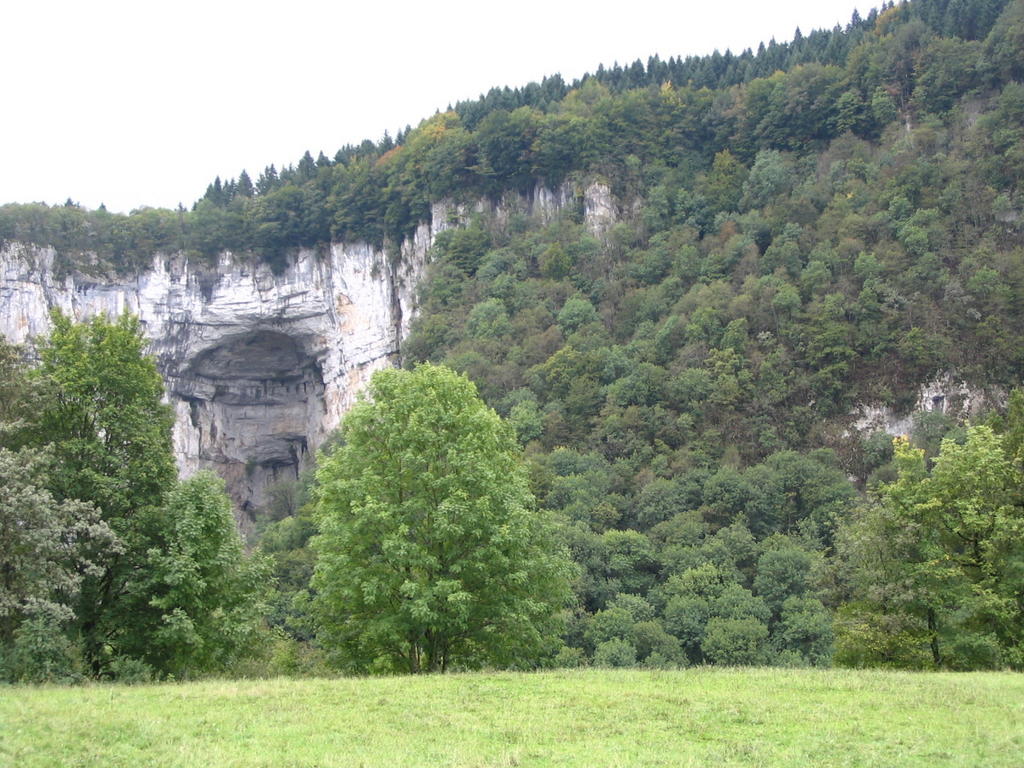
The Grotte Sarrazine

Bief (occasional source) of the Sarrazine

Finally we walked a kilometre along beside the Lison to the Taillanderie, a 19th century water-powered metal factory specialising in edge-tools for farming and agriculture. It survived until the 1960s and has now been restored as a working museum.
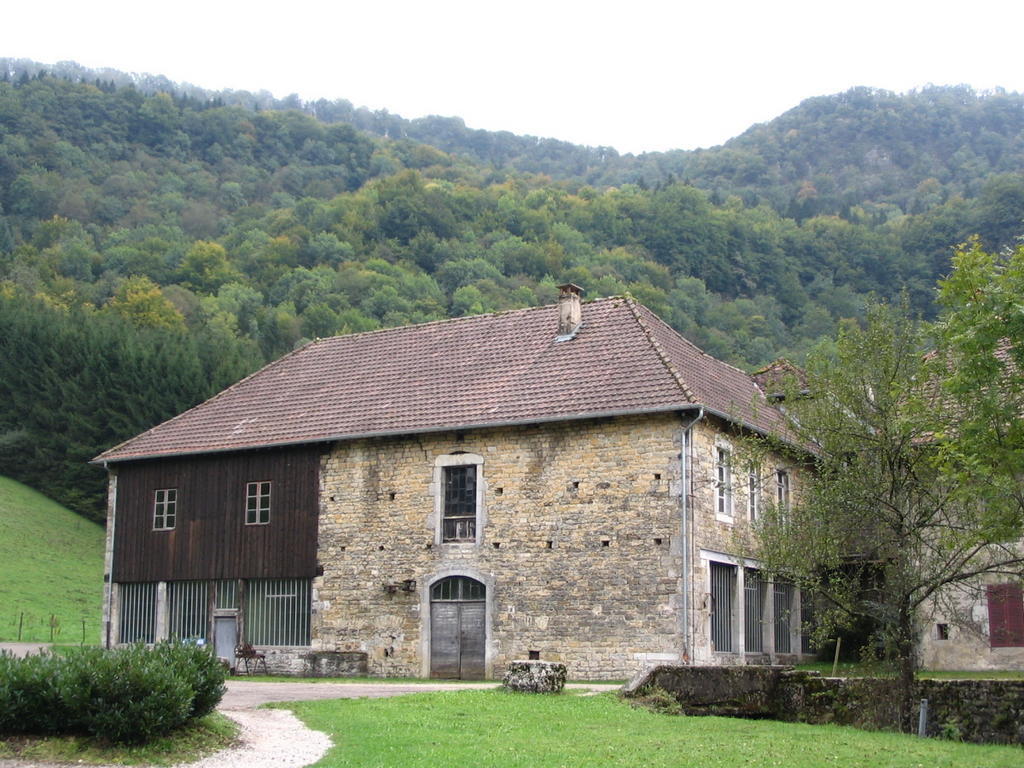
La Taillanderie

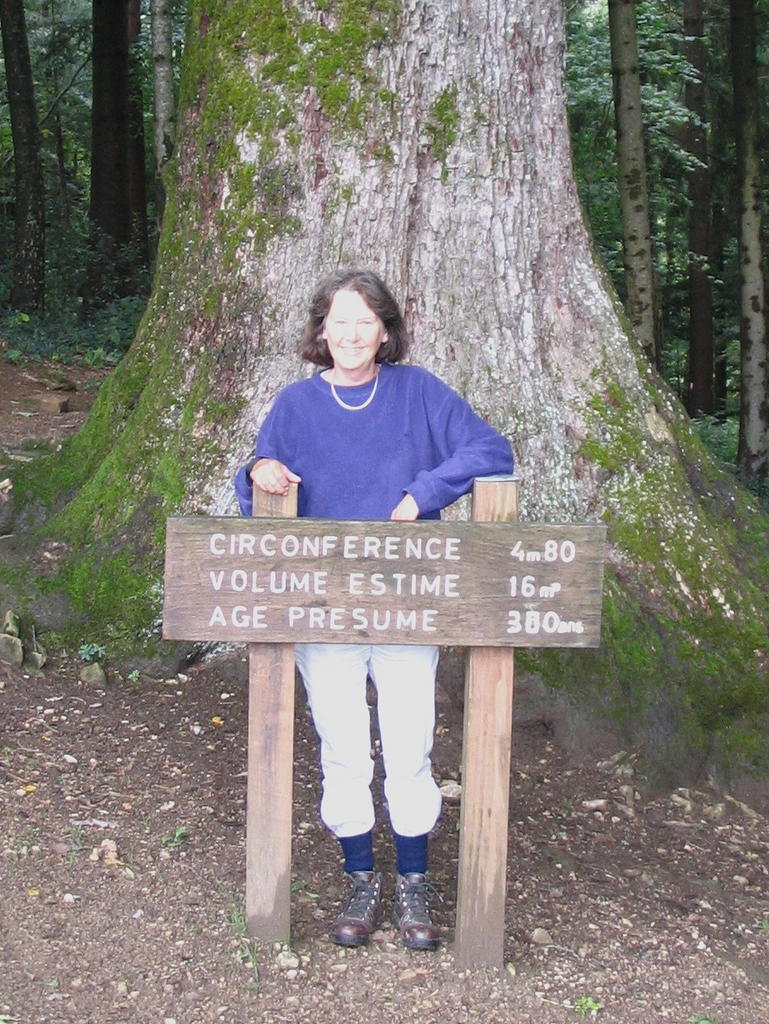
Jill measures the effects of too much German food

Wednesday 5th October 2005, Champagne-sur-Loue
Jill’s shoes having worn right through we decided a trip to Besançon was called for but the hassle of driving to Besançon and finding somewhere to park did not appeal. So we cycled to Arc et Senans, chained the bikes to the railings and climbed aboard the local train which skimmed us along the valley to reach Besançon a mere 20 minutes later. The on-board guard/ticket man even gave us 25% discount because we were poor old pensioners. (Fortunately he’s not observed us peddling furiously through Arc et Senans to catch the train or he may not have been so kind.)

Once in Besançon our plans to buy shoes gradually faded as we explored libraries, bookshops, churches and fascinating back streets and courtyards. We have returned with a couple of books and a copy of the Times, but no new shoes.
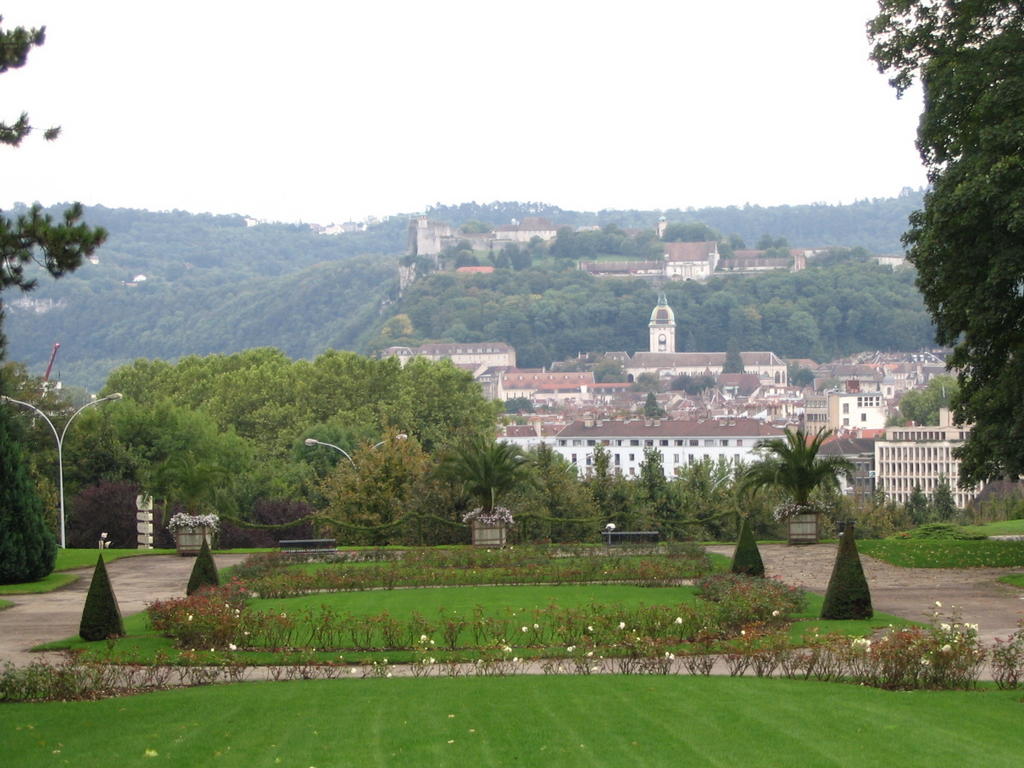
Besançon with the citadelle viewed from the station
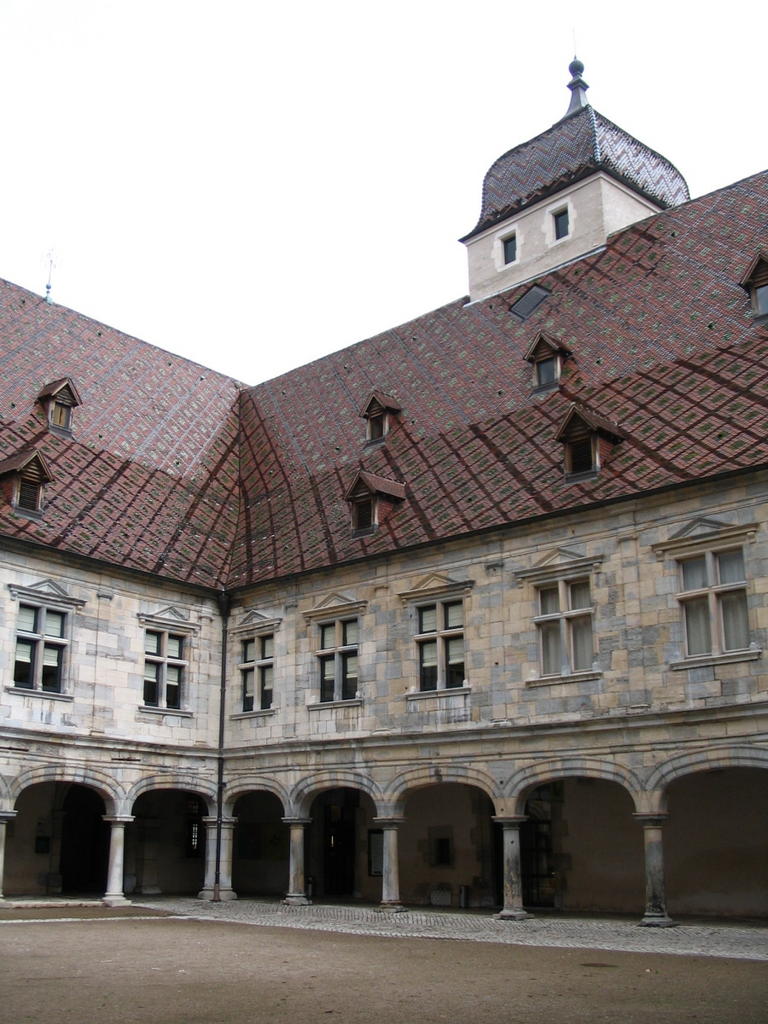
The Palais Granvelle

One of the many fountains in Besançon

We visited an excellent exhibition of early botanical books at the Bibliothèque Municipale with beautifully illustrated, hand coloured prints and herbals from the collections. The library is one of the oldest public libraries in France the present building dating from 1818, many of its collections coming from works confiscated by the State following the French Revolution. (Even many of the smaller towns in France have wonderful collections of early printed materials acquired during the Revolution that major libraries in Britain could never aspire to own.) In the case of Besançon there had been a public library since 1694 when Jean-Baptiste Boisot bequeathed his collections to the town. Boisot had saved much of the collections of the Granvelle family, leading figures and patrons of the arts in the 16th century, and many of their specially commissioned bindings are included among the library’s 500,000 items. The library suffers from the problem of having to live in the straightjacket of the original building of 1818. Despite having an out-store, the reading room is cramped with no space even for an adequate working collection of open access books. Most items are on an on-line union catalogue of all the main libraries in the town, covering public, university and museum collections. Exhibitions have to be held in one of the store rooms, with leather-bound books piled high in bays to the ceiling, reachable by ladder. Ian got reprimanded for touching a volume of correspondence between Diderot and Grimm which intrigued him. Having apologised and explained our interest in early printed material we were introduced to the charming and knowledgeable conservatrice who was delighted to discuss her work and the exhibitions for which she has responsibility.

There is a changing series of exhibitions, often with catalogues. The present exhibition formed part of the annual “Month of written heritage” for which the Ministry of Culture suggests a theme each year. This year’s is entitled “Se réunir et se distraire”, revolving around leisure and social life. The library had departed from this theme as it had been working cooperatively to produce a DVD of treasures of botanical literature in the region. Items exhibited included the work of Maria Sybilla Merian, represented by Metamorphosis insectorum Surinamiensium (Amsterdam, 1705), Pierre-Joseph Redouté Choix des plus belles fleurs (Paris, 1827) and the remarkable six volume work of Elisabeth Blackwell Collectio stirpium … (Nuremberg, 1750). English imprints included Mark Catesby’s Natural history of Carolina (London, 1731-43) and John Martyn’s Historia plantarum rariorum (London, 1728). There were also interesting collections of pressed specimens of local lichens with printed labels, reminiscent of the specimens of local seaweeds published as Algae damnonienses, exhibited in Exeter in 2004 as part of the “Picturing plants” exhibition which Ian worked on together with the Royal Albert Museum.
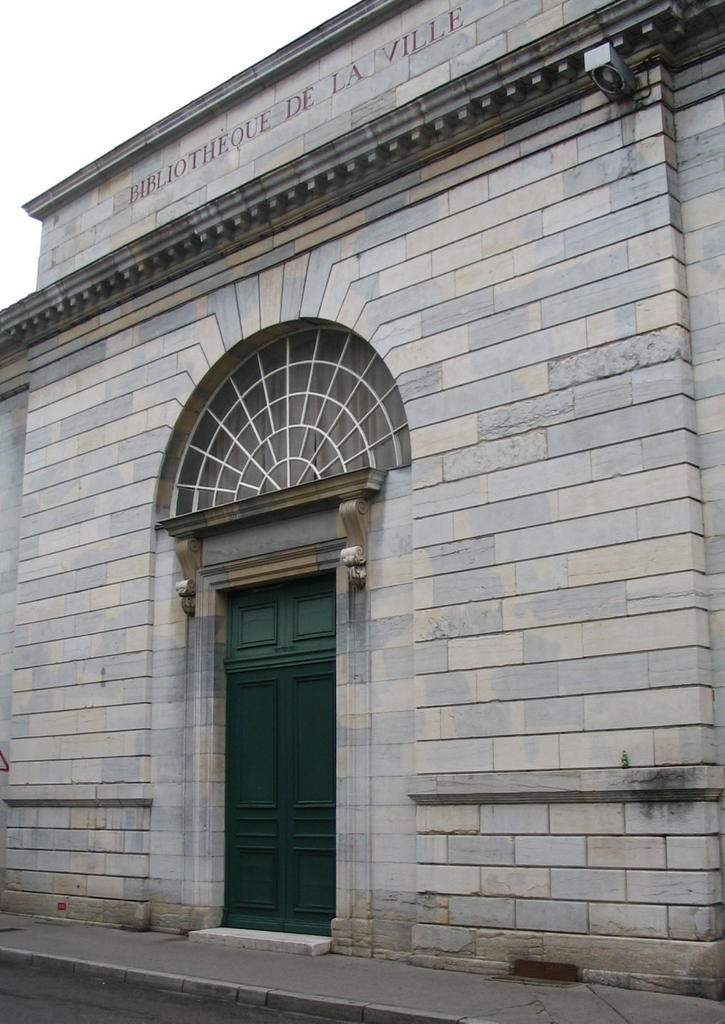
The Bibliothèque Municipale

Some of the items exhibited

Around 5pm we returned to Arc et Senans and collected our bikes for the ride back home where after supper we entertained/bored Susanne with pictures and accounts of our recent visit to Germany.

Thursday 6th October 2005, Champagne-sur-Loue
After a morning on the internet in Salins-les-Bains we had a picnic lunch by the River Lison at Nans-sous-Sainte-Anne before continuing along wooded canyons and across grassy plateaux to the little town of Ornans, charmingly located higher up the River Loue which is placid at that point, offering picturesque reflections of the old houses on stilts beside the river. Photographs in the town hall, located in a limestone Renaissance building, showed that the stilts were not always sufficient to protect the houses from flooding and there were dramatic views of the main street awash in the 1950s – there were also floods earlier this year. The town is perhaps best known as the birthplace of the painter Gustave Courbet (1819-1877), the leading light of the realist school in Paris in the mid-nineteenth century. We visited the house where he was born, now a museum, which included a special exhibition of other artists from Franche Comté during the 19th and 20th centuries. Courbet took much of his inspiration from his home town and region. His landscapes seemed in many instances to foreshadow the impressionists and his portraits are penetrating studies of their subjects. Scenes included the Castle at Chillon and the Ornans “mirror” or view of the river with reflections of houses. Courbet was a controversial figure, both artistically and as a socialist. Involved in the Paris commune of 1870, he was accused of toppling the Vendôme column and, after having served a term in prison, was ordered to meet the enormous costs of re-erecting the column. Ruined, he sought exile in Switzerland in 1873 – his sculpture “Helvetia or Liberty” dates from this period – and he died near Vevey in 1877. Unfortunately the museum shows the difficulties of maintaining an important piece of national heritage in a small town of only 5,000 people. The house is rambling and the displays somewhat formless. Also the originals of many key paintings are in the Musée d’Orsay and other collections in Paris. Still, we understand that there are plans to redevelop the museum.

The view from the bridge at Ornans

The birthplace of Courbet

We ended our visit to Ornans by driving up the very steep, spiralling road to the castle ruins above the town with views down onto the river and the rooftops.

The Castle above Ornans

Ornans from above the town

Ornans from the castle

Friday 7th October 2005, Champagne-sur-Loue
The day dawned misty with poor visibility but the promise of a warm day once it lifted. We passed the time of day in Susanne’s kitchen upstairs for an hour where she told us tales of village life in the this part of rural France before and during the war and we added several new words to our vocabulary. By 10.30 the sun had dispelled the mist and the temperature had risen making it by far the nicest day since we returned from Germany.

We drove to Arbois on yet another fruitless mission for shoes. This time we were seduced by the weekly market with its stalls of cheeses and dairy produce, vegetables and flowers, local wines and beers, clothing and footwear, meat and charcuterie. There was a pleasant, friendly atmosphere and most people seemed to know each other. We queued with the locals for spit-roasted meat and for 3.50 euros we took home for lunch half a cooked chicken in its own sauce with roast potatoes. We also bought a bunch of bright blue and red anemones as a little present for Susanne. On the way back to Modestine we noticed different little groups of people converging on a small restaurant on the banks of the Cuissance and decided it merited further investigation. It looks delightful with several set menus that include local terrines, game, cheeses and wine. It would be good to try it before we move on from here.

Back in Champagne it was so warm that after lunch we sat in the garden watching the lizards enjoying the unexpected sunshine on the old stone wall as we drank our coffee. Susanne’s niece lives in nearby Chissey and arrived to take an afternoon walk with Susanne. They invited us to join them and we have spent a very pleasant afternoon on a local ramble beside the Loue, crossing from the Jura into the Doubs and continuing through the neighbouring village of Buffard. Beyond this we climbed up through the woodland to the wooden cabin where the local huntsmen gather for their lunch when they are out together searching for deer or sangliers (wild boar.) They have the right to hunt six days out of seven during the season and last week they shot a sanglier here. Fortunately we saw no sign of any wild animals and the only evidence of the huntsmen was the table inside the cabin covered in used wine glasses, several pruning knives used for cutting their lunchtime bread and cheese, and an assortment of half empty wine bottles. We suspect that probably the hunting is little more than an excuse to get together in the woods for a drink and to avoid being given tasks to do by their long-suffering wives!

After a brief rest in the cabin on one of the long wooden benches, the walls covered in pictures of pheasants, hares, deer, sangliers and other wild game, we continued along the ridge of the hill with pretty views back down to Buffard and the Loue until we reached a statue of the Virgin, placed there to watch over the village in 1946. It is not a wonderful work of art but is dedicated to the memory of the Abbé Coutteret, the priest of Buffard and Champagne who died in Germany after being deported. (See entry for 4th September, “A local hero.”)
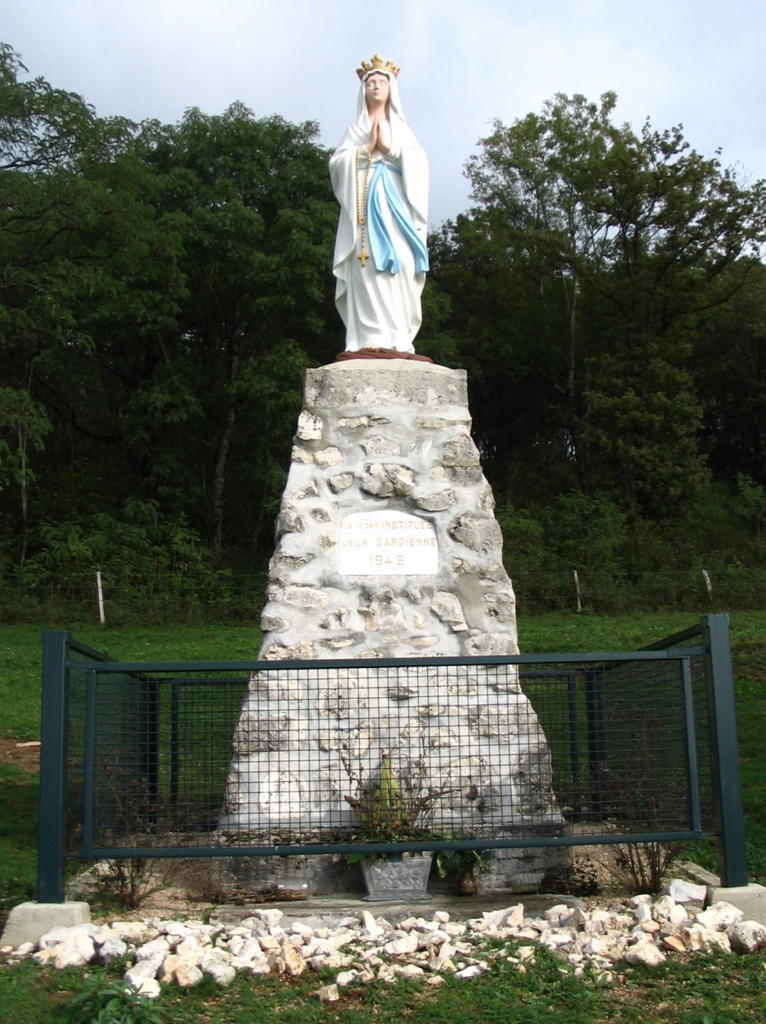
The Virgin of Buffard

View from the statue, Buffard in front, Champagne beyond

Here we gathered wild mushrooms before returning to the village through an area of woodland where horses roamed free. They quickly discovered our presence and within minutes ten of them emerged onto the path from the surrounding bushes. There is little for them to eat here and they seemed thinner than they should be. They eagerly searched us for food but sadly we had nothing for them. Ever hopeful they accompanied us on our way until we reached the gate half a mile further on. Some were really very tall and they completely surrounded us but were not at all aggressive though their noses were permanently in our hands and pockets.

Some of our walking companions

Our way then took us through the vineyards, now robbed of their grapes and with the leaves turning colour from green to gold and bright scarlet. Finally we returned to the pretty village with its traditional farmhouses where the roads are lined with walnut trees. The nuts have now burst out of their protective coverings and lie on the verge waiting to be gathered. Soon we had a big bagful which we shared out between the four of us while chatting about French bureaucracy and the incomprehensible tax laws over cold drinks once we reached home.

Changing colours in the vineyard

A typical farmhouse in Buffard

Susanne is either related to or knows everyone locally so whenever we passed people we stopped to chat and to be introduced, so it has been excellent language practice for us. It really has been a lovely day.

For old time’s sake – Jill was photographed exactly here in 1962.

Incidentally, we forgot to mention that Roland’s vendange, (grape harvest) which took place while we were in Germany, was a great success and it is reckoned to be an excellent year. Certainly the remaining grapes we tasted in Susanne’s kitchen this morning were wonderfully sweet and juicy. Nineteen members of the family turned up from as far away as Paris and they all worked solidly on the hillside for the weekend. Now everything is fermenting happily in the large wooded vats down in the cellar. We’ve been warned that this might smell a bit but as yet we’ve noticed nothing. The neighbours cultivate a different strain of grape which is harvested later so they were out gathering theirs today. We watched them at lunchtime loading huge round barrels onto their tractor and driving off with them to the vineyard.

Besancon and around

Sunday 4th September 2005, Champagne-sur-Loue
Yet another hot day. In the morning Hugues and Thibault arrived from Dole to make themselves useful around Roland’s little domain. He has buildings, and fields scattered around Champagne, including a couple of vineyards. He had dragged wooden barrels out of the cave into the garden to clean them ready for the grape harvest in a week or so and Hugues had come to inspect the vines. They took us up to Roland’s plantations on the hillside above Champagne where Hugues showed us the different varieties of grapes and examined the newer vines that had only been planted a year or two and were bearing their first bunches of grapes. He could visually differentiate Trousseau from Pinot and Poulsard, and Chardonnay from Savagnin by the shape of the leaves and the way the bunches formed, but they all looked the same to us. They tasted wonderfully sweet and were declared ready for harvesting. We also helped to gather the final few peaches, but generally the fruits were disappointing this year – no plums, apples or pears as insects had ravaged the buds.

In the vineyard

It was already hot in the vineyards and the heat continued to increase as we drove in the afternoon to a vide grenier (jumble-cum-car boot sale) at the nearby village of Pagnoz. Stalls were set out along the village streets and up into the meadow above, piled high with old toys, children’s books and assorted bric-a –brac, all in aid of the restoration of the local castle which it was too hot for us to climb up to see. We had been attracted to the sale by the announcement that the Pudding Théâtre were going to be present but they seemed to be little more than two stallholders sitting in coffins amongst a motley collection of unlikely goods who hurled ribald comments at passers-by through megaphones. We purchased a couple of books by Marcel Aymé, whose birthplace we had visited the day before and, it being too hot to poke through the stalls any longer we made out way to Port Lesney where we found shade beneath the trees, bathed in the River Loue and read our purchases. As evidence of how hot it has been, the LCD of Jill’s watch, left in the car while she swam, actually melted! The keeper of the local campsite took a strong liking to Modestine. He was a retired mechanic and said that, if he were younger, he would take photographs and set up in competition for the French market.

Monday 5th September 2005, Champagne-sur-Loue
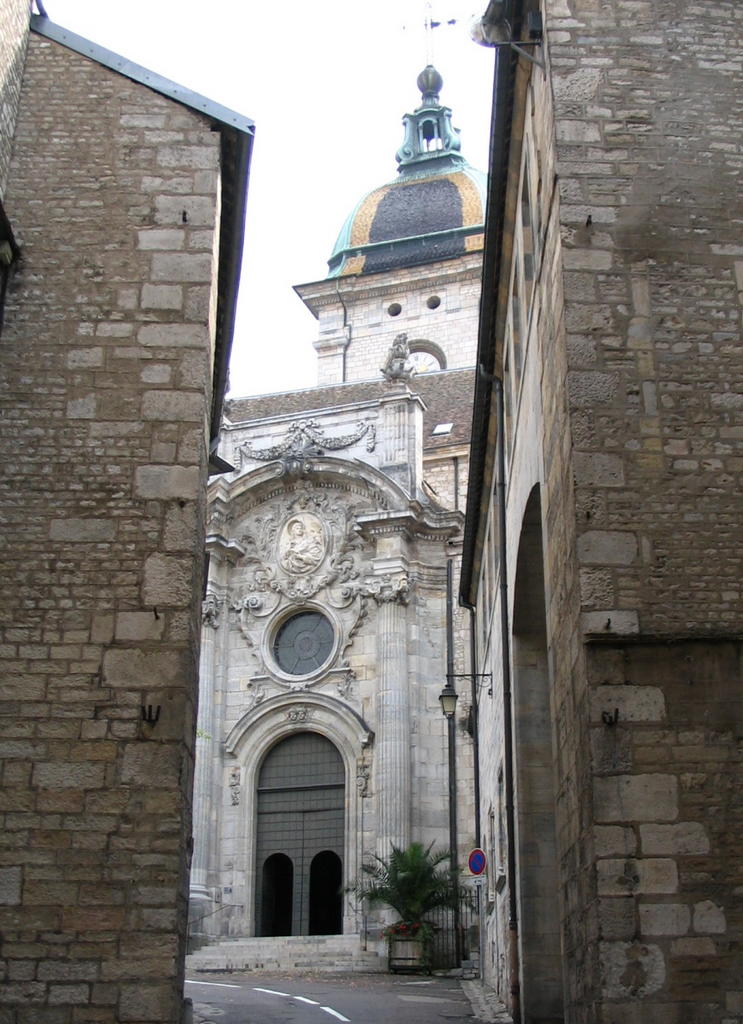
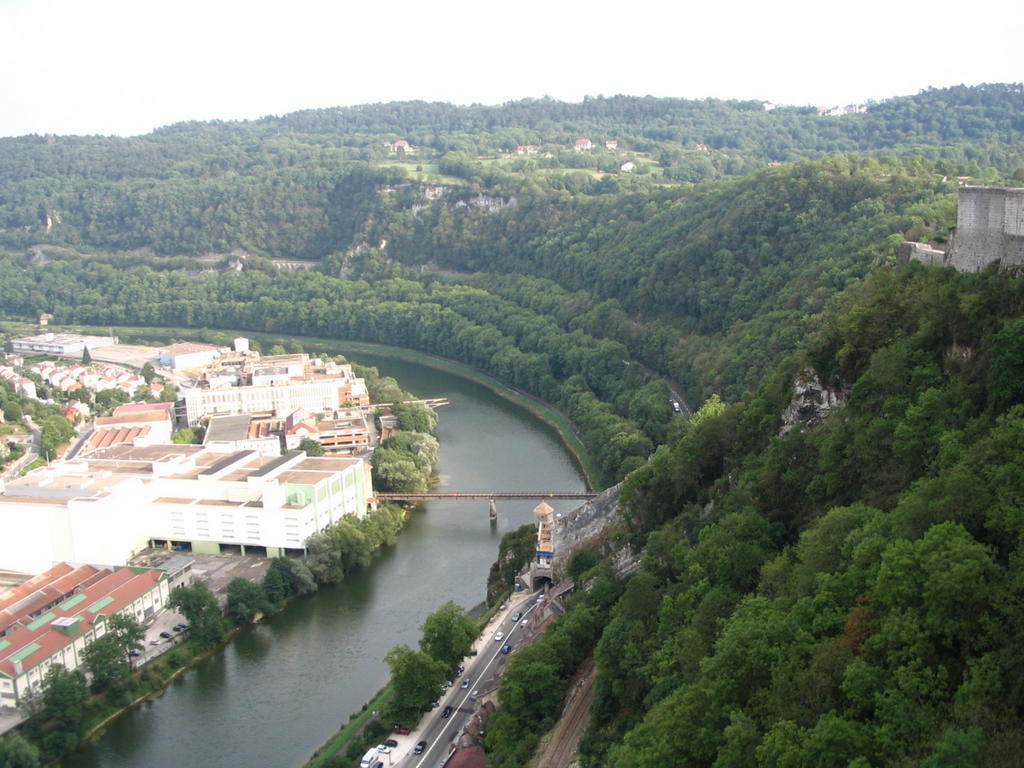
A marginally overcast day, promising rain so we decided that it was time at last to visit the city of Besançon, some 20kms from here. With 130,000 inhabitants it is the capital of Franche-Comté and is strikingly situated on a horseshoe bend of the River Doubs. It is dominated by a high rock on which Vauban constructed the Citadelle, one of his military engineering masterpieces. Besançon has been an important centre since Roman times, indeed the Porte Noir, a triumphal arch erected in the second century still straddles the end of the Grande Rue, just before it rises past the Cathedral, up to the Citadelle.

It is a lively and interesting city, which was once notable for its clockmaking industry, the riverside fronted by rows of arcaded late 17th century houses and the streets filled with grand buildings, often with polychrome tiled roofs. In one square we could stand on a single spot and photograph the birthplace of Victor Hugo, one of France’s greatest writers, the birthplace of the Lumière brothers, the pioneers of cinema in the 1890s and the birthplace of Charles Nodier (1780-1844), the romantic poet, Hugo’s friend and librarian at the important Arsenal Library in Paris. Another square is romantically set out with fragments of Roman remains unearthed from Vesontium in the 19th century by the archaeologist Castan. With the museums and libraries there is certainly more than enough to fill another day.

Victor Hugo’s birthplace

The birthplace of the Lumière brothers

The cathedral in Besançon

Today’s visit was tinged with a certain degree of sadness. Since we were last here our friend Alain, librarian of the university of Besançon has died and we were aware of a sense of loss.

We found our favourite eating place, Au Petit Polonais, named after a Polish immigrant who had established it in 1870. It had been in the same hands since the 1970s when we had first frequented it, then a lively student haunt with red check tablecloths. It was rather more sedate over lunchtime today, but certainly not devoid of colourful clients who added a curious amusement to our lunch there. (So we are counting our Comtois salad and red wine as our second frivolous expense, courtesy of the local history societies in Devon. Thank you.)

The Citadelle houses a range of places of interest within it defences. Apart from the walk around the ramparts with spectacular views over the river and town 100 meters below, there is a small zoo, a museum of Comtois life, information on Vauban and the Museum of the French Resistance and Deportation. It was to this that we made our way, after enquiring at the entrance gate that it would be possible to visit the documentation centre in pursuit of a local Resistance member. When we arrived twenty minutes later we found that the three staff had all been beavering around and had come up with several items of information. They declined our offer to pay for photocopies and even offered to lend us one of the books to read at our leisure. An excellent service, which it would be hard to better back home. More of our findings at a later date. We gained additional background by looking round the twenty rooms of the museum itself – a detailed and often harrowing collection of photographs, posters and documents tracing the rise of Nazism, the defeat and partition of France, collaboration, resistance, deportation and the final victory. There was much material on the concentration camps where many French people ended up, and touching final letters to family and friends from people about to be executed. Much happened close to home rather than in Germany. More than one hundred resistance fighters were executed by firing squad in the Citadelle of Besançon following intense activity, including hundreds of attacks on local railway lines, canal locks, factories and other strategic targets.

A view from the Citadel ramparts

Interlude – a local hero
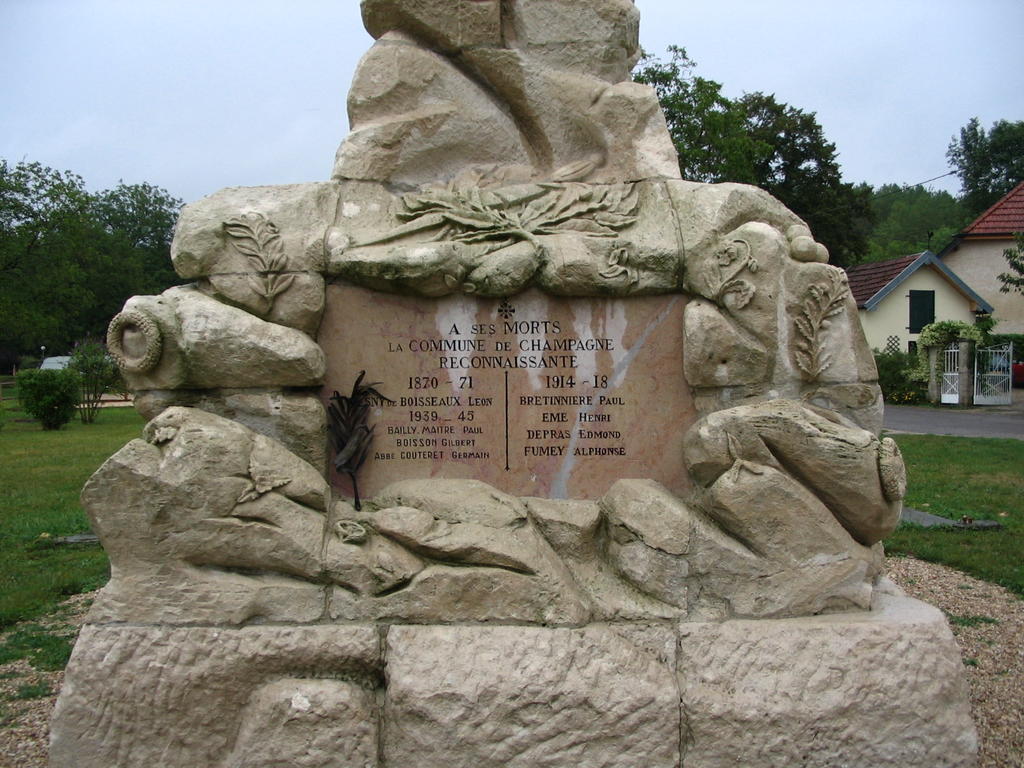
There are not many names on the war memorial at Champagne – nor would one expect there to be from a community of little more than one hundred people. There is one from the 1870-71 war, four from the 1914-18 war and three from the 1939-45 war. The inclusion of Abbé Couteret Germain [sic] among the last intrigued us - how come that a local priest lost his life? We were even more intrigued when, cycling back from Quingey, we noticed on the wall of a house in the village of Lombard a plaque reading “Here was born Abbé G. Coutteret 2 November 1902. He died in deportation 3 May 1945 for acts of resistance.” We asked Suzanne if she knew anything about him and he was certainly remembered locally as the curé at Buffard, just across the river from Champagne, who was arrested after officiating at a service. She thought he had helped a parachutist. Searches at libraries in Arbois and Salins, who have small sections on the local resistance, revealed nothing, so we decided to pursue enquiries at the documentation centre at the Museum of the Resistance in Besançon.

The plaque in Lombard

The war memorial in Champagne

It transpired that Germain Coutteret had a calling as a priest at an early age and entered the seminary at Besançon at the age of twelve. In 1941 he was appointed curé at Buffard and, being himself from local peasant stock he easily fell into the role of providing pastoral care to his country parishioners. In 1943 air raids by the allies increased and numerous pilots who had been shot down sought help from the Resistance. The demarcation line between Vichy France and the German occupied zone ran just a few kilometres to the south and neutral Switzerland was not far away, so activity in this area was particularly intense. So when a parishioner requested help to disguise an American pilot, the curate gave her one of his cassocks. Unfortunately the pilot was captured, the woman interrogated and, under torture by the Gestapo, revealed the name of Germain Coutteret, who was arrested on 31 August 1943. A long period of suffering followed. He was held captive at La Butte in Besançon, then at Compiègne and Fort St. Denis before being sent to Germany. After deportation he went first to Neuengamme and then to Fallersleben. Unusually, the reports of several companions survive. He was known to them as Germaine and continuously exercised his priestly role, comforting, consoling, giving absolution. One of his comrades reports: “We only had very little food each day, just enough to prevent us from dying too quickly, and yet Germain gave a large part of his ration to sustain his companions. He often took the place of a weak detainee to give him respite.” Clement Vanhoutte gives a moving description of receiving Easter communion early in April 1945 and quotes extracts from a diary which was laboriously maintained in pencil, giving an account of his spiritual struggles.

In April 1945 the pace of events quickened. The Germans decided to remove the detainees in trucks containing 120 to 140 men each. After seven days and seven nights of torment the train arrived at Woblin on 15 April 1945. Although suffering from pleurisy Germain forgot his illness and used his remaining strength to help those that he called his brothers. On 3 May having learned of the news of the arrival of the liberators, he breathed his last.

His life was remembered at his native village of Lombard on 25 April 2004 when a square in the village was named after him and a plaque was fixed to the house where he was born.

Kern, Paul, Les jours de notre mémoire (1940-1945) Neuengamme (La Pensée Universelle, 1975).
Vanhoutte, Clement “Qui était donc l’Abbé Germain Coutteret?” Reflet Comtois (avril 2003), 3, 13.
Devillard, René “L’Abbé Germain Coutteret: victime de son dévouement” L’Est Républican, (22 avril 2004).

Tuesday 6th September 2005, Champagne-sur-Loue
When Francoise and Eugene visited us here a week or so ago - time ceases to be precise when one can please oneself each day and the only time displayed on one’s watch is a black blob of melted LCD! – we arranged to visit them with Suzanne when she returned from Brittany. So today the three of us drove up high above Salins, through Nans-sous-Ste. Anne to their home in Amancey where we had been invited for lunch. Francoise used to teach the domestic skills of cookery and needlework to the pupils at Champagne and became a good friend to Jill when she was there. She was always warm natured and very slightly eccentric. In this respect she has not changed at all and her husband is a perfect match.

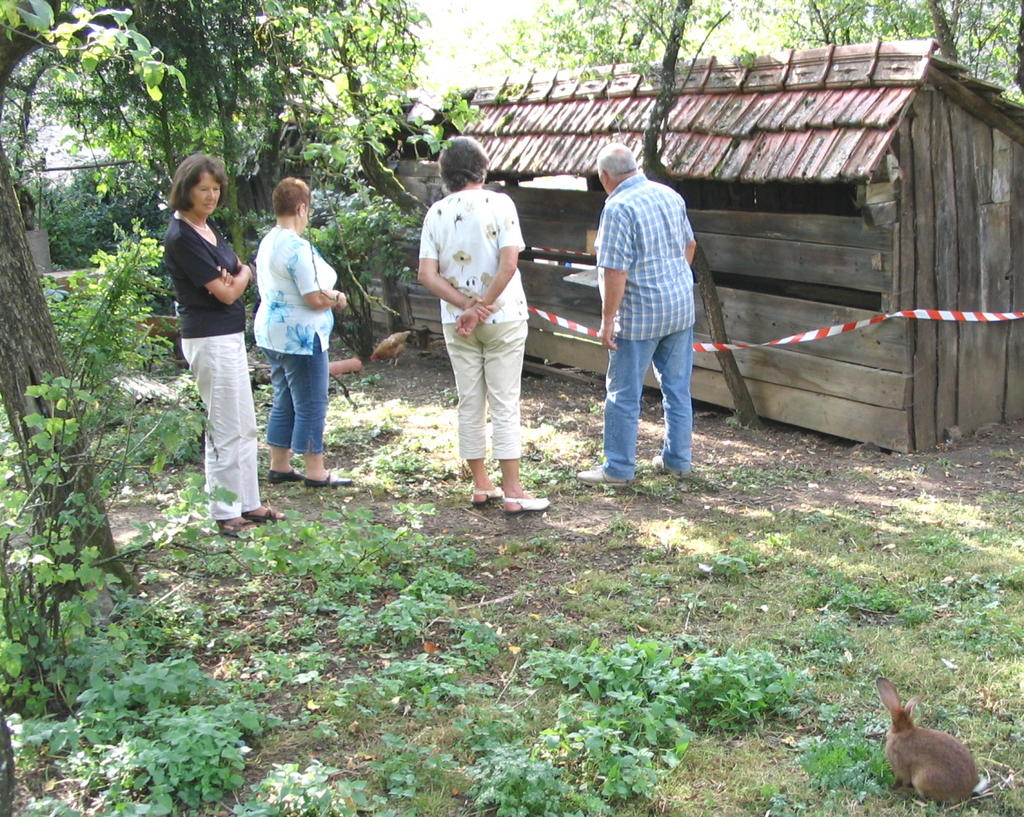
Their home is chaotic being in the centre of a large overgrown orchard on the edge of the village, surrounded by their huge barns and hangers crammed full of bits of farm machinery, dilapidated caravans, trailers, builder’s rubble, thousands of stacked tiles, and old, rotten timber. The large vegetable garden is filled with ripe tomatoes, leeks, parsley, haricot beans and carrots. Flowers run riot amongst them - hollyhocks, marigolds, geraniums and dahlias (these last, Eugene complained, are being destroyed by ferrets who for some reason love them!) A vine, heavy with grapes covers the entire crumbling façade of the house and a dozen wellies stand upside down on poles under the plum trees (drying out after their son Flavien, a fireman in Paris, brought home a crowd of friends over the weekend to go potholing in the caves to be found everywhere around here). Around the huge, rambling, overgrown garden, thick with nettles, elderberry bushes, walnut trees, and brambles, domesticated chickens, rabbits, doves and pigeons co-existed, awaiting their turn to eventually reach the cooking pot. Francoise gathered up eggs in a basket from odd corners of the garden as we made our tour of inspection and we helped with feeding the dozens of caged rabbits reared for food. This year, a new venture, beekeeping, with 80 kilos of honey produced.

In the orchard

Feeding the rabbits

Eugene hunts every day during the season and stockpiles his game in the freezer for the winter months which can be very hard in the mountains. Hunting here is nothing like hunting in England and is done on foot with a dog. Eugene’s seems far too docile for such an activity and is called Tintin. A good dog will easily fetch £600! So long as one has a license to hunt anything is allowed it seems. On a bad day he will bring home nothing but a couple of thrushes, a grouse or a partridge. On a better day Francoise will have to skin, clean and quarter a wild pig or a mountain goat.

Inside, the house is bursting with character. Eugene courteously removed his rifle from the chair beneath the crucifix so Ian could sit down. On the opposite wall hung another gun, two stags heads, an assortment of hunting horns and a fishing basket. As town dwellers, this all strikes us as astonishing, which is why we repeat it now, but it must be recognised that it is a completely different way of life here and to them it is us who are slightly strange and rather colourful! Francoise used to work in an orphanage in French Gabon. Here she cooked the local produce for the children. This included wild monkeys. On our last visit, amongst the half dozen bottles of home produced wine and eau-de-vie on the table at the end of our meal, she casually placed a bottle containing a pickled uterine ape she had discovered one day inside the stomach of the lunch she’s been preparing and had kept as a souvenir.

Today was tame by comparison. We ate a superb lunch where absolutely nothing came from a supermarket. (No such thing 600 metres high in Franche Comte!) Only the bread, cream and cheese were not home made and even they came from within the village. We started with aubergine pate, followed with stuffed tomatoes and hardboiled eggs in homemade dressing and then came the main course. (Vegetarians can skip this bit.) The most beautiful, tender and succulent meat we have ever tasted. Wild sanglier, the result of a recent foray on the hills above the house. This was accompanied by haricot beans picked within the hour from the garden. To follow, a platter of local cheeses and finally fresh raspberries completely smothered by chantilly cream. Each course brought yet more bottles onto the table. Jill was driving so had to be content with home-produced apple juice, but Ian and Eugene sampled everything from home produced wines to eau-de-vie produced from their own pears. Conversation was fast and furious and as usual Francoise and Eugene held different conversations simultaneously with us. Our brains were straining to follow half of what was said to us on topics as diverse as the German officers quartered with Eugene’s family during the war, the “imbecility” of officials trying to implement hunting regulations, the spate of fires in Paris that is keeping Flavien so busy and the lack of fruit this year as a result of infestations of insects and the ravages of birds – at this point Eugene got up from the table, picked up his gun and rushed into the garden to stop them eating his grapes. Their way of life is as different from ours as it could possibly be, but their sense of goodwill and friendship is completely sincere and we feel very privileged to have experienced such genuine hospitality.

After the meal

Francoise gave us a newspaper cutting from their local paper that she had seen by chance. It showed both of us taking part in the Morbier cheese-making session at Nans-sous-Ste Annes recently. We had no idea it had been taken but she had recognised us from the photo.

All good things come to an end eventually. Having bought several jars of their honey as presents for friends, we were about to leave when the storm that had been threatening for days arrived with a violent wind, crashing thunder and lightening. Within seconds everywhere was a river of water. Impossible to leave until it eased. The worst was the swirling force of the wind! I could never have controlled Modestine on the mountain roads in the near darkness produced by the storm clouds.

Eventually it eased and we made a run to the car. The roads, right the way down the mountains were completely covered in greenery and branches torn from the trees and there were a number of rocks washed down from the banks. Until the storm the roads had been baked relentlessly by the sun. Now steam rose up in clouds ahead of us, and, most amazing of all, crevices in the rocks by the roadside, and in the surrounding fields were white with hailstones that had fallen in such profusion they lay in frozen drifts around us! This remember, is two days after Jill’s watch melted from the heat!

The roads were completely deserted as we made our way gingerly down to Salins-les-Bains and home to Champagne. Here there has been heavy rain, but nothing like the storm up at Amancey.

Wednesday 7th September 2005
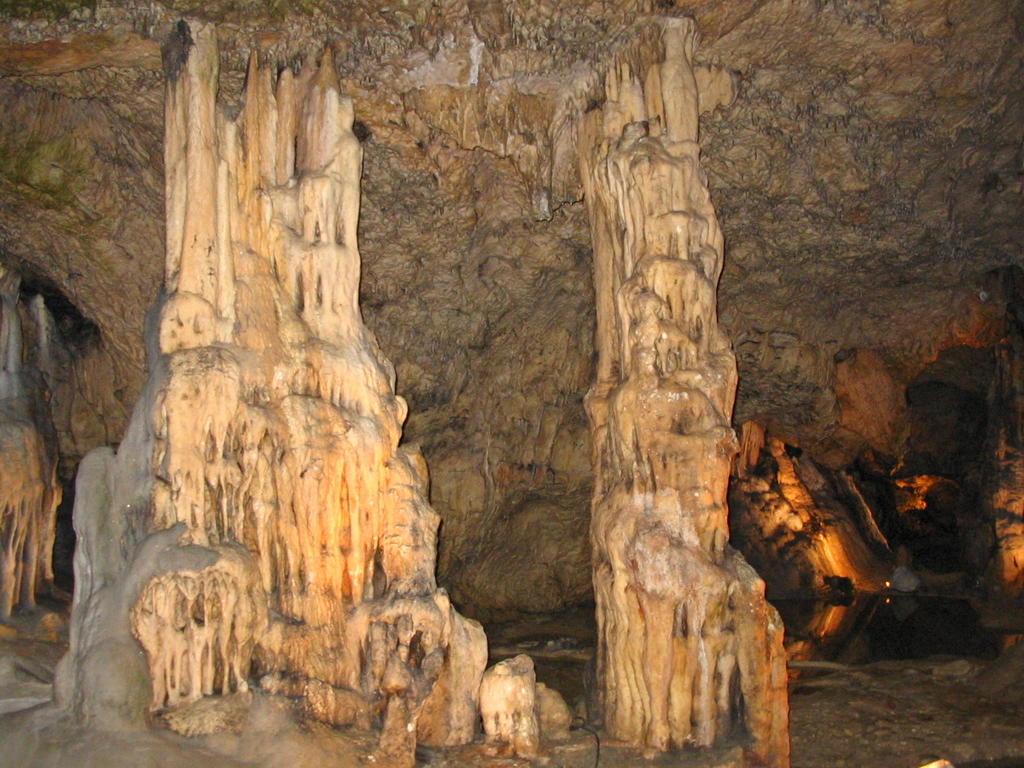
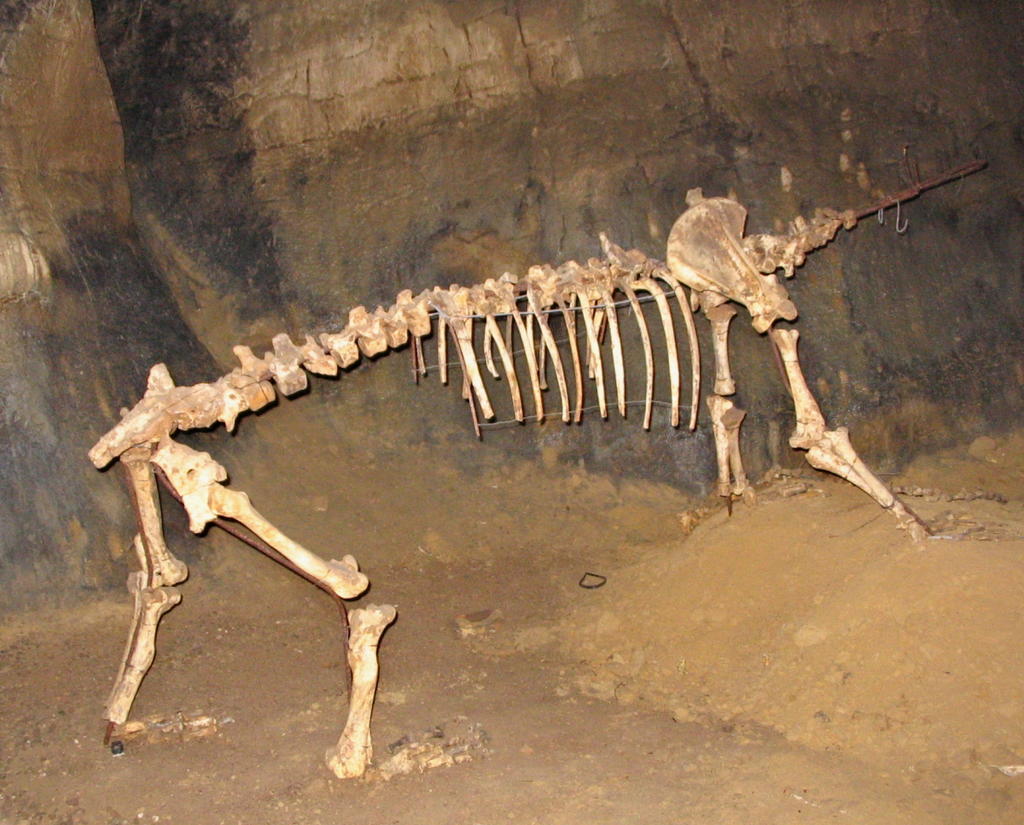
We didn’t manage to leave for Germany today. Problems in getting access to the internet delayed our departure, so this afternoon we visited the Grotte d’Osselle, pleasantly situated on the banks of the Doubs about 10 KM north of Champagne. They are among the largest networks of limestone caves in the Jura with more than 1300 metres open to the general public, and they have been known since the Middle Ages, being on the regular tourist route since 1504. There have been wild theories as to their origins in the past, but one of the scientists who undertook serious research on them was the geologist William Buckland who excavated the skeletons of cave bears in the 1820s which he promptly removed to the British Museum. An interesting link with Devon, as he also worked on fossils on the Devon and Dorset Jurassic Coast at about the same time. Beside the normal displays of stalactites and stalagmites, many beautifully coloured by trace elements in the limestone rocks, we saw caverns where priest had taken refuge during the French revolution and where banquets were held in the 18th century, one of the visitors being Voltaire. At about that time a bridge was constructed over the underground river, which fortunately for us, now flows through caves at a lowerlevel than in previous times. The stones had to be dragged more than a kilometre from the cave entrance.

Part of the Haas mineral collection

Limestone formations in the caves

The skeleton of a cave bear, found in 1970
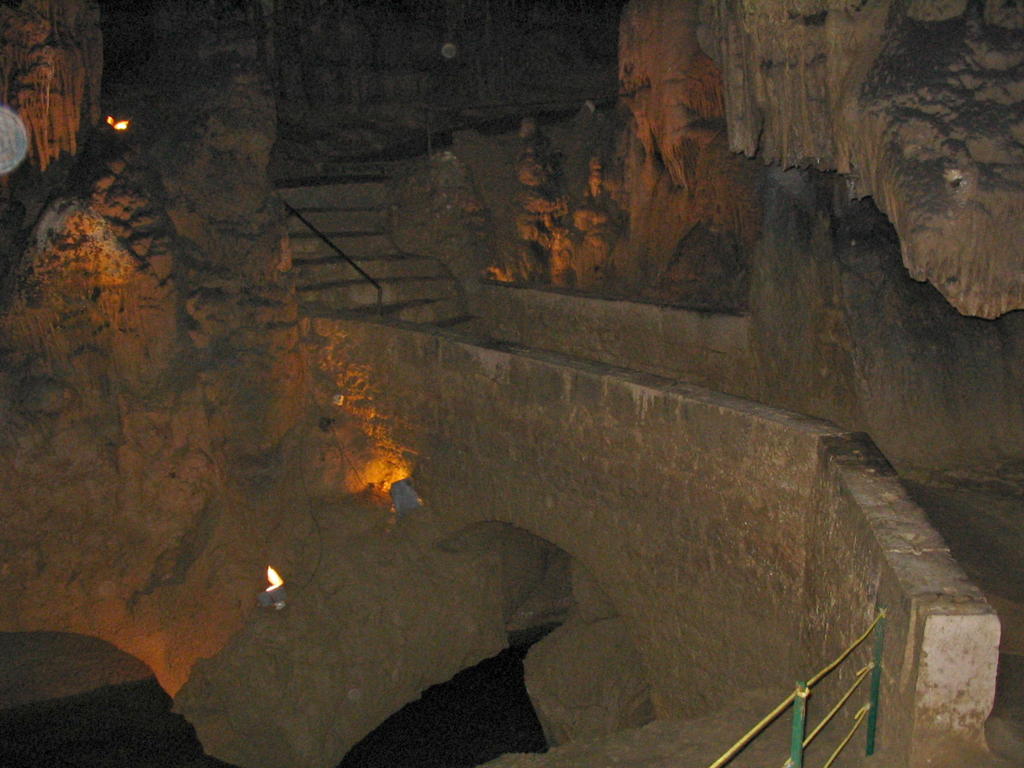
The bridge over the underground river, built in the 1750s

Poligny and elsewhere

Friday 26th August 2005, Champagne-sur-Loue

Thursday had been a day incessant rain with reports of severe floods across Europe. For us it was a day to rest and recovery with some French exercise in the evening coping with La Fille du Puisier, an excellent but dated film by Marcel Pagnol.

On Friday we drove the 25 Km south to Poligny, in medieval times the capital of Franche Comté. In 1638 it was taken and burned under the orders of Richelieu. At that time much havoc was wrought in the region by the Swedish troops allied to France under the leadership of Bernhard von Sachsen-Weimar, which gave rise to the local expression “mauvais comme Weimar” – best not mentioned when we visit Weimar next month. Many of the houses which lined the Grande Rue are of the eighteenth century with elaborately carved doors in classical style. Among them is the Convent of the Ursulines with its arcaded courtyard, established in the 1680s to teach the girls of Poligny to be dutiful housewives.


The Ursuline convent in Poligny


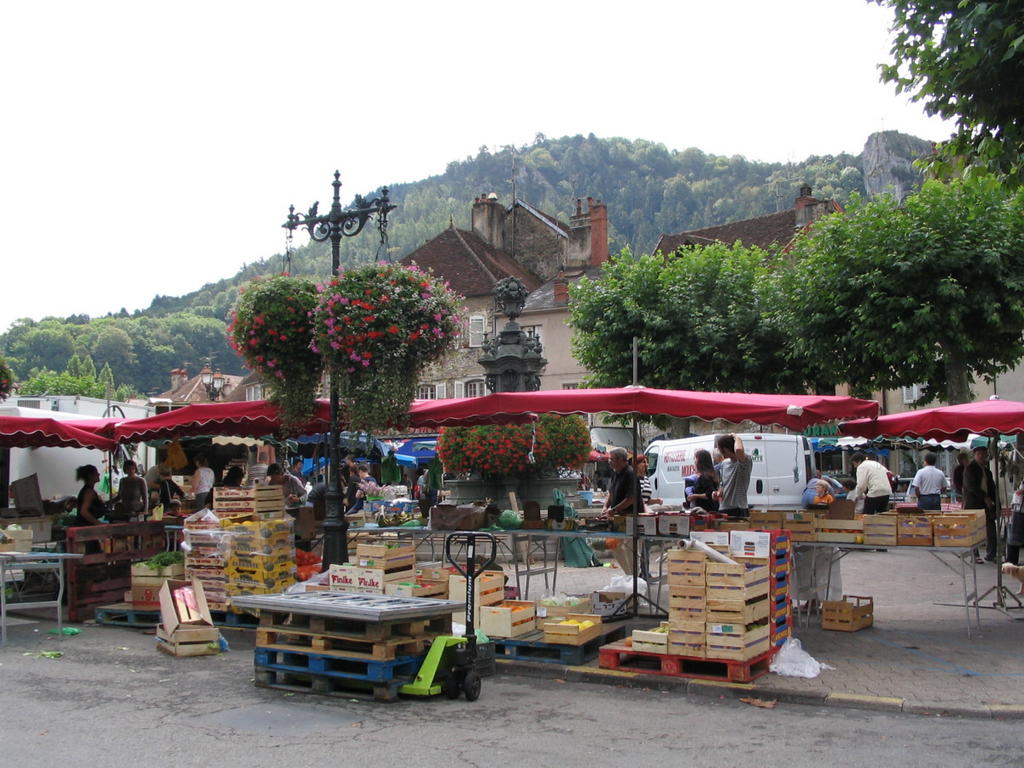
Friday is market day in the Place des Deportés, not a very grand affair, a modest series of stands with local foodstuffs. We noticed a stall with a wide variety of smoked sausages made of an exotic variety of the local and not so local fauna, including bison, ostriches and even donkey! We took a coffee on a pavement terrace in the sunshine, the Croix du Dan looking down from the top of the limestone cliffs that dominate the town – like Arbois and several other towns, Poligny lies at the entrance of a reculée or blind valley, hollowed out from the limestone rocks by rivers.


Market day


We visited the gothic Collegiate Church of Saint Hippolyte which contains an excellent series of 15th century sculptures, several in polychrome alabaster, by local sculptors who worked for the dukes. They included not only saints but notable persons of the period, including Jean Chousat, the founder of the church, complete with his falcon. There was also a series of 1890s stained glass windows of events in the life of Saint Colette who founded the convent of the poor Clares, located just behind the church, in 1415. She was a very busy lady, reinvigorating the order of St. Francis of Assisi and establishing some thirty convents across France and Germany, including places such as Beziers which we hope to visit later in our travels. Despite all this activity she was only canonised in 1804 and a gold casket holds her relics in the convent where she died.


Collegiate Church of Saint Hippolyte

15th century carved reredos in the church


We joined four local people for a guided visit to the pharmacy in the Hôtel-Dieu, a hospital set up in 1681 by a religious order, just after Franche-Comté became part of France. The walls were lined with elegantly carved wooden shelving which contained row upon row of ceramic containers, all of them produced by local potteries. They were decorated with floral motifs green, yellow, blue and mauve and labelled in French with the names of their contents. As we were a small group our enthusiastic guide took examples off the shelves to show them more closely, opened some of the drawers which still contained fragile heaps of herbs. She even ventured to open one of the cupboards, apparently for the first time, and was astonished to discover a collection of early books on pharmacy, some dating from the 1680s when the hospital had just been established, complete with copper line engravings showing the different types of apparatus used in preparing medicines.


The pharmacy in the Hôtel-Dieu


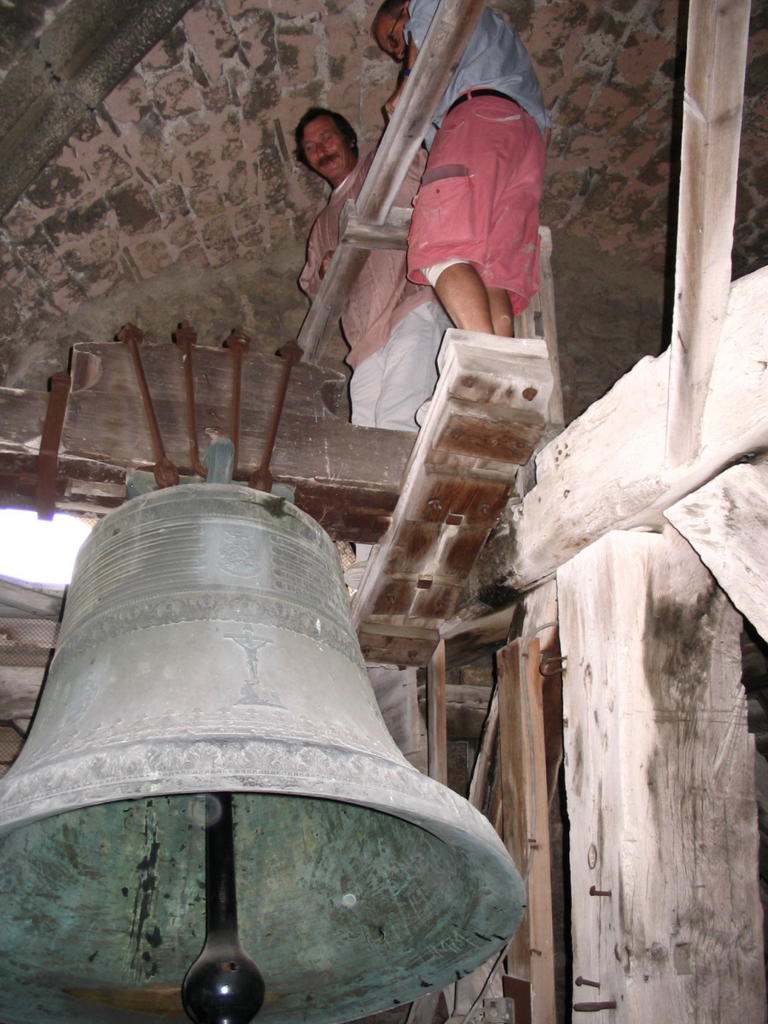
In the evening there was an opportunity to climb the tower of Saint Hippolyte where we joined a steeplejack who acted as guide and a family who seemed to be friends of his. With Ian’s fear of heights he never knows why he goes in for such ventures. In this case a short spiral staircase led out into the wide and lofty main body of the square tower, up which a series of flights of narrow and uneven wooden stairs ascended, clinging to the walls and opening onto the cavernous void below. This brought us out above the vaulted ceiling of the main nave and below the roof. We were able to see the holes through which chandeliers could be lowered in the days before electric lighting. Then up another spiral staircase and we emerged some fifty-five metres above the streets of the town, separated only by a low railing from the mosaic of red tiled roofs below us. Our guide pointed out the defensive towers of the city, several now incorporated into more extensive buildings, and the site of the former castle, demolished in the 17th century, its stone being used for buildings such as the Hôtel-Dieu. There were also many former monastic buildings scattered across the town. On our way down we visited the large wrought-iron turret clock which used to control the bells. We had seen the massive weights hanging some thirty metres below as we climbed, and each week it took five-hundred turns of the winding gear to wind the four movements. Small wonder it is now disused. The dusty belfry contained three main bells and a carillon of forty smaller ones. We were puzzled when our guide told us that the bells were inscribed with the names of the godparents, but he explained that these were the individuals who had provided the money for the casting and hanging of the bells. Our guide and his friend climbed onto the cradle from which one of the bells hung and see-sawed until it started to ring. From such close proximity it was deafening! Then Jill was offered the chance of operating the carillon. As she is not at all musical, the long-suffering people of Poligny were treated to a cacophony of sound for a few minutes as Jill attempted to ring out God Save the Queen! We imagined them looking up, fingers in their ears, shaking their heads and saying “Not another guided tour of the tower!” (or even – “il y a quelquechose qui cloche!”)


Staircase inside the church tower

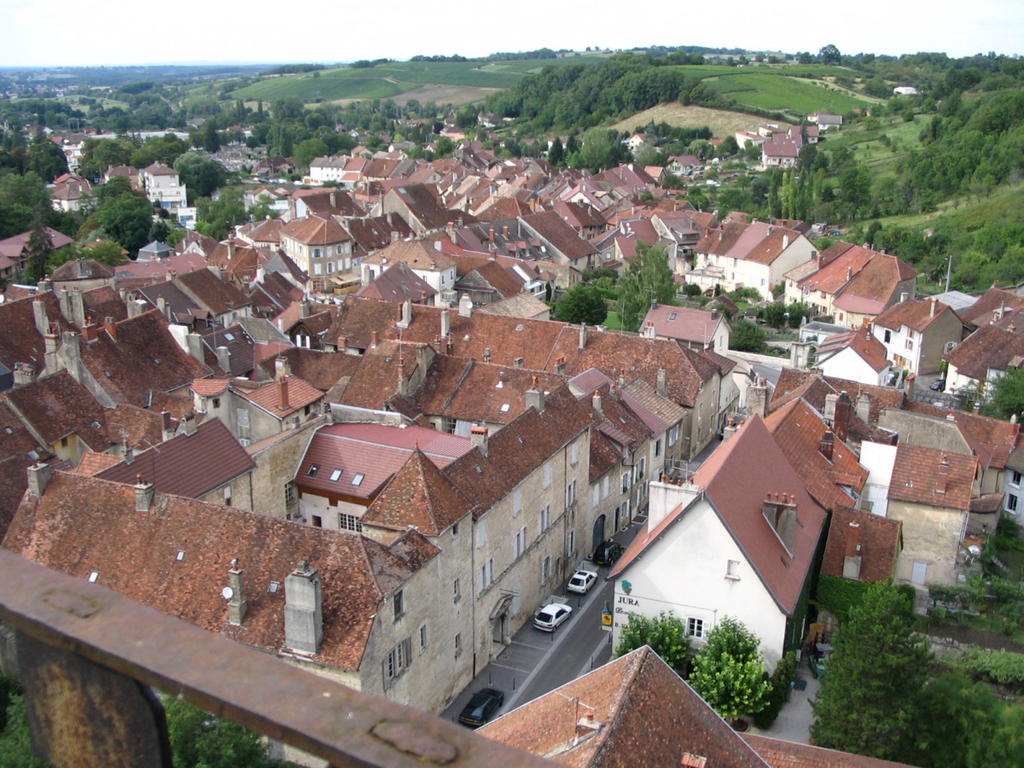
View onto Poligny from the top of the tower
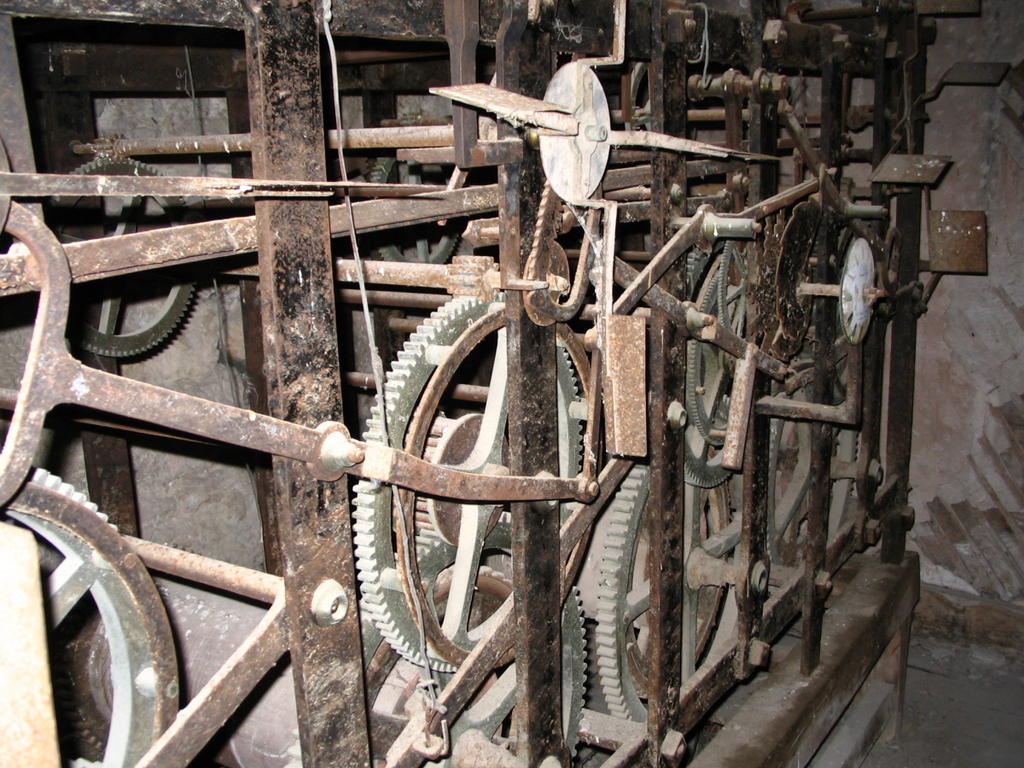
The turret clock

Quasimodo in action!

What a carillon!


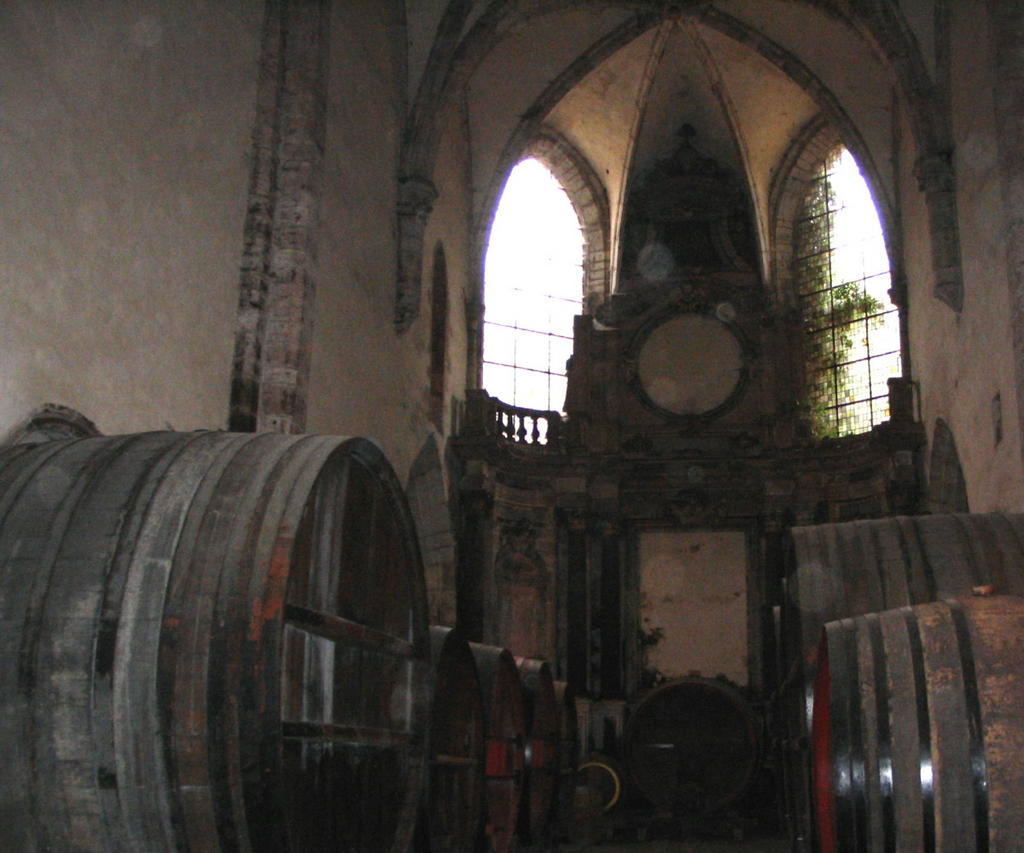
One of the convents pointed out to us was the Couvent des Jacobins, originally a wonderful 14th century church in a simple gothic style, but now in a sorry state of repair and converted into a temple of Bacchus, as the local winegrowers co-operative had used it as a store and showroom since 1905. Huge barrels had replaced the pews and grubby baroque cherubs peered out over the tops of the racks of wine.


More than enough communion wine!


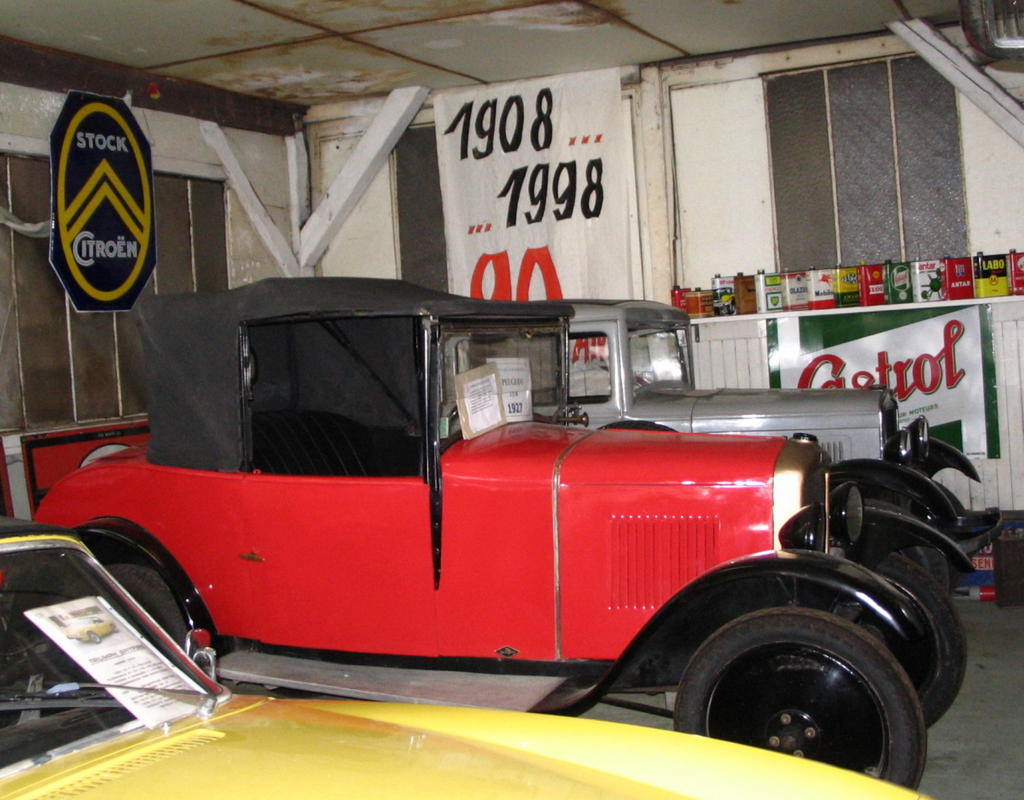
Our final stop in a varied day was an old garage we noticed just before rejoining Modestine. It contained a collection of a couple of dozen vintage motor cars which the good humoured and enthusiastic owner was only too willing to leave his glass of wine to show us. They were mainly Peugeot, Renault and Citroën cars dating from the 1920s to the 1950s, but there was also a Ford Model T whose chassis was imported in the 1920s and converted by boat builders in Bordeaux who had provided it with polished wooden bodywork. We said that in some ways it paralleled Modestine, whose Citroën Berlingo chassis had been imported and converted on the Isle of Wight. He asked us to collect Modestine and he then examined the only vehicle in our collection with great interest before we finally set off back to Champagne.


Specially for Dick and Marlies who crossed the Andes in an Austin 7!
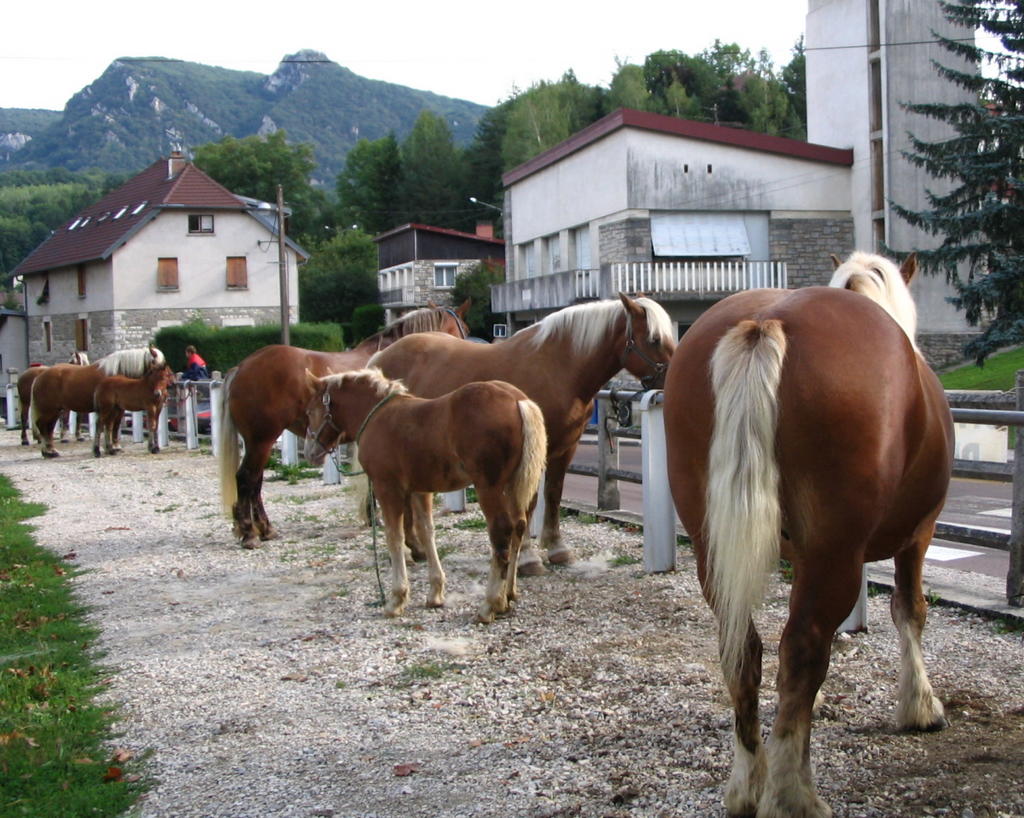

Saturday 27th August 2005, Champagne-sur-Loue
Today was the annual Concours de Chevaux in Salins with dozens of farmers arriving in the town with trailers carrying beautiful Comtois horses, strong, sturdy, animals with straw-coloured manes and tails, their short-legged bodies a rich golden-brown. The horses seemed to enjoy the day as much as the rest of us, whinnying with delight as they were unloaded and tied to nearby railings with their fellows while their owners busied themselves in varnishing their hooves, brushing their tails and plating their manes. The sun shone, everyone was happy and all the local kids enjoyed endless free rides. There were maybe a hundred horses and foals being put through their paces and tensions ran high amongst their owners.

Lunch, understatedly termed a “casse-croute champêtre” or country picnic, struck us as most extraordinary, being a full menu of terrine forestier with crudités followed by a main course of boiled ham and potatoes in a béchamel sauce. Then came fromage du Comté with a huge slice of cream gateau to follow. This was provided for a couple of hundred people from a camp kitchen on the back of a trailer and served, with napkins and wine, at folding benches and tables under a marquee at the edge of the arena. Needless to say, there was also a van dispensing wine and beer.


Comtois horses at the show

The mane attraction!


Salins is apparently one of the only towns of any size in the Jura that lies in a valley with an exit at either end. Most towns lie at the entrances of blind valleys, or reculés, formed by water erosion on the jurassic limestone. Either side of the town is dominated by very steep hillsides on top of which are a couple of defensive forts. During the afternoon, deciding we needed the exercise more than Modestine, we left her down in the town and climbed the steep, unfrequented footpath 300 meters up the hillside to the Fort St. André. The other, Fort Belin is a nineteenth-century construction, but our destination was one of Vauban’s masterpieces, constructed in 1674 during the final conquest of Franche Comté by France and containing one of the only chapels he designed. Perhaps the greatest military architect of his day, Vauban undertook much work in this frontier region, including the citadel at Besançon and the fortifications at Belfort. It replaced a series of earlier fortifications which had crowned this strategic summit. The various buildings inside still bore their 19th-century labels: prison, guard-room and so on, but were now dedicated to more peaceful pursuits, the barrack blocks being converted to holiday apartments by the current owner while a horse and two donkeys grazed the grassed area inside the fortifications. The views of the town and across the hills westward to the Bresse plain were well worth the struggle up the hill. We left through the massive gateway which bore the Sun King Louis XIV’s boastful motto Nec pluribus impar and, forsaking the footpath, returned to Modestine along the road through pleasantly undulating countryside.


Salins-les-Bains from the Fort St. André
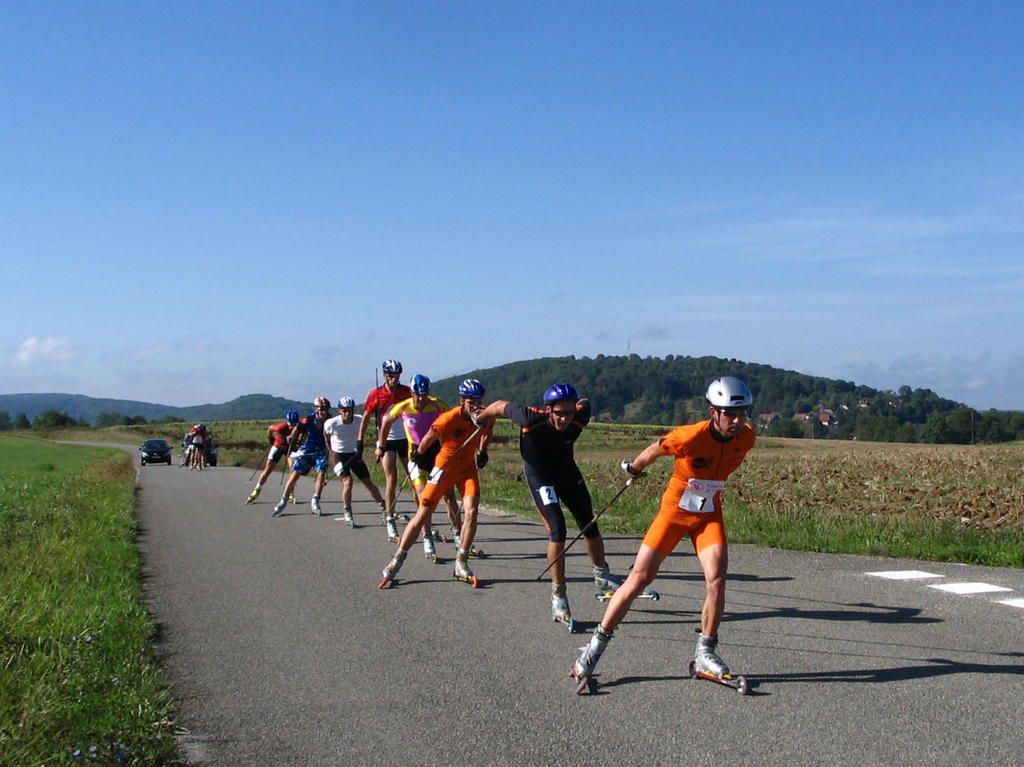

Sunday 28th August 2005, Champagne-sur-Loue
At ten in the morning Rollski Loue, a friendly race for roller bladders, started from Port Lesney to cover the 20 Km to Quingey. We rode our bikes to a road junction in the middle of the fields where we would have a good long view of them approaching. A friendly marshal told us that there were 170 participants including national champions, the eldest of them 80 years old. They set off in two batches, one for competitors on roller skis with sticks and the other for roller blades. They passed us at a great rate of knots in their colourful lycra costumes and helmets, making us feel very unfit. We spent the rest of the morning on a leisurely ride around the village.


Rollski Loue

Jill contemplating on the Loue

Champagne from the bridge


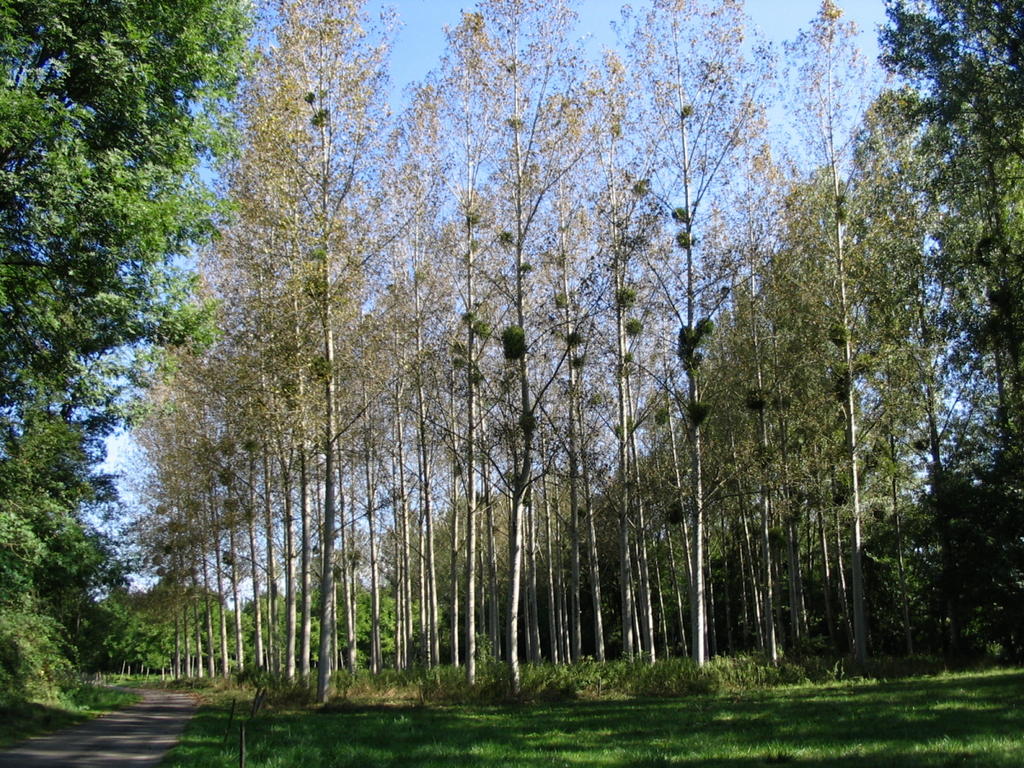
At lunch-time Hugues, the son of our friends Roland and Suzanne called to see us with his son Thibaut having spent the morning working in the family vineyard above the village. They presented us with a bag of peaches fresh gathered from the trees surrounding the vines. Hugues also owns a plantation of poplar trees on the banks of the Loue, which he planted sixteen years ago when Thibaut was born. These will be felled shortly to provide packaging for the French camembert you buy in your local supermarket!


Hugues poplars heavy with mistletoe


In the afternoon the prospect of eighty hot air balloons all ascending at the same time as a finale to the 31st French championship for Montgolfières drew us to a free air display at Thise airport just outside Besançon. We joined crowds of other people braving the sun, and apparently indifferent to the lack of facilities. We found some welcome shade beneath the wings of one of the light aircraft from where we could watch all those magnificent men in their flying machines. Many were what would be expected on such an occasion: breathtaking aerobatics from small planes, fly-pasts of early warplanes, a parachute jump by a team which formed a stack in the sky, demonstrations by gliders. There was even a French version of the Red Arrows - six blue jet planes flying in formation and trailing smoke. But the most remarkable event of the afternoon was Christian Moullec and his twelve geese! They certainly lived up to the programme’s description of “quelquechose hors du commun”. His microlite flew round the airfields accompanied by the geese, who had adopted him as a squadron leader. They followed him in close formation as he circled and dived, taking up the V-formation of migrating birds. Truly a bird-man with a difference and greeted with warm applause by the French audience who are generally more used to taking pot-shots at anything with feathers and wings. In the end there were no Montgolfiers. The ascent was called off at last minute as ground level winds were too high to allow them to spread out the fabric for inflation. Nobody seemed bothered and everyone had had a grand day out.


Those magnificent geese with their flying machine


Monday 29th August 2005 Champagne-sur-Loue
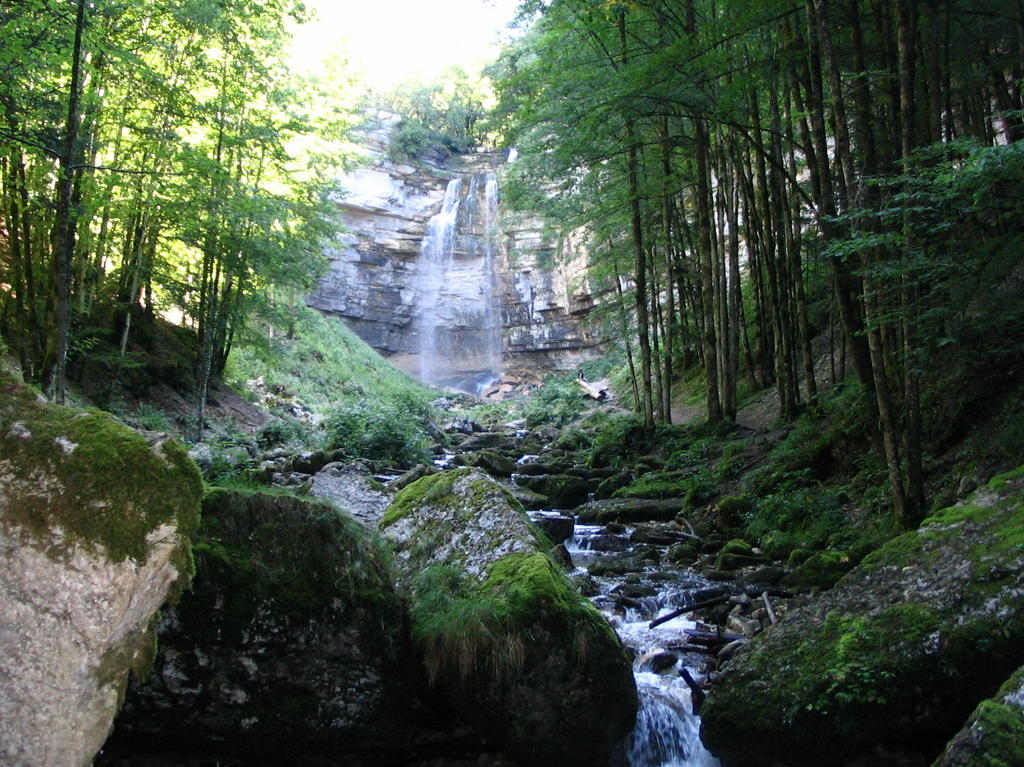
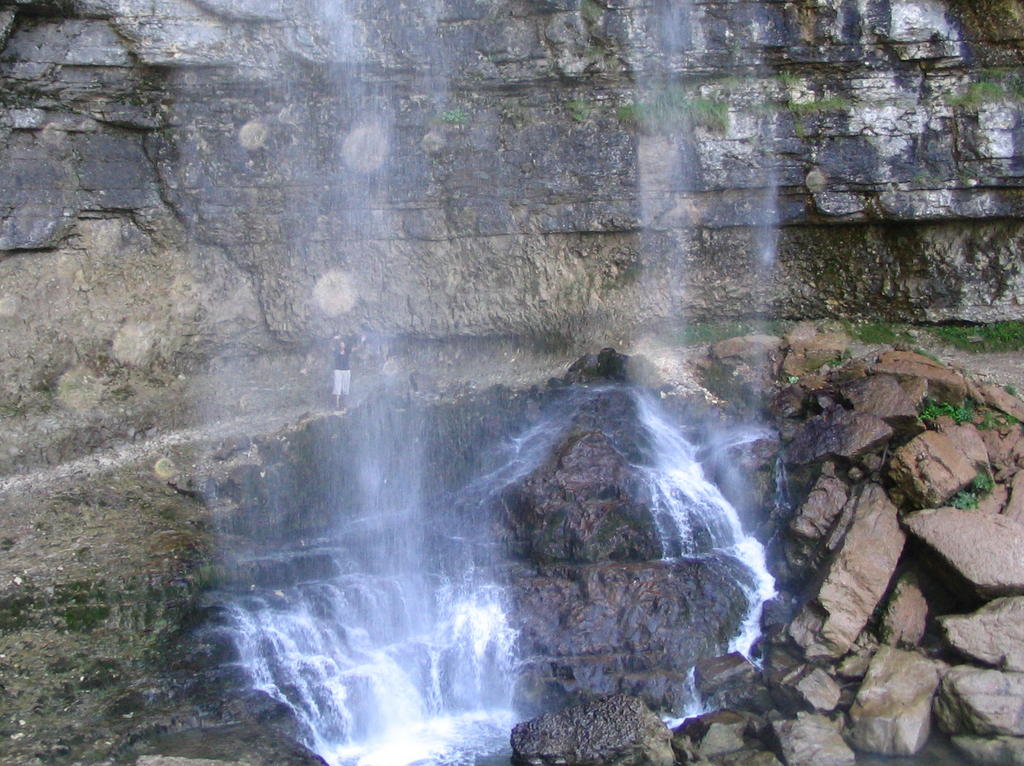
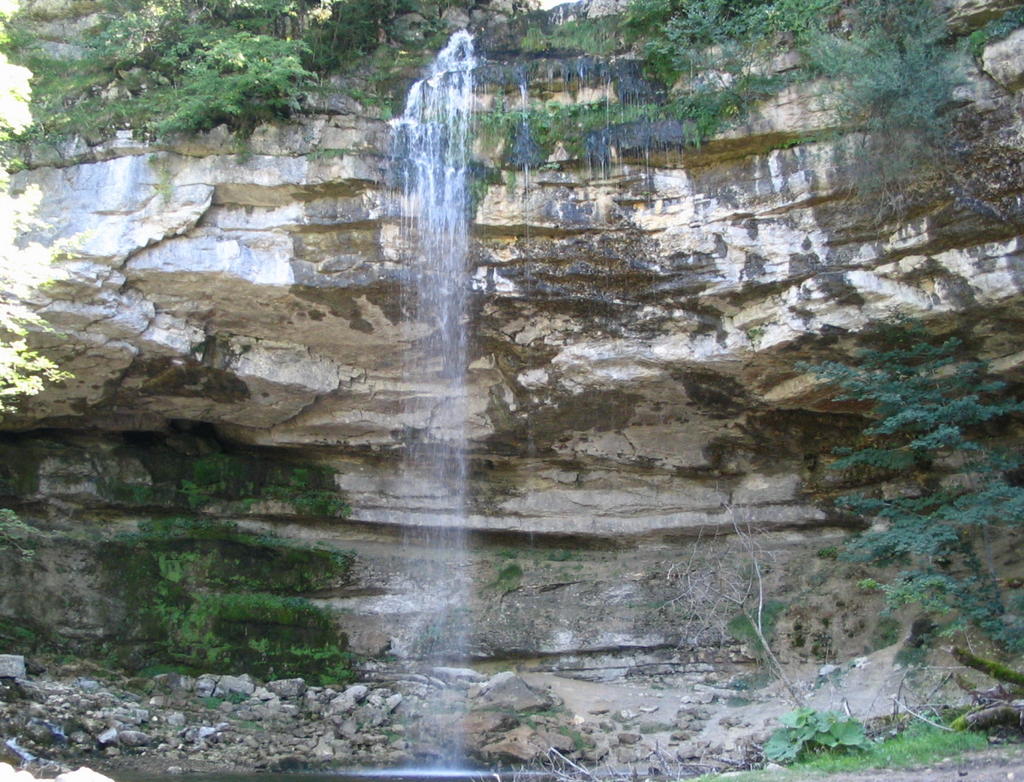
This morning threatened to be another scorching hot day so we headed for the cool river valleys higher in the Jura hills. By 9.30a.m.we were some 60km from Champagne scrambling steeply along slippery paths through cool woodland in the valley of the Hérisson (hedgehog – although etymologists claim more prosaically that it derives from words meaning sacred water) with its series of 36 stunning cascades or waterfalls. The most spectacular, the Eventail falls in a beautiful fan shape some 65 metres to break in cool spray on the grey rocks below before continuing to tumble along the shallow river-bed through the leafy woods. A slippery climb took us to the Grotte Lacuzon, currently a huge dry cave but in winter it becomes the mouth of another cascade. It is named after the leader who resisted the French in the 17th century and had his headquarters there. The path then passed behind the Grand Saut, 60 metres of white water soaking us in a misty spray as it hurtled past to join the river below. From here we clambered upwards for a further 3 km, the sound of falling water ever present, passing numerous smaller rapids until we reached the highest cascade, Le Saut Girard (coucou G, C, et E.) a mere 35 metres. Wherever the sun penetrated through it was glaringly bright but deep within the forest crowding the river to either side, it was wonderfully cool and damp, though dangerously slippery and muddy – as the seat of Jill’s shorts can testify! It’s a little disheartening to discover road access at the top, but at least it ensured we could enjoy ham baguettes and coffee before starting the 2 hour descent, which was actually more difficult than climbing up had been.


L’Eventail (Fan)

The Hérisson above the Eventail

Grotte Lacuzon

Le Grand Saut

Jill behind Le Grand Saut
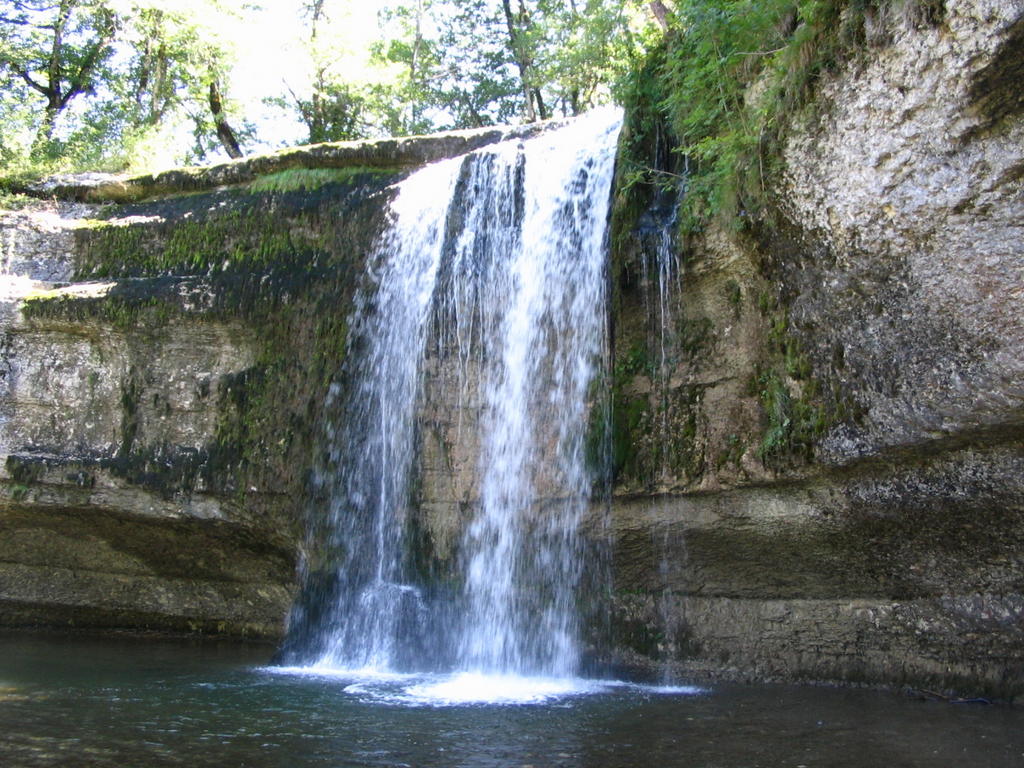
Le Saut de la Forge

Le Gour Bleu

Le Saut Girard


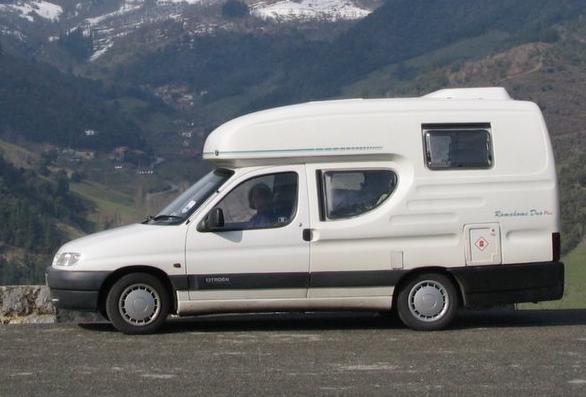
As usual Modestine has been attracting attention, this time from a group of Spaniards. We’ve also had a Dutch couple who have taken details of the Romahome company as they are now desperate to buy one! We’ve taken to just leaving the door open if we are around and letting people to go in and look round.

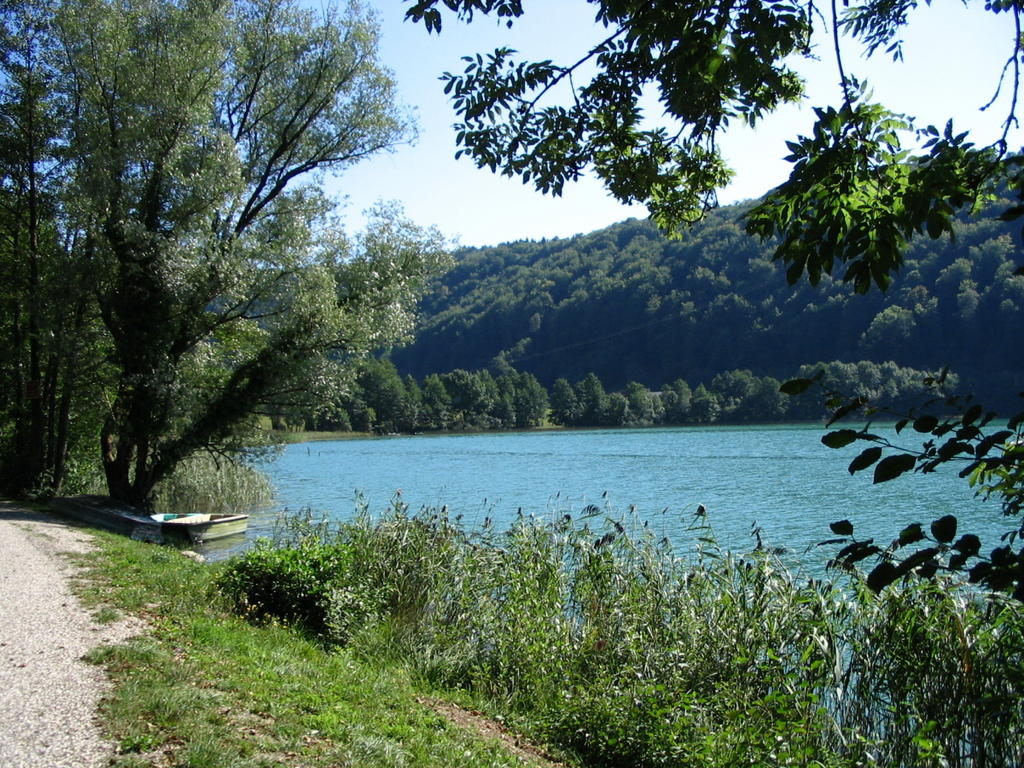
The Hérisson lies in the Région des Lacs near Lons-le-Saunier. There are a number of breathtakingly beautiful pale green, clear lakes surrounded by dark green forests right to the water’s edge. The Hérisson itself is fed by the Lac de Bonlieu and nearby we stopped to enjoy the silent tranquillity of the Lac du Val.


Lac du Val

Couldn’t resist a second view!


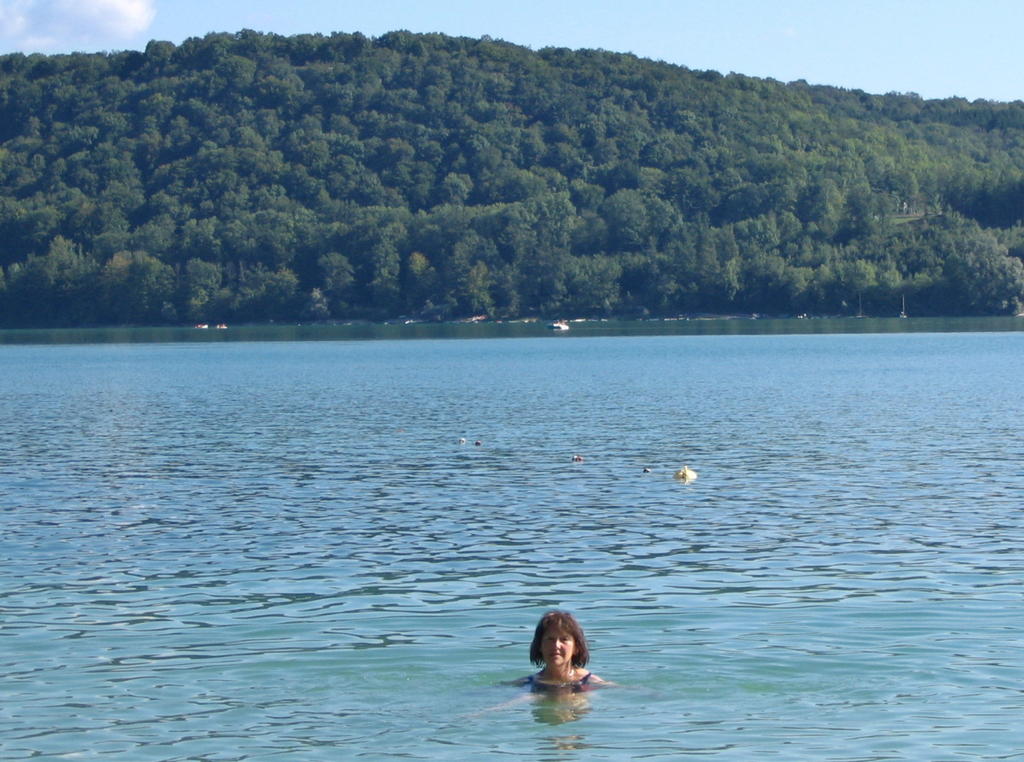
Jill was by this time, desperate for a swim. The waters looked so inviting but with the surrounding reeds they were quite inaccessible. Fortunately we discovered Lac Chalain nearby where Jill enjoyed the most perfect pool she’s ever used – it certainly has the edge on St. Lukes at Exeter University. Even here though, Ian could not be persuaded to get even his feet wet!


Lac Chalain


Pausing on our way home in Lons-le-Saunier, the administrative capital of the Jura region, we discovered a statue to Rouget de Lisle in a very flamboyant and patriotic pose. He was born in the town and in 1792 was the author and composer of the Marseillaise, which of course was later adopted as the French national anthem.


Allons enfants de la Patrie,
Le jour de gloire est arrive!


Even this evening back in Champagne, it has been so warm we sat drinking wine and eating supper by candlelight in the garden at 9.30, the rest of the village completely silent, as seems the case with most French villages after dusk. The stars were bright and in the woods on the hill behind the chateau, owls could be heard.